

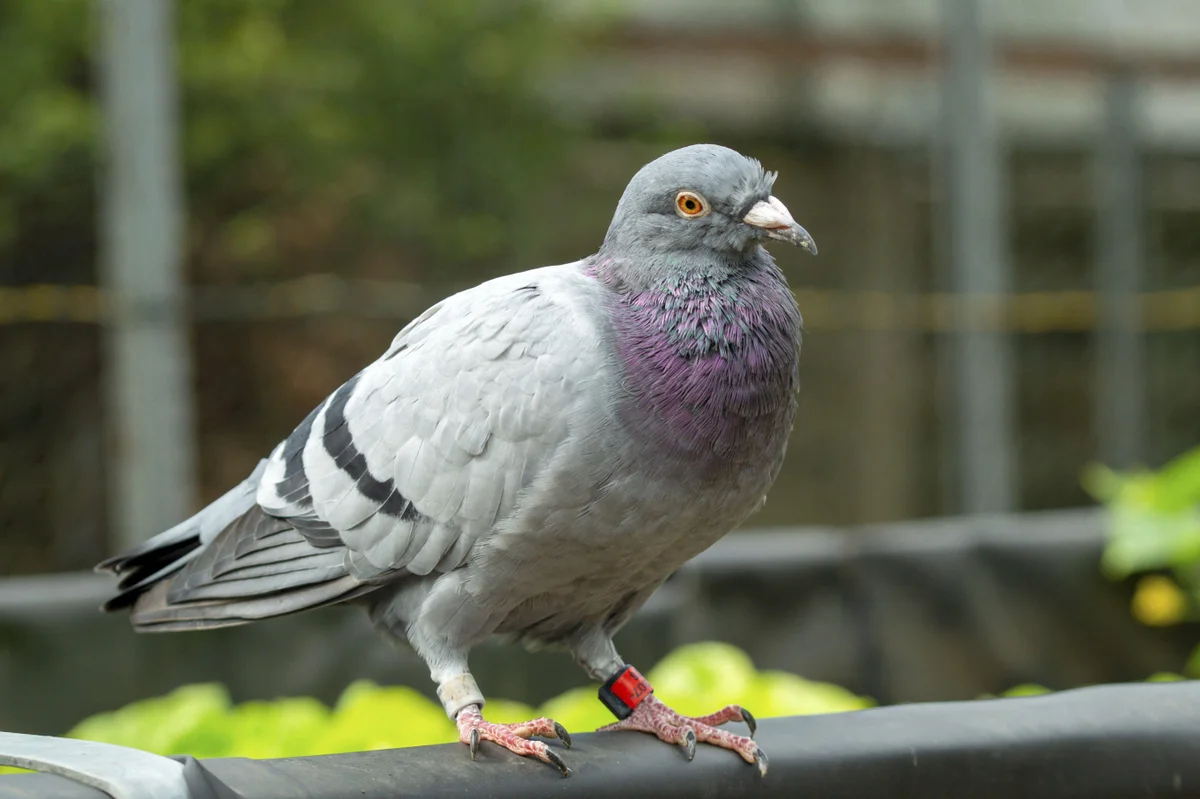
A new theory claims to have solved the long-standing conundrum of how homing pigeons use Earth’s magnetic field to find their way. The hypothesis: pigeon livers act like compasses. Biologists have been unable to confirm the myriad previous theories for the pigeons’ navigational abilities—from magnetite in their beaks to quantum entanglement in their eyes—and some experts are already saying the new theory doesn’t stand up to scrutiny, either.
The study, published today in Science, finds that homing pigeon livers are packed with magnetic immune cells containing a specific form of iron and that removing these cells messes with the birds’ navigation.
The study authors haven’t established how the pigeons might glean geographic information from these cells, but they’re optimistic that they will figure this out soon. “What we think we found here really fits all the evidence that’s out there,” says Martin Wikelski, a researcher at the Max Planck Institute of Animal Behavior in Radolfzell, Germany, and a co-senior author of the study. He thinks the new hypothesis could be “possibly happening from bees to mammals and bats to all kinds of birds, and so on.”
On supporting science journalism
If you’re enjoying this article, consider supporting our award-winning journalism by subscribing. By purchasing a subscription you are helping to ensure the future of impactful stories about the discoveries and ideas shaping our world today.
But other experts aren’t so confident. “I am not convinced,” says Joe Kirschvink, a geobiologist at the California Institute of Technology, who has studied the relationship between Earth’s magnetic field and animals for decades and was not involved in the new study. “I am surprised this paper cleared the review process for Science.”
The new theory rests on macrophages in homing pigeons’ livers—these immune cells are the body’s garbage disposal. When a red blood cell dies, the carcass—and the iron it contains—doesn’t just lay around, or it would inflame the surrounding tissue. That’s where macrophages come in. “They are the vacuum cleaners of the immune system,” says Christian Kurts, an immunologist at the University Hospital Bonn in Germany and one of the study’s co-senior authors. Periodically, macrophages empty their trash bags, recycling the iron back into the bone marrow to create new red blood cells. “But until then, the macrophages are full of iron,” Kurts says.
In humans, these metal-rich immune cells congregate mainly in the spleen. But by sweeping homing pigeons’ bodies with an extremely powerful magnetic field—far more powerful than Earth’s—the team found that the birds’ livers were stuffed with them. And the magnetic immune cells also abutted nerve endings, suggesting a potential pathway to the brain.
To test the new hypothesis, the team turned to a fleet of pigeons trained to fly home to their aviary in Radolfzell, Germany, from nearly 20 kilometers away. The researchers gave the pigeons a drug that selected and killed macrophages and then tested their homing capabilities on a cloudy day. “They were completely lost,” says immunologist Clivia Lisowski. “I mean, it was crazy—they were going in all directions.”
But as to how these liver microphages might respond to a bird’s changing orientation in Earth’s relatively weak magnetic field, let alone transmit that information to the brain, the paper doesn’t have an immediate answer. “We have our theory, but right now it would just be speculation,” Lisowski says.
A landmark 2012 Nature study suggests what the team has found may be impossible. It refuted earlier claims that pigeons’ beaks contained compasslike neurons, by showing that these were actually iron-bearing macrophages. This and other past studies conclude that macrophages contain the wrong kind of iron to explain the pigeons’ magnetic sense. This form of iron barely responds to Earth’s magnetic field, which is far weaker than the laboratory magnets Lisowski and her team used to home in on the liver.
To try and address this, the team points to “superparamagnetism,” a quantum mechanical phenomenon that heightens the macrophage-borne iron’s response. But there’s no evidence that that would be enough for the cell to pick up and notify a neuron, says Carl Meyer, a biologist at the Hawaii Institute of Marine Biology, who studies magnetic navigation in sharks and was not involved in the new research. Until then, he says, “I remain skeptical—not least because of all the previous declarations of victory.”
“The specific mechanisms by which organisms detect and navigate via magnetic fields is one of the greatest outstanding mysteries of biology,” Meyer says.
Many others have tried and failed to demonstrate what the new research claims, says Caltech geobiologist Kirschvink. “So the biophysical models of superparamagnetic magnetoreceptors basically hit a dead end.”
Neuroscientist Pascal Malkemper, who was also not involved in the study, says that among the paper’s more surprising findings is that killing off the pigeons’ liver macrophages disrupted their navigation. Research shows that these birds use lots of visual and smell-based cues to navigate, as well as the magnetic field.
“The magnetic sense is usually the least important sense somehow. It’s kind of the last resort,” Malkemper says. He speculates whether the drug administered to kill the macrophages might have agitated the birds in some way. “It’s a lot of correlational evidence and no causality,” Malkemper adds. In their experiment, the team tried to eliminate other sensory cues such as landmarks by choosing particularly foggy weather in which to test the macrophage-depleted pigeons’ homing abilities.
Importantly, the new paper also shows that birds treated with the drug could find their way home on a sunny day, when they were able to use solar cues to navigate. “On sunny days many motivational things are different,” Kirschvink says.
“Nevertheless, it is always good to have a new hypothesis on the table,” says Malkemper, who studies magnetoreception in mole rats. “We’re looking in the inner ear, we’re looking in the eye—now we might be looking in the liver as well.”
