


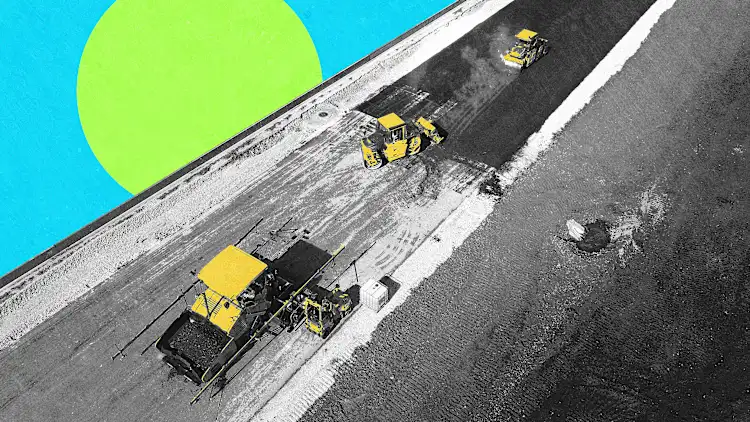
It’s a sound—and smell—car commuters have become intimately familiar with: the noxious fumes of asphalt repaving. U.S. road maintenance and highway expansion require a massive quantity of asphalt every year, roughly 400 million tons a year on average, according to Asphalt magazine, a publication of the international trade association Asphalt Institute. But a new process developed by St. Louis-based firm Verde Resources seeks to streamline the process, making it more sustainable and odorless.
Verde’s new BioAsphalt process, which has been in development since 2022, utilizes what’s called biochar, or natural wood remnants from forestry waste that get added into the traditional asphalt material mixture of limestone and granite aggregates. This allows the road mixture to sequester a small amount of carbon. Verde CEO Jack Wong estimates that for every 100 tons of BioAsphalt that gets laid, 10 tons of carbon dioxide gets sequestered.
“We’re essentially creating a no-brainer model for the industry to transition to, making the product as competitive as traditional asphalt with environmental advantages and benefits,” Wong says.
Asphalt’s environmental footprint is significant. In addition to using petroleum-based materials and requiring extensive energy for heating and installation, it also releases dangerous particulate matter as cars and trucks drive atop it. The National Asphalt Pavement Association estimated that laying down the material results in 20 million metric tons of carbon dioxide emissions annually in the U.S.; for comparison, that’s about one-seventh the amount of emissions created by the nation’s commercial airline industry.
An Inc.com Featured Presentation
Earlier this summer, BioAsphalt passed the initial stages of a test at the National Center for Asphalt Technology at Auburn University in Alabama. A section of BioAsphalt roadway was tested for a year, with staff running modified 80-ton trucks across the test bed to verify its durability. The material, one of a handful trying to make asphalt less environmentally damaging, has been given an okay for lower-impact applications like local roads and parking lots.
“We’ve had plenty of materials and ideas come through the test track over the years, but few show the carbon reduction potential that Verde’s Biochar Asphalt does, and it’s definitely the first technology on the track with a carbon sequestration component,” said Nathan Moore, assistant director for test track research at NCAT, in a statement. While the early validation confirms its suitability for light-duty pavements, continuous evaluations are underway to determine its long-term viability for medium- to high-traffic roadways and even runways, as part of NCAT’s multiyear test cycle.
The secret to Verde’s process is a proprietary emulsifying agent that blends with a liquid asphalt binder to create a specialized emulsion, bonding the biochar and aggregate. This offers an alternative to the petroleum-based bitumen that traditionally binds roads Wong wouldn’t reveal the exact additives in the firm’s process, other than to say they’re nonhazardous. A self-proclaimed Dune fan, he calls them “spice.” But they bond the roadway mixture without needing the heat required during the traditional asphalt laying process, which can hit 300 degrees Fahrenheit.
This opens up new opportunities for the road construction industry. On-site crews don’t need to cart gas canisters or additional gear to heat up the asphalt, so they can travel more lightly. In addition, since heat isn’t needed in the application process, they can work longer into the cold months of the year, expanding when they can repair and resurface roads and parking lots. This also means that the factories that make the asphalt mix don’t need to use heat as well.
Wong added that while the BioAsphalt is about 15% to 20% more expensive to make, by weight, due to the different materials, it’s engineered to require a thinner layer when applied. So it actually ends up being slightly cheaper when energy savings and reduced material volume are factored in.
Wong hopes to scale up quickly. BioAsphalt doesn’t need to be heated with traditional furnaces, but it can be made in the same factory settings as traditional asphalt—meaning that existing infrastructure can make the mix without needing to spend money on powering industrial furnaces. Verde is working with Ergon Asphalt & Emulsions, one of the largest liquid asphalt producers in North America, on arranging distribution and licensing the proprietary process to other producers. Wong hopes to ramp up production substantially in the next year and eventually capture 10% of the market.
Roadways, of course, aren’t just sources of pollution themselves. But they can be considered fossil fuel infrastructure because they support the use of cars and trucks burning gasoline and diesel fuel. In response, Wong says that he feels Verde’s product offers a practical way to immediately reduce emissions that go into roadway repair and expansion.
“We’re providing an immediate solution to the day-to-day needs for our very robust and mature road network,” Wong says.
By Patrick Sisson
This article originally appeared in Inc.’s sister publication, Fast Company.
Fast Company is the world’s leading business media brand, with an editorial focus on innovation in technology, leadership, world changing ideas, creativity, and design. Written for and about the most progressive business leaders, Fast Company inspires readers to think expansively, lead with purpose, embrace change, and shape the future of business.
