



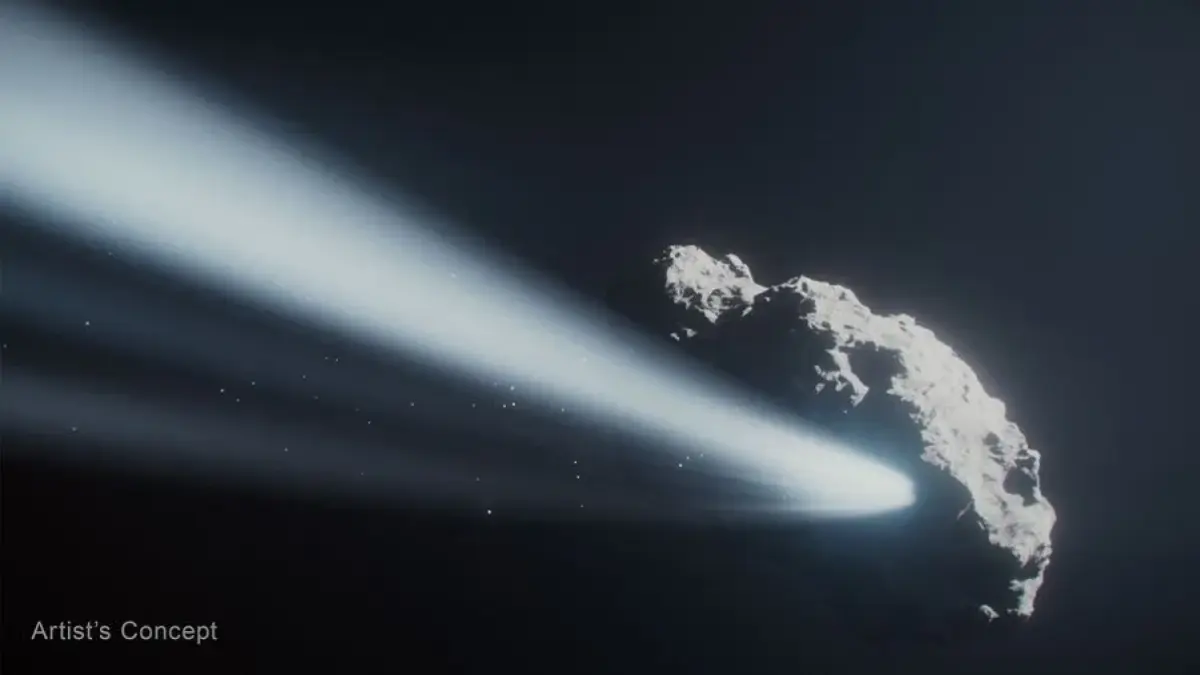
An artist’s impression of the jet that will eventually explode comet 41P.
Credit: NASA/ESA/CSA/Ralf Crawford
Last week, NASA announced that the Hubble Space Telescope had spied a truly one-in-a-billion event: an asteroid creating a jet stream of compressed gases that acts as a sort of natural propulsion. The problem? The force is causing the asteroid to spin faster and faster. One day soon, this will accelerate to the point that the asteroid pulls itself apart.
Called comet 41P, it was originally spinning—tumbling, really—in one direction as it wended its way around the Sun. NASA believes it was in this orbit for about 1,500 years, allowing the Sun to heat its core to all-new temperatures.
As this happened, previously frozen substances quickly sublimated into gas; surrounded by hard ice and rock, these gases built up pressure until they eventually erupted from the surface, creating thrust.
The jet was positioned so that it generated angular momentum directly opposed to the existing spin. In other words, it caused the first-ever observed spin reversal in an asteroid. I don’t know if scientists were really feeling a glaring absence of having seen that up until now, but there you have it.
Comet 41P has been spied before, though, and noted for its highly energetic spin. The preexisting data suggest it could have spun up repeatedly across multiple approaches to the Sun, perhaps eventually losing so much ice that it will stop the cycle.
The researcher behind NASA’s announcement, David Jewitt of UCLA, doesn’t think so, however. His paper suggests that this increasing angular thrust will soon spin the asteroid fast enough for it to “very quickly self-destruct,” as he puts it. How soon “very quickly” is, though, isn’t too clear; in astronomy, that could easily mean hundreds or thousands of years.
You can bet that Hubble and probably other instruments will be watching closely to gather information as that happens.
Interestingly, the event described in Jewitt’s paper occurred in 2017. It was only by trawling through publicly available databases of unexamined Hubble data that he noticed it at all. It’s just one more example of how openness and transparency can drive new insights, helping the broader scientific community better understand the cosmos.


