

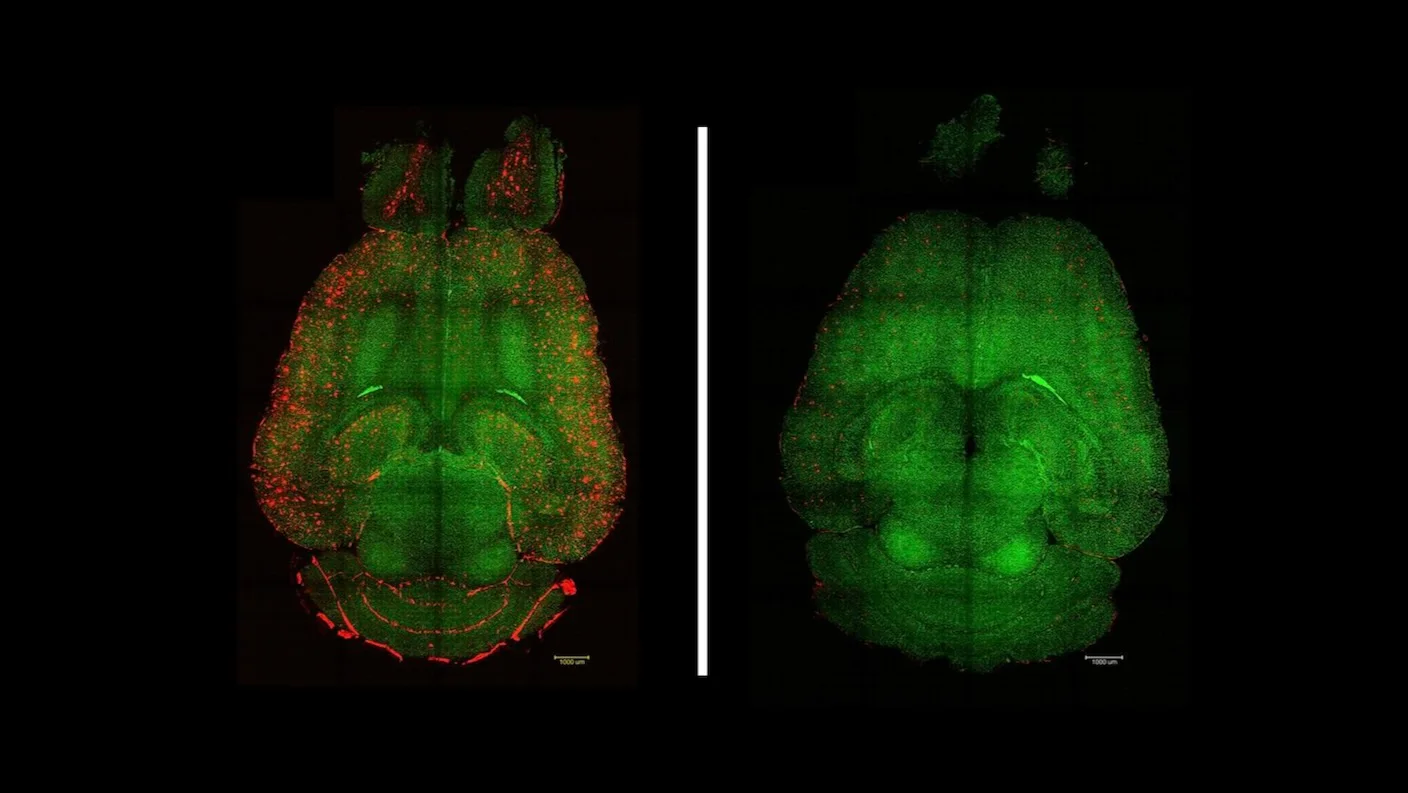
The brain is like a city within a fortress.
Its cellular inhabitants normally hum along in their daily routines. Neurons send out the electrical signals underlying memory and cognition. Supporting cells provide nutrients and fine-tune neural signals. Immune cells keep an eye out for infection and other dangers. A liquid bath washes away toxic proteins.
Surrounding the city is a tight-knit cellular wall called the blood-brain barrier. The barrier blocks potential invaders, like infectious diseases swimming in the blood. But it’s far from impenetrable. The barrier selectively chooses which molecules go into the brain and which go out.
In Alzheimer’s disease, toxic clumps of a protein called amyloid-beta build up inside neurons. Scientists have long tried to neutralize them, but most attempts have failed. This month, a new study turned to the blood-brain barrier to rid the brain of amyloid proteins using cleverly designed nanoparticles.
In mice modeling Alzheimer’s disease, three shots tricked the barrier into trafficking the toxic proteins out of the brain and into the bloodstream, where they were rapidly destroyed. In just an hour, the treatment slashed amyloid-beta levels in half. The mice also better remembered spaces—kind of like where you last parked your car—with effects lasting for six months.
“The long-term effect comes from restoring the brain’s vasculature,” said study author Giuseppe Battaglia in a press release. “What’s remarkable is that our nanoparticles act as a drug and seem to activate a feedback mechanism that brings this clearance pathway back to normal levels.”
Blocked Drain
The accumulation of amyloid-beta protein clumps is a hallmark of Alzheimer’s. They increase in number over time and, like toxic waste, pollute nearby cells. Whether the proteins cause the disease is still debated. But scientists generally agree that their presence worsens brain function and degrades memory and cognition over time.
Potential Alzheimer’s treatments have targeted these clumps for decades. Most failed during clinical trials. Researchers abandoned initially promising interventions due to lack of efficacy or side effects—earning the attempts the “graveyard of dreams.”
Despite these troubles and with much controversy, the US Food and Drug Administration approved a drug in 2024 to tackle amyloid buildup in patients suffering mild stages of the disease. The treatment, a type of medication called anti-amyloid therapy, reduces levels of the protein, and patients showed some cognitive improvement. But the drug also caused serious side effects, including brain bleeds and stroke-like symptoms in some participants. It also requires repeated dosing at a hefty price tag.
Instead of directly targeting amyloid-beta in the brain, what if we can flush it out?
Molecular Charon
The brain has multiple cleansing systems. Each cell has an acidic bubble to break down proteins, fats, and other components the cell deems toxic. The blood-brain barrier also ferries potentially dangerous proteins out of the brain for the body to neutralize.
This process breaks down in Alzheimer’s. The barrier is made of tightly knitted cells like a brick wall, with protein receptors are dotted along its surface. These molecules shuttle cargo between the brain and bloodstream. Not all proteins make it through. Some are directed to the barrier’s acid bubble, and others are chopped up by the cell’s recycling factory. Amyloid-beta clogs both waste disposable facilities and destroys the barrier from within.
Previous studies found a protein transporter that can grab amyloid-beta proteins and potentially drag them into the bloodstream. Called lipoprotein receptor-related protein 1 (LRP1), the molecule keeps the blood-brain barrier healthy and shuttles the toxic protein out of the brain.
Inspired by LRP1, the team engineered a nanoparticle to help it work more effectively. But the transporter is finicky. Normally, it carries proteins across the blood-brain barrier. But in Alzheimer’s, it’s often rerouted to the cell’s acid bubble and destroyed. As the disease progresses, LRP1 dwindles, causing the brain to struggle with waste disposal.
The team’s nanoparticles rejuvenate the sluggish transporters. Nanoparticles are generally used to carry genetic treatments and aren’t therapies. But here, their shape interacts with the transporter.
The team designed the nanoparticles to include several “hooks” that interact with LRP1 in highly specific ways, such as shifting its routes across the blood-brain barrier while carrying cargo, rather than drifting into self-destruction in the cell’s acid baths.
The trick paid off.
The team gave mice modeling Alzheimer’s disease three injections of the nanoparticle—it slashed levels of amyloid-beta. “Only one hour after the injection we observed a reduction of 50-60 percent in Aβ [amyloid-beta] amount inside the brain,” said study author Junyang Chen.
Reactivating transcytosis—the process of shuttling proteins across the blood-brain barrier—was only partly responsible for the improvement. The treatment also restored the health of the barrier itself, rejuvenating its structure and adding more protein shuttles.
This improvement correlated with better memory and cognition. The team gave mice with human Alzheimer’s genes the shots when they were roughly middle-aged and tested their memory six months later—well into old age. In one test, the seniors easily navigated a milky, watery maze using visual cues. Those that didn’t receive the treatment swam around aimlessly.
“We think [the nanoparticles work] like a cascade,” said Battaglia. “When toxic species such as amyloid-beta accumulate, disease progresses. But once the vasculature is able to function again, it starts clearing Aβ [amyloid-beta] and other harmful molecules, allowing the whole system to recover its balance.”
Treated elderly mice also seemed happier. Rather than languishing, they built nests out of available materials—such as cotton—and bounced up to get a sugary water treat when offered. They cared about fixing their homes and enjoying treats, like younger mice, which points to a higher “quality of life,” wrote the team.
To state the obvious, mice are not people. Plenty of promising Alzheimer’s therapies in mice have faltered in clinical trials. And although we share a similar blood-brain barrier with the critters, their molecular makeup doesn’t exactly map to ours. But the nanoparticle concept adds to an increasingly diverse bank of methods that don’t directly target amyloid-beta with antibodies.
“The blood-brain barrier is not merely an obstacle to be bypassed but a dynamic and reparable interface whose dysfunction can be therapeutically reversed,” wrote the team. The results suggest we can move “beyond the paradigm of ‘overcoming the barrier’ towards ‘repairing the barrier.’”
