

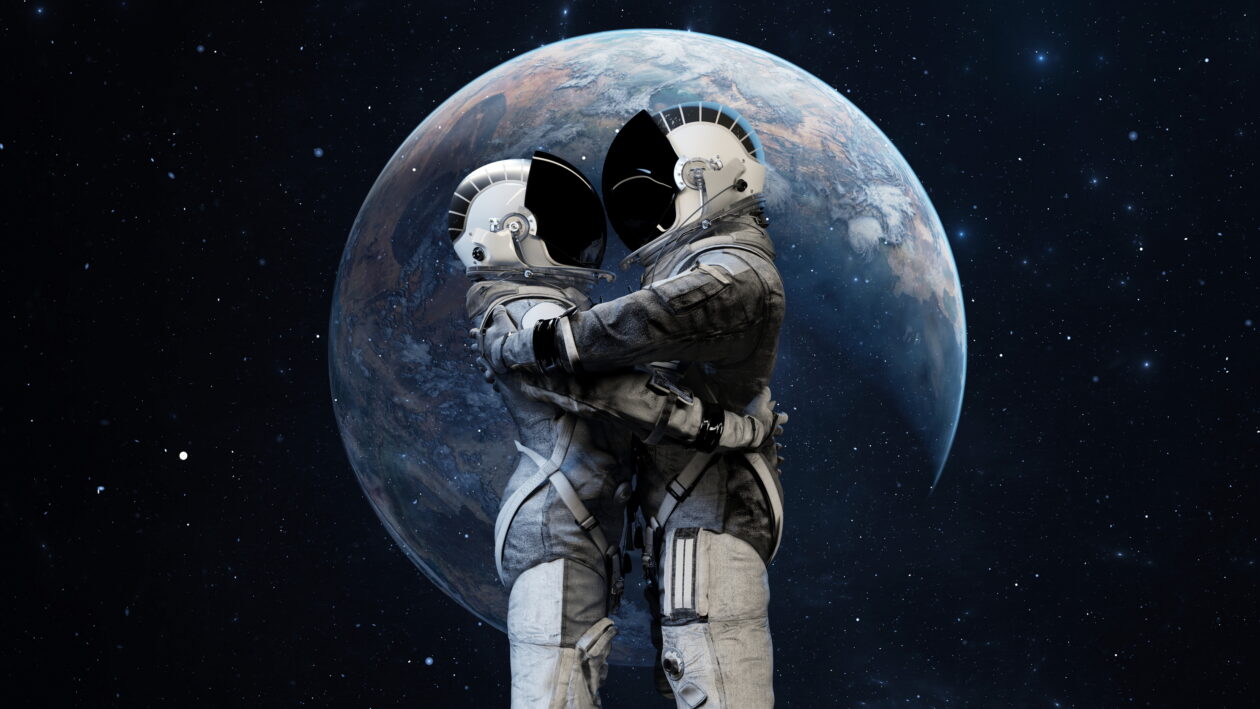
Researchers say the mechanics of having sex in space would be easier to manage than the biology of pregnancy and fetal development in a reduced-gravity environment. (Credit: ID 309694213 © Anna Ivanova | Dreamstime.com)
Sex in space is the perfect subject for levity and double entendres, and the panelists at a Deep Tech Week session held at Thinkspace Seattle leaned into the humor early on.
“We can all imagine Newton’s Third Law dictates that, unrestrained, you get one thrust in and then you’re at the other end of the spacecraft,” said Shawna Pandya, chief of space medicine at the Florida-based Advanced SpaceLife Research Institute, or ASRI. Early pioneers in the field even designed a spacesuit customized for zero-G intimacy that was equipped with flaps and harnesses in strategic places — giving new meaning to the term “love handles.”
But the researchers at Friday’s session didn’t dwell on the mechanics of in-space intercourse. “I think the sex part will be the easiest part, operationally,” said James Logan, former chief of medical operations at NASA’s Johnson Space Center. “The problems are what comes after that.”
For that reason, the panelists left the levity behind and focused on the serious subject of pregnancy and fetal development in the challenging environment beyond our home planet.
Related
How science weighs the pluses and minuses of sex in space
Last year, researchers found evidence that exposure to space radiation during pregnancy would carry a “significantly higher” risk of producing congenital birth defects. More recently, a different set of researchers reported that zero-G conditions impaired sperm navigation, egg fertilization and embryo development in mammals.
Alex Layendecker, ASRI’s founder and director, said the health effects of exposure to the space environment might not show up until more than a generation later. That conjecture is based on a study of female mice that were flown on the International Space Station, and then brought back to be mated with males on Earth. “The first generation seemed not to have many differences, but when the grandchildren mice were born — and this was a really big smoking gun — the grandchildren mice actually had a significantly altered phenotype,” Layendecker said. “They had differences in mass. They had differences in behavior.”
All this could be a deal-killer for the kinds of space settlements seen in science-fiction shows like “For All Mankind” — and it casts serious doubt on SpaceX trillionaire Elon Musk’s dream of sending a million settlers to Mars.
“Based on my knowledge and experience, I don’t think one-third G (Mars-level gravity) is going to be enough, and if one-third G isn’t enough, one-sixth G (moon-level gravity) isn’t going to cut it, either,” Logan said. “So, it may be eventually that the moon and Mars will be resource depots. They will remain outposts. I don’t really believe that men, women and children of multiple generations are going to be living on the moon the way it is envisioned.”
Layendecker said that raises an “existential question” about humanity’s future beyond its home planet. And maybe about humanity’s future, period. “If you are not able to make yourselves multiplanetary, then mathematically, over the course of time, single-planet species don’t survive,” he said. “There is only so much time in Earth’s geological history before some cataclysmic event happens that eventually puts you out of the game.”
Former NASA flight surgeon James Logan speaks at a Deep Tech Week presentation in Seattle titled “From Homo Sapiens to Homo Stellaris.” The panelists included, from left, moderator Sierra Clouse; Alex Layendecker, director of the Advanced SpaceLife Research Institute; Shawna Pandya, ASRI’s chief of medical research; Logan; and Morgan Kainu, chief of staff and research fellow at ASRI. (GeekWire Photo / Alan Boyle)
The proponents of off-Earth settlement, led by Musk, regard settlements on Mars, the moon and other celestial bodies as a Plan B guaranteeing the human species’ survival. But in order for that plan to work, humans have to be able to reproduce in those settlements. “Let’s theorize here,” Layendecker said. “We have a settlement on Mars … and Earth is completely wiped out, so no humans here. The planet is uninhabitable. If the people on Mars cannot have children and cannot reproduce over time, they’re going to die out one generation deep.”
Pandya said genetic engineering could provide a way out. She pointed to an article on the subject published by MIT Technology Review. “They make the argument that it’s not an ethical question to genetically enhance your astronauts,” she said. “It’s actually more unethical to send them into this high-radiation, dangerous environment if you’re not protecting them.”
Logan said radiation protection measures and gravity countermeasures should be considered as essential for future space settlers as air, water and food. So far, however, those issues have gotten relatively little attention.
ASRI is trying to do something about that: The institute has drawn up a 30-year roadmap for space research focusing on reproductive biology — an initiative known as Sexual Health and Reproductive Planning, or SHARP. It’s also looking to expand its presence to Europe, where the regulatory environment is friendlier to reproductive science, and perhaps also to Seattle.
“We are one organization that I hope blossoms into multiple organizations around the world,” Layendecker said. “I hope that we don’t remain the only ‘space sex institute’ that is out there, because it is going to take hundreds, probably thousands of researchers, thousands of people to really begin to tackle this problem.”
Even though the serious study of sex in space still hasn’t gotten past first base, Logan sees reason for hope. “When you talk about sex in space, nobody really giggles anymore, because people are more attuned to it,” he said. “They know the ultimate thing is to get humans off the planet, so very few people giggle anymore — and that giggle factor in my time at NASA was the largest impediment to progress.”
