

October 11, 2025
5 min read
The Math That Predicted the New Pope
A decades-old technique from network science saw something in the papal conclave that AI missed
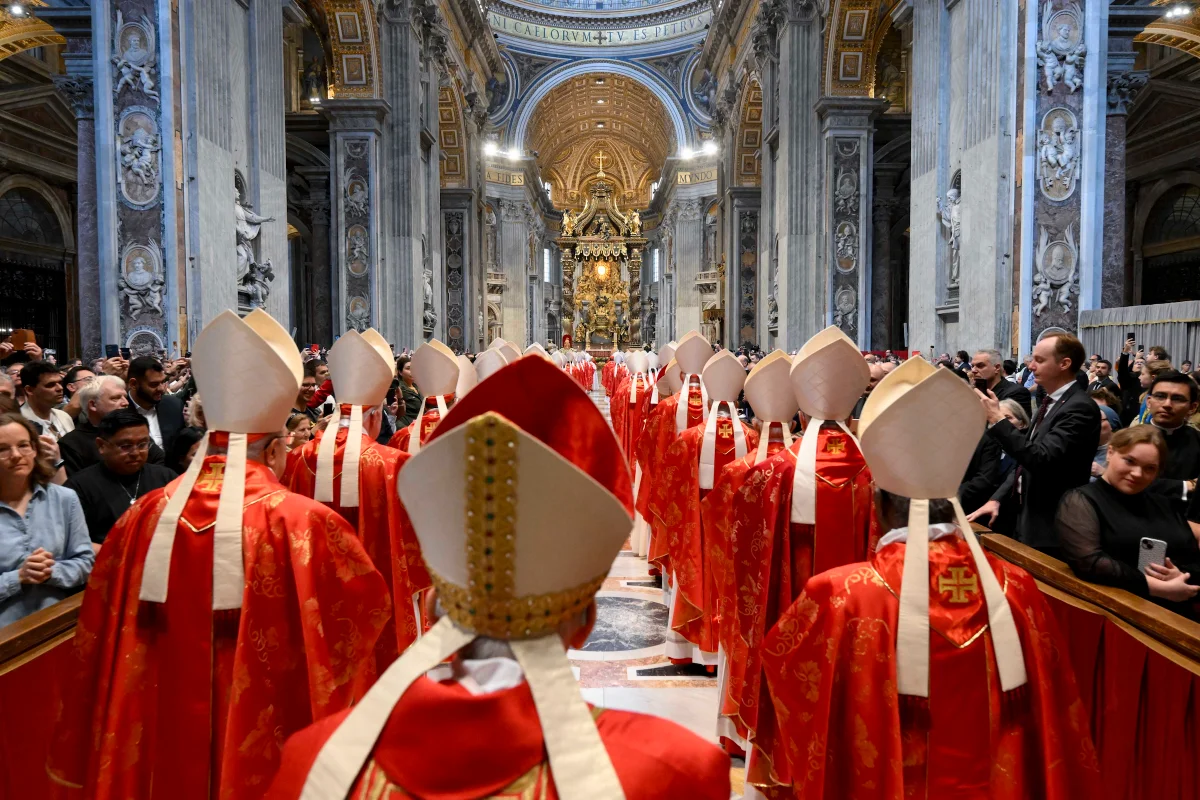
Cardinals attend the Holy Mass, which is the prelude to the papal conclave, in St. Peter’s Basilica, on May 7, 2025 in Vatican City.
Vatican Media/Vatican Pool – Corbis/Corbis via Getty Images
When Pope Francis died in April on Easter Monday, the news triggered not only an outpouring of mourners but also a centuries-old tradition shrouded in secrecy: the papal conclave. Two weeks later 133 cardinal electors shuttered themselves inside Vatican City’s Sistine Chapel to select the next pope. Outside the Vatican, prognosticators of all stripes scrambled to predict what name would be announced from the basilica balcony. Among the expert pundits, crowdsourced prediction markets, bookies, fantasy sports–like platforms and cutting-edge artificial intelligence models, almost nobody expected Robert Prevost.
Where every known method of divination seemed to fail, a group of researchers at Bocconi University in Milan found a hint in a decades-old mathematical technique, a cousin of the algorithm that made Google a household name.
Even with the benefit of polling data and insights from primaries and historical trends, predicting the winners of traditional political elections is difficult. Papal elections, by contrast, are infrequent and rely on votes from cardinals who have sworn an oath of secrecy. To build their crystal ball under such circumstances, Giuseppe Soda, Alessandro Iorio and Leonardo Rizzo of Bocconi University’s School of Management turned to social networks. The group combed through publicly available records to map out a network that captured the personal and professional relationships among the College of Cardinals (the senior clergy members who serve as both voters and candidates for the papacy). Think of it like an ecclesiastic LinkedIn. For instance, the network included connections between cardinals who worked together in Vatican departments, between those who ordained, or were ordained by, another and between those who were friends. The researchers then applied techniques from a branch of math called network science to rank cardinals on three measures of influence within the network.
On supporting science journalism
If you’re enjoying this article, consider supporting our award-winning journalism by subscribing. By purchasing a subscription you are helping to ensure the future of impactful stories about the discoveries and ideas shaping our world today.
Prevost, known by most analysts as an underdog and now known as Pope Leo XIV, ranked number one in the first measure of influence, a category called “status.” An important caveat is that he didn’t break the top five in the other two measures: “mediation power” (how well a cardinal connects disparate parts of the network) and “coalition building” (how effectively a cardinal can form large alliances). Whether this “status” metric can shed light on future elections (papal or otherwise) remains to be seen. The study authors weren’t expressly trying to predict the new pope, but rather they hoped to demonstrate the importance of network-based approaches in analyzing conclaves and similar processes. Even so, their success in this instance combined with the widespread applicability of their method’s mathematical underpinnings make it a model worth understanding.
How do mathematicians make “status” rigorous? The simplest way to find influential people in a network is called degree centrality—just count the number of connections for each person. Under this measure, the cardinal who rubs shoulders with the greatest number of other cardinals would be named the most influential. Although easy to compute and useful for basic contexts, degree centrality fails to capture global information about the network. It treats every link equally. In reality, relationships with influential people affect your status more than relationships with uninfluential people. A cardinal with just a handful of close colleagues might wield enormous influence if those colleagues are the Vatican’s power brokers. It’s the difference between knowing everyone at your local coffee shop and being on a first-name basis with a few senators.
Enter eigenvector centrality, a mathematical measure that captures the recursive nature of influence. Instead of just counting connections, it assigns each person a score proportional to the sum of the scores of their friends in the network. In turn, those friends’ scores depend on their friends’ scores, which depend on their friends’ scores, and so on. Computing this circular definition requires some mathematical finesse. To calculate these scores, you could assign everybody a value of 1 and then proceed in rounds. In each round, everybody would update their scores to the sum of their friends’ scores. Then they would divide their scores by the current maximum score in the network. (This step ensures that scores stay between 0 and 1 while preserving their relative sizes; if one person’s score is double another, that remains true after the division.) If you continue iterating in this way the numbers will converge eventually to the desired eigenvector centrality scores. For those who have studied linear algebra, we just computed the eigenvector corresponding to the largest eigenvalue of the adjacency matrix of the network.
Google uses a similar measure to rank web pages in search results. When you type in a search query, Google’s algorithm gathers a collection of relevant sites and then must decide in which order to present them. What makes one website better than another to an end user? At its core, the Internet is a large network of web pages connected via hyperlinks. Google founders Larry Page and Sergey Brin wanted some measure of “status” for the nodes in this network to decide how to rank search results. They realized that a link from an influential, or well-connected, site like Scientific American carries more weight than a link from someone’s personal blog. They developed the PageRank algorithm, which uses a variant of eigenvector centrality to calculate the importance of web pages based on the importance of pages that link to them. In addition to delivering high-quality search results, this method hinders search-engine cheating; artificially boosting your web page by putting up a thousand pages linking to it won’t accomplish much if those pages have low status. PageRank is more complicated than eigenvector centrality in part because links on the Internet are one-directional, whereas friendships in a social network are bidirectional, a symmetry that simplifies the math.
Eigenvector centrality and its relatives pop up everywhere researchers need to identify influential nodes in complex networks. For example, epidemiologists use it to find superspreaders in disease networks, and neuroscientists apply it to brain imaging data to identify neural connectivity patterns.
The new pope would probably appreciate the Bocconi team’s efforts because he studied math as an undergraduate before donning his vestments. Time will tell if eigenvector centrality can reliably inform future papal elections. Its success this time could have been a fluke. But as white smoke billowed from the Sistine Chapel chimney, it was clear that cutting-edge AI models and prediction markets had failed. They missed the wisdom of an old piece of math: influence stems not just from the people you know but who they know.
It’s Time to Stand Up for Science
If you enjoyed this article, I’d like to ask for your support. Scientific American has served as an advocate for science and industry for 180 years, and right now may be the most critical moment in that two-century history.
I’ve been a Scientific American subscriber since I was 12 years old, and it helped shape the way I look at the world. SciAm always educates and delights me, and inspires a sense of awe for our vast, beautiful universe. I hope it does that for you, too.
If you subscribe to Scientific American, you help ensure that our coverage is centered on meaningful research and discovery; that we have the resources to report on the decisions that threaten labs across the U.S.; and that we support both budding and working scientists at a time when the value of science itself too often goes unrecognized.
In return, you get essential news, captivating podcasts, brilliant infographics, can’t-miss newsletters, must-watch videos, challenging games, and the science world’s best writing and reporting. You can even gift someone a subscription.
There has never been a more important time for us to stand up and show why science matters. I hope you’ll support us in that mission.
