

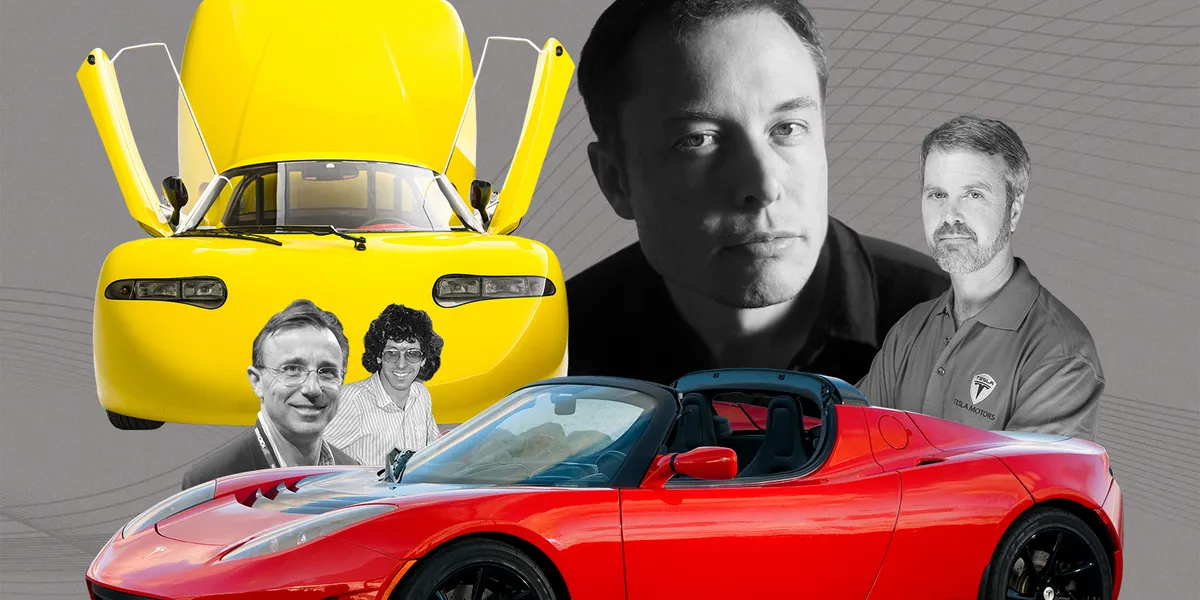

In 2003, Martin Eberhard, a cofounder of Tesla Motors, decided it was time to start wooing investors. To do that, however, he needed an electric car. So he talked to Alan Cocconi and asked if he could borrow the tZero, the revolutionary and blazingly fast electric roadster that Cocconi had built at AC Propulsion.
Eberhard’s idea was to drive the tZero up and down Sand Hill Road in the heart of Silicon Valley and do demonstrations for curious entrepreneurs and VCs. Eberhard was joined by Tom Gage, Cocconi’s partner at AC Propulsion, on many of the visits. Like Tesla, AC Propulsion was also seeking investors, but to build a considerably more utilitarian EV.
Adapted with permission from The EV Guys: How Caltech Engineers Reinvented the Electric Car, by Charles J. Murray, published by Purdue University Press.
In December 2003, Eberhard also proposed a demo at Buck’s of Woodside, a popular restaurant frequented by tech entrepreneurs. At 5 o’clock on any evening, Buck’s probably had more VCs per square foot than any building in the country. Eberhard’s plan was to “show off what a real electric sports car can do,” he wrote in an email to Buck’s owner, Jamis MacNiven. MacNiven happily obliged.
In some ways, the tZero was a hit. When a VC would ride shotgun in the car with Eberhard at the wheel, Eberhard would implore them to touch the dashboard. As they reached forward, he’d punch the accelerator. As the car accelerated and the g forces piled up, the VC was literally unable to touch the dashboard. That was how powerful the tZero’s acceleration was, Eberhard would say.
Many of the VCs were astounded. Some even questioned whether the car was really electric. Many owned Ferraris or Lamborghinis. They knew sports cars—but this? They could never have imagined it was possible to do this with an electric drivetrain.
On December 13, 2003, Martin Eberhard brought AC Propulsion’s tZero electric roadster [yellow] to Buck’s of Woodside, a popular hangout for entrepreneurs and venture capitalists. Next to the tZero is a Scion xB, which AC Propulsion’s principals thought they could turn into a mass-market electric vehicle.Martin Eberhard
Still, the demo at Buck’s garnered little investor interest—with one exception. Google cofounders Sergey Brin and Larry Page were both at Buck’s that day, and they told Gage they knew an individual whose funds were liquid, as he’d recently sold his stake in a startup. What’s more, this individual liked fast cars.
The man’s name was Elon Musk.
In 2004, it wasn’t apparent to anyone that Elon Musk had a future in the auto industry. He was notable for cofounding PayPal, which he then sold to eBay in 2002 for a whopping US $1.5 billion. He had already launched Space Exploration Technologies Corp., or SpaceX, with the stated goal of paving the way to a sustainable colony on Mars. Musk did love fast cars. He owned a million-dollar silver McLaren F1, one of only 64 road-going F1s in the world, as well as a 400-horsepower BMW M5 sports car and a 1967 XK-E Series 1 Jaguar roadster. But he’d never expressed an interest in building cars or starting an auto company, at least not publicly.
Elon Musk was photographed in 2008 at Tesla’s headquarters, then in San Carlos, Calif., around the time when Tesla’s Roadster was being delivered to its first customers.Patrick Tehan/MediaNews Group/Bay Area News/Getty Images
Still, Musk’s affinity for fast cars made it almost impossible for him to ignore an email from Gage on 21 January 2004. “Sergey Brin and JB Straubel both suggested you might be interested in driving our tZero electric sports car,” Gage wrote. (Straubel was the young Stanford engineering graduate who would later serve as Tesla’s chief technology officer.) “The tZero goes quite well,” the email continued. “We ran it against a Viper last Monday and it won four of five sprints on a 1/8th of a mile track. I lost one because I was carrying a 300-pound cameraman. Do you have time for me to bring it by?”
Musk quickly replied. “Sure, I would really enjoy seeing it. Don’t think it could beat my McLaren (yet) though I’m in town Feb 2nd through 4th.” “Hmm, a McLaren, boy that would be a feather in my cap,” Gage wrote back. “I can have it there on Feb. 4.”
Two of the principals behind AC Propulsion were businessman Tom Gage, left, and engineering genius Alan Cocconi.Left: Tom Gage; Right: Alec Brooks
The emails marked the beginning of Musk’s involvement in electric cars and in the auto industry. Gage drove the car to SpaceX headquarters, a warehouse in El Segundo, Calif., about 30 kilometers southwest of Los Angeles. In Musk’s cubicle in the “office” portion of the warehouse, Gage made his pitch.
There was a void in the market, he said. GM had abandoned the EV1. Toyota, Honda, Ford, and Chrysler were shutting down their electric car programs. California’s zero-emission vehicle (ZEV) rules, which mandated the sale of increasing numbers of vehicles with no tailpipe emissions, had been plundered. But electric vehicle technology, he said, was getting a bad rap. Here was the tZero, an electric car that could take off like a jet. The tZero proved that the technology was readily available. He and Cocconi wanted to use that technology to make an electric car that was useful and practical: the eBox, an electrified Toyota Scion.
After building the tZero roadster, AC Propulsion’s principals pinned their hopes on an electrified version of the Toyota Scion they called the “eBox.” It did not appeal to Elon Musk.Jeff Chiu/AP
For Musk, Gage’s introduction of the eBox was unexpected. He was meeting with Gage because he was interested in the tZero. It was the car’s performance that appealed to Musk.
He wasn’t interested in the eBox. He then drove the tZero and offered to buy it.
The lithium-ion version of the tZero electric roadster could get 515 kilometers on a charge and go from zero to 97 km/hr (60 miles per hour) in 3.6 seconds. Only three tZeros were built and only two survive. Scott Sorbe
Gage told him it wasn’t for sale. Undeterred, Musk offered a quarter million dollars if AC Propulsion would squeeze its lithium-ion battery pack into his Porsche. Gage declined again. AC Propulsion needed money to electrify the Toyota Scion, Gage said.
Musk shook his head. The idea seemed incredible to him. “Who wants to take an ugly $20,000 car and buy it for $65,000?” he asked incredulously, as he later recalled during an interview with Vanity Fair magazine. “I wouldn’t want to drive it. My wife certainly wouldn’t want to drive it.”
Many years later, Musk would tell his biographer Walter Isaacson, “Nobody is going to pay anything near that for something that looks like crap.” Musk believed that the way to start a car company was to build high-priced cars first and then let the technology trickle down to the mainstream. It was a classic Silicon Valley approach.
Alan Cocconi, the engineering whiz behind AC Propulsion, stands next to the company’s legendary tZero electric roadster in a picture taken in the early 2000s. The small yellow wheeled pod on the other side of the car is a trailer with a small gasoline engine that, when connected to the tZero, turned it into a hybrid gas-electric vehicle.Martin Eberhard
In Musk’s mind, it was all very obvious. He liked fast cars. He liked the tZero and believed it “could change the world.” He couldn’t even imagine why Gage was sitting here trying to sell him on the idea of the eBox. “Gage and Cocconi were sort of madcap inventors,” he told Isaacson. “Common sense was not their strong suit.”
Gage concluded that he wasn’t going to convince Musk to invest in AC Propulsion. “Well, if you want to do a sports car, then you should talk to Martin Eberhard,” Gage said. A few weeks later, Gage sent an email to Eberhard introducing him to Musk. “Elon Musk heads up SpaceX, is a car enthusiast,” Gage wrote. “He would be interested in hearing about your activities at Tesla Motors.”
As it happens, Eberhard and Marc Tarpenning, Eberhard’s partner and cofounder at Tesla, had considered contacting Musk even before Gage’s email arrived. They’d known of Musk and appreciated the way he thought. A few years earlier, they saw him speak at a Mars Society conference at Stanford University. Musk had talked about the rather improbable idea of sending mice to Mars. The presentation gave them a window into Musk’s unconventional approach to high-tech entrepreneurism and to life in general.
Eberhard and Musk agreed to meet, and then Eberhard emailed Gage. “Any chance of my borrowing the car for next week?” he wrote. Gage, of course, complied.
Martin Eberhard posed next to an electric motor at Tesla’s San Carlos, Calif., headquarters in 2006. Paul Sakuma/AP
By this time, Tesla was nine months old. It still had just three employees—Eberhard, Tarpenning, and Ian Wright, a New Zealand-born engineer and neighbor of Eberhard’s. The founders were arranging to pay the licensing fee on AC Propulsion’s drivetrain technology. And they were making arrangements to build their first cars using the chassis of the Lotus Elise two-seat roadster. They estimated they needed $6.5 million to go further. And that’s where Musk came in.
The original Tesla Roadster prototype, or “Mule,” was built inside the chassis of a 2002 Lotus Elise. Dylan Stewart/Image of Sport/Sipa/Alamy
Eberhard and Wright flew to Los Angeles on a Friday and met Musk in his cubicle at SpaceX. The meeting was supposed to last a half hour, but Musk’s questions came virtually nonstop, and as the meeting progressed, he repeatedly shouted to his assistant to cancel his next meeting.
Over the following weekend, Musk called Tarpenning to get his input about their financial model. “I just remember responding, responding, and responding,” Tarpenning said, according to a 2015 book by Ashlee Vance.
The Tesla founders were all impressed with Musk. He was unlike any of the VCs they’d met with in the previous months. He was technically astute. He’d earned a bachelor’s degree in physics from the University of Pennsylvania, and in his two-day stint as a Ph.D. student at Stanford, he’d intended to do a dissertation on solid-state capacitors for use in electric cars.
Moreover, he wasn’t averse to risk—at least not intelligent risk. He loved technical challenges, and he loved proving that the impossible was possible. “You’re presenting an electric car company to this person on the other side of the table, and he’s doing something even crazier,” Tarpenning said later. “He’s building rocket ships.”
On the Monday after their first meeting at SpaceX, Eberhard and Tarpenning flew back to Los Angeles. Musk agreed to invest $6.35 million. He would become the biggest shareholder as well as chairman of the company.
Now, Tesla Motors was really in business. All it needed was someone to design and build a groundbreaking electric car.
“All Electric Cars Have Sucked”
No one at AC Propulsion believed that Tesla Motors had even a remote chance of success. The whole idea—building and selling electric vehicles and competing against the giants in Detroit, Japan, and Germany—seemed impossible. Even Toyota, which was having so much success with the hybrid Prius, was not planning to build pure electric cars.
The prospect of starting any kind of auto company was unbelievably daunting. Automotive startups had been the undoing of many ambitious entrepreneurs, including Henry Kaiser, Preston Tucker, and John DeLorean. Such endeavors required mountains of money, connections, and expertise. There were unseen obstacles around every corner. And the people who’d launched Tesla, as smart as they were, were almost certainly unprepared for what lay ahead.
Years later, Musk would contend that their struggles were caused by the fact that Tesla had been founded on “two false premises.” The first was that Tesla’s founders believed they could simply convert an existing gasoline sports car to electric. The second was that they could use the existing AC Propulsion technology with little or no modification. “That turned out to be, in retrospect, staggeringly dumb,” Musk said.
In April or May of 2004, Tesla engineers worked on an early test vehicle, or “mule,” of the Roadster. The group included (clockwise from upper left) mechanical engineer Gene Berdechevsky, in the pink shirt, electrical engineer Phil Cole, and mechanical engineer Dave Lyons, in the dark blue shirt.Martin Eberhard
He also later concluded that their early path almost doomed them. “It ended up being much worse than if we had designed the car from scratch,” he said. But Tesla decided it could not go back and start over. It could only deal with the problem at hand.
Eberhard and Tarpenning were terrified of going into production with the existing analog motor controller and drivetrain electronics, which were unreliable and jittery. If those problems weren’t fixed, they knew their new vehicle would fail, and so would the company.
Another looming issue was the safety of the Tesla lithium-ion battery pack. To test it, Eberhard brought the engineering team to his home, where they dug a pit in his backyard. They took a brick of cells, covered it with a sheet of Plexiglass, and then remotely heated one of the cells with an electrical wire. As they expected, the heated cell burst into flame, setting neighboring cells on fire. The cells went off one at a time—pop, pop, pop. “We had a conflagration,” Eberhard said. “One cell caught fire, and it blasted right through the pack.”
Buyers of sports cars were known to be forgiving. In their quest for performance, they could put up with poor reliability. But the fire hazard was another matter, and one that had the potential to take down the company. Eberhard took the news right to Tesla’s board of directors. “It was my first big oh-shit moment to my board,” he said. “I told them we’ll have a day-to-day schedule stop until we figure this out.”
Working with friends from his Stanford days, Straubel began developing a new pack in his garage. The team acquired 7,000 lithium-ion cells from LG Chem, then constructed battery bricks, each with 69 cells, and tested them with different kinds of liquid-cooling systems. By October 2004, they’d finished a prototype pack and used a crane to lower it into the back of a Lotus Elise sportscar.
A few months later—in January 2005—the team had completed a working prototype of that first car. At the end of the month, they showed it off at a board meeting, and Musk took it for a spin. Impressed by its performance, he invested $9 million more, and Tesla completed a $13 million round of funding. Now the vehicle had a name—Roadster—and a tentative production schedule. The plan was to begin delivering it to customers in early 2006.
Tesla’s struggles with the Roadster were not apparent to the outside world, especially to those invited to the reveal of the Roadster at the Santa Monica Airport in July 2006. By then, the yellow test car, or “mule,” had evolved into two prototypes: a red car and a black car, both of which would be available for drives at the event.
Tesla unveiled the Roadster, its first vehicle, at the Santa Monica, Calif., airport on 19 July, 2006.Glenn Koenig/Los Angeles Times/Getty Images
The prototypes were more advanced than the mule, with more of a production-type design. But Musk and the team didn’t know what to expect at the reveal. The company was just coming out of stealth mode, and at that point, Tesla had received no media coverage. It had no customers, no deposits, and no sales team.
Still, Musk planned a huge party for the unveiling—an “awesome event,” in his words, staged inside the airport’s Barker Hangar. He told his personal assistant to invite 350 guests, including Michael Eisner of Disney, movie producer Richard Donner, actor Ed Begley Jr., California Governor Arnold Schwarzenegger, and many other luminaries. All were told to bring their checkbooks in case they wanted to write a $100,000 check to put a deposit on an electric Roadster. Meanwhile, a Roadster prototype zipped around a makeshift road inside the hangar, out the door, down a runway, and back inside again.
Musk took center stage, telling the audience that they were witnessing the start of a new era in automotive technology, according to CNET’s coverage of the event. “Until today, all electric cars have sucked,” he told the audience. “Electric cars play into the strength of Silicon Valley. A lot of the things inside the car are conventional automobile technology. The magic is the battery technology and the software and the controllers.”
Tesla Hooks Arnold Schwarzenegger, George Clooney
Musk’s message was perfect for such an event, especially for the dozens of reporters who were there to publicize the reemergence of the electric car. They adored the Roadster. It was small, powerful, electric, and above all, cool. It was anti-Detroit—a new kind of car that burned no gasoline and was born in Silicon Valley instead of an antiquated factory in Michigan.
The night was also a financial success for Tesla, with twenty $100,000 checks gathered from prospective buyers. And the momentum continued. A few days after the event, Joe Francis, creator of the adult entertainment franchise Girls Gone Wild, sent an armored truck to Tesla’s San Carlos office to drop off $100,000 in cash. A few days after that, Schwarzenegger put his money down, as did actor George Clooney. Within two weeks, Tesla had presold 127 Roadsters.
California Governor Arnold Schwarzenegger was among the first buyers of the Tesla Roadster on the day the car was officially unveiled, 19 July, 2006.Glenn Koenig/Los Angeles Times/Getty Images
Meanwhile, though, the company’s manufacturing woes continued. The mechanical problems weren’t even the biggest issue. The biggest issue was the supply chain. This was ironic, because some in the media admired Tesla for its global approach. They liked the fact that the battery pack, the motor, the chassis, and the assembly had an international flavor. It was a world car, they thought.
But for Tesla, it was a nightmare. The battery pack was being assembled in Thailand by a manufacturer of barbecue grills. The facility was 3 hours from Bangkok, literally in a jungle where the heat was almost unbearable, and the factory building consisted of a truss roof held up by some steel columns. There were no walls because no one there wanted to work indoors.
And because the pack assembler was inexperienced, Tesla engineers were repeatedly flying to and from Thailand to direct the effort. They would find animal droppings on the battery packs, which were sitting out in the open air all day and all night.
For the umpteenth time, Musk wondered if the company would be able to survive. “We’re doomed if we don’t in-source the battery pack,” he told one of Tesla’s manufacturing engineers, “because we have a supplier in Thailand who is great at making barbecues but not great at battery packs. And the supply chain is so long that it takes six months from when the cells are built to when the battery pack is done and in a car. So that means the capital cost is gigantic because we have to pay for all that inventory and process. And inevitably, there are mistakes in the design or fabrication of the battery pack, and then we have six months’ worth of battery packs that don’t work.”
Never mind that this chaotic approach was central to their plan. Tesla had never been envisioned as an old-fashioned, Detroit-style, vertically integrated manufacturer. From the beginning, it had been a Silicon Valley–type enterprise that would rely on others for the bulk of its manufacturing. Only now, as the fledgling company sent batteries and motors and assembled cars back and forth across two oceans, was its plan beginning to appear untenable. “We had this misguided idea that everything must be cheaper and better if built in Asia,” Straubel later said.
Tesla’s Chances of Success: 10 Percent
From the beginning, Musk had never been optimistic about Tesla’s chance of success. He repeatedly said he thought it was approximately 10 percent. “In 2004, the idea of starting a car company was extremely stupid,” he said. “The idea of starting an electric car company was stupid squared.” As he watched Tesla struggle with its supply chain, his earlier words were starting to look prescient.
The only chance, the engineering team concluded, was to bring the manufacturing of all of the subsystems, such as the battery packs, motors, and inverters, in-house. They disassembled their overseas operations and moved them to California, starting with battery pack manufacturing. Assembly stations were loaded into huge shipping containers, transported back to one of the company’s new facilities on Bing Street in San Carlos, and then reassembled there. It took five and a half months. They also redesigned the battery packs and developed machines for automating their assembly.
In 2008, with mass production of the Tesla Roadster just getting underway, Elon Musk gave an interview at the company’s headquarters, then in San Carlos in northern California. At the time, Tesla was merely a startup in a precarious position, bleeding cash and grappling with many manufacturing problems.Ryan Anson/Bloomberg/Getty Images
Musk concluded that the key to success was not the design of the car itself but rather the manufacturing. Henry Ford had reached the same conclusion a hundred years earlier. It was “the realization of how important it is to build the machine that builds the machine,” Musk said at the Tesla Annual Shareholder Meeting in 2016. “And how much harder it is to build the manufacturing system that builds the product, than it is to create the product in the first place. You can create a demo version of a product…with a small team in maybe three to six months. But to build the machine that builds the machine takes at least a hundred to a thousand times more resources and difficulty.”
Gradually, Tesla’s idea of letting others do its manufacturing slipped away. Packs were built in San Carlos, and then installed in the Lotus Elise chassis there instead of in England.
“We had control now,” said manufacturing engineer Jason Mendez. “We had all the engineers there. We didn’t have batteries on the water, not from Thailand to England and not from England to here.”
Musk began to talk about a new vision. He called it the gigafactory. Raw materials would enter at one end, and a car would exit at the other end. This was the ultimate in vertical integration, and it sounded a lot like Henry Ford’s vision for the River Rouge plant in Dearborn, Mich., in 1917.
Tesla Motors was becoming an auto manufacturer.
From Your Site Articles
Related Articles Around the Web
