

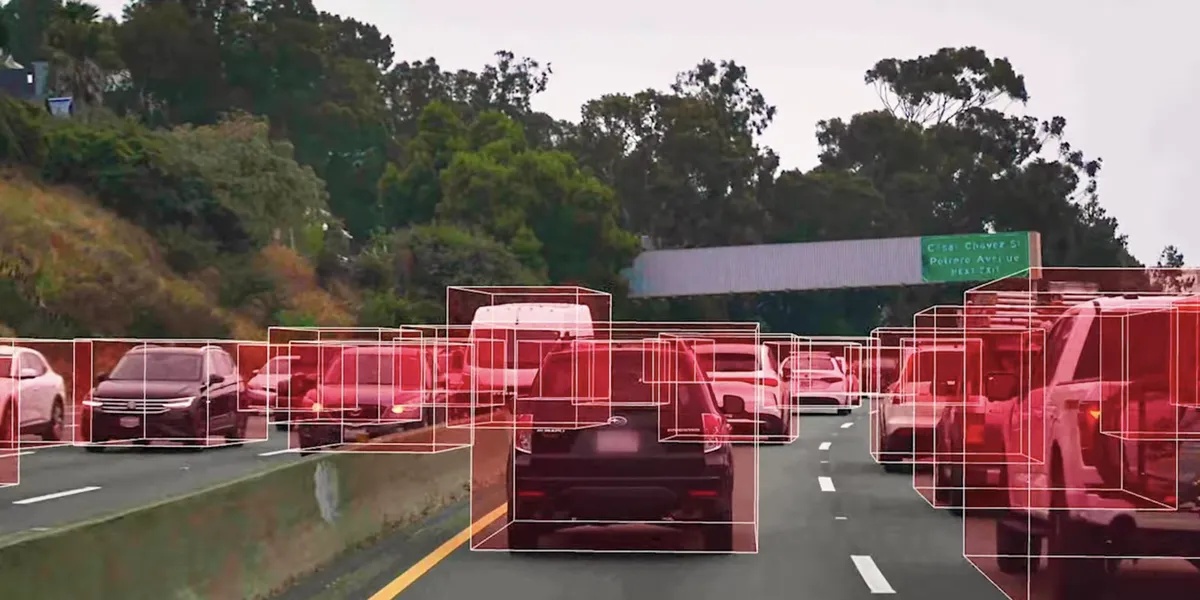

Plenty of people remain spooked by autonomous vehicles, or AVs. Some experts and policymakers have cautioned that AVs won’t necessarily make roads safer. When it comes to partial or full autonomy, the picture isn’t entirely clear, in part because there aren’t enough self-driving cars to make meaningful apples-to-apples comparisons.
Yet mounting research suggests that self-driving cars crash significantly less often than people, and with far fewer injuries. Evidence also shows the building blocks of autonomy, including advanced driver assistance systems, or ADAS—which are already mandated on every new car—are also reducing occupant and pedestrian injuries and deaths, along with insurance claims.
On the ADAS front, the Insurance Institute for Highway Safety found that automatic emergency braking (AEB) systems that recognize people in front of the car cut pedestrian crashes by 27 percent. A separate IIHS study found that automated braking greatly reduced rear-end crashes, by 50 percent, and their injuries by 56 percent. The Highway Loss Data Institute found that cars with AEB alone showed a 13 percent drop in property-damage claims. Cars that bundled ADAS features, including automatic braking for pedestrians, adaptive cruise control, and lane-departure warnings, saw claims reductions up to 39 percent.
Move to Level 4 autonomy, and Waymo says its robotaxis have now given 20 million paid rides over 220 million miles, the equivalent of 250 lifetimes of driving. In March, Waymo’s independent study showed 92 percent fewer fatal or serious-injury crashes, a 13-fold reduction versus human drivers in comparable city environments. That included 92 percent fewer pedestrian injuries, 83 percent fewer crashes with airbag deployments, and 82 percent fewer crashes with any injuries whatsoever. That included a 96 percent reduction in injury-causing crashes at intersections, among the deadliest environments for any automobile.
How Does Limited Fair-Weather Data Compare to Traditional Crash Statistics?
A key question is whether Waymo’s robotaxis, currently limited to fair-weather operation in a handful of cities in the U.S., are directly comparable to humans driving a wider variety of roads in much more variable conditions.
The IIHS is looking to dig deeper by cleaning up often-incomplete data. Researchers estimate roughly half of human crashes go unreported, and up to one-third of injury accidents, because drivers hope to avoid insurance price hikes. That potentially skews safety numbers in favor of human drivers. And while Waymo leads the industry in transparency, and robotaxi operators are required to report even the tiniest scrape to the National Highway Traffic Safety Administration (NHTSA), not every company voluntarily reports their total miles driven.
The IIHS’s latest July study flatly stated that automated cars crash less often than people. But it also sought clarity by creating a more-reliable category of “police-reportable crashes.” It then compared crash rates of human-driven cars against Waymo taxis in San Francisco, Phoenix, Los Angeles, and Austin. Waymo’s Jaguar I-Pace taxis traveled about 50 million driverless miles over the study period, versus 222 billion human miles in the same cities.
In a potential boost for public trust, the study generally supported Waymo’s own findings. Waymo taxis were involved in 68 percent fewer crashes overall than human drivers: 76 percent lower in Phoenix, 71 percent in LA, and 35 percent in San Francisco. A 4 percent higher Waymo rate in Austin may reflect an extremely small sample size. Significantly, Waymo’s injury crashes were still 81 percent lower on a per-mile basis.
The industry and its supporters continue to press the safety advantages of autonomous vehicles that never get drunk, drowsy, or distracted. Yet for this fledgling AV industry, there are still no national performance or safety standards. A crazy quilt of state or local regulations can allow or prohibit their deployment. That balkanized approach makes it harder to compare crash rates, according to the IIHS, which is calling for better federal reporting standards.
A posting on the IIHS website quotes the institute’s director of statistical services, Eric Teoh: “Those are encouraging signs for the future of driverless vehicles.” Teoh, who was also the lead author of the institute’s study, added that “Now we need to get the data-collection system right, so that we can ensure that level of safety continues as these technologies become more prevalent.”
Amazon’s Zoox Gets an Exemption for its Robotaxis
On July 30, in a move seen as fast-tracking the tech’s deployment, NHTSA granted Zoox, a subsidiary of Amazon, the first-ever exemption from certain motor-vehicle safety standards. That will allow commercial operation of Zoox’s toaster-shaped robotaxis, which have no steering wheel or pedals aboard. The agency determined that Zoox’s purpose-built robotaxi “would provide an equivalent level of safety” as a compliant vehicle, thereby satisfying the standard for an exemption.
On that final day of the SAE’s Automated Transportation Symposium, NHTSA also announced a partnership with SAE Industry Technologies to develop the nation’s first performance and competency standards for AVs, via a three-year, $5 million “A2SCEND” consortium.
Some doctors and health professionals are arguing that policymakers need to stop viewing self-driving cars as a tech moonshot but rather as a critical public-health intervention. Jonathan Slotkin, a neurosurgeon, makes a powerful case for the medical and societal benefits of AVs. Researchers at the Johns Hopkins Bloomberg School of Public Health say that highlighting the social value of AVs is critical to driving public trust and adoption.
Consider that roughly 40,000 people in the U.S., including more than 7,000 pedestrians, are killed each year in roadway accidents. About 1.16 million people die in roadway crashes around the world, making them the leading cause of death for children and young adults between the ages of 5 and 29. Cutting that by even 50 percent—let alone the 90 percent reductions suggested by some studies—would save 580,000 lives a year. That social and economic gain would dwarf that of seat-belt adoption or anti–drunk driving campaigns.
From Your Site Articles
Related Articles Around the Web
