

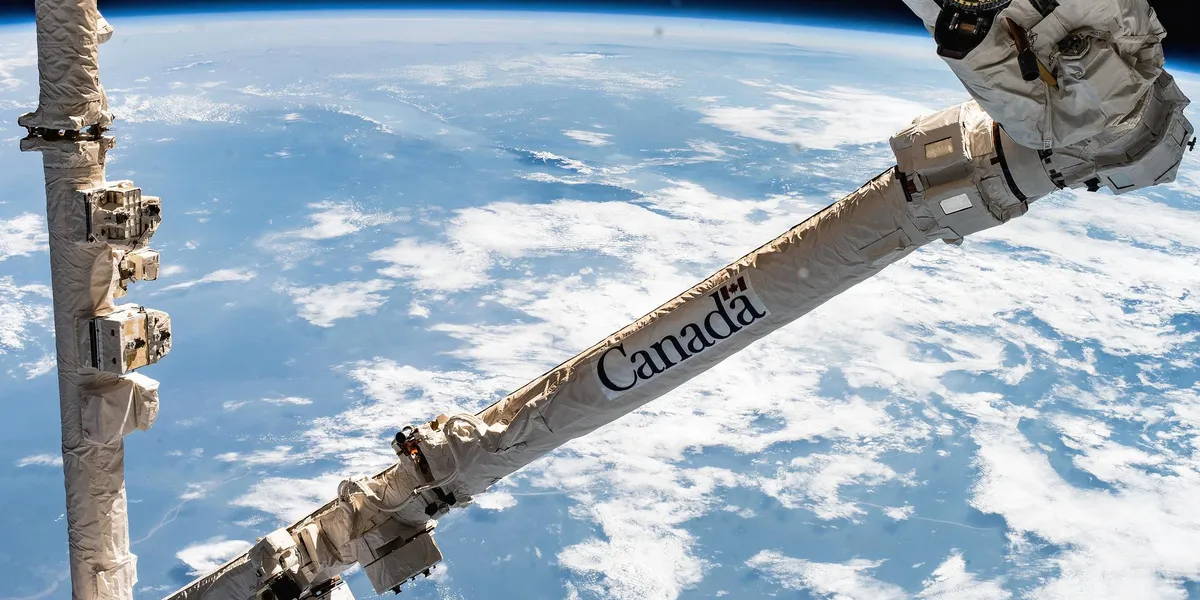

In the 1960s NASA began developing a system of reusable space shuttles to make its work more efficient and to reduce costs. The shuttles could launch like rockets, maneuver in Earth’s orbit, and land like airplanes. They also could carry large satellites to and from orbit.
Like other types of transportation, machinery eventually breaks down, and parts need to be replaced or fixed. And the cargo being carried to and from Earth has to be moved to its final destination. To complete such tasks, Spar Aerospace (now part of MDA Space) of Brampton, Ont., Canada, and the National Research Council in Ottawa developed a robotic arm, the Shuttle Remote Manipulator System. The project was a joint venture between the U.S. and Canadian governments.
Known as Canadarms, the robotic tools attached to shuttles’ exteriors. They allowed astronauts to handle and transfer tools, satellites, and other payloads. Inspections of the shuttle and repairs could be completed using the robots.
The system was first deployed in 1981 aboard Columbia’s second flight. Canadarm was used for 30 years on five shuttles and on the International Space Station.
The robotic arm was dedicated on 19 June as the 300th IEEE Milestone. The ceremony was held at MDA Space headquarters. The IEEE Toronto Section sponsored the nomination.
“It is appropriate that the 300th Milestone is the Canadarm,” says Michael Geselowitz, senior director of the IEEE History and Heritage group. “The technology spans aerospace, robotics, and computing fields of interest. It involves international cooperation between the United States and Canada, and it shows how IEEE and its members are at the cutting edge of many frontiers of science and technology.”
Seeking to collaborate with other countries on the reusable spacecraft, NASA invited Canada to participate in 1969. It took some time for the country’s officials to determine what technology it could contribute. They learned of a robot that loaded and replaced spent fuel bundles in Canada’s deuterium uranium nuclear reactors, according to the Milestone webpage. That robot, developed by DSMA-Atcon (also now part of MDA Space), inspired what would become the Canadarm.
A proposal was submitted in 1974 to design and build the Shuttle Remote Manipulator System. The robotic arm would unload the contents of the space shuttle’s payload bay. NASA approved the project, and development began in 1975.
Canada had no space agency at the time, so the country’s National Research Council coordinated the organizations that collaborated on the project. Spar Aerospace led the subcontractor team, which included DMSA-Atcon, CAE, and the Canadian subsidiary of RCA Corp. Engineers from the University of Toronto’s Institute for Aerospace Studies contributed to the project.
Building an arm for zero gravity
NASA had strict requirements for the robot: The arm had to be lightweight and small enough to fit on the shuttle, as detailed in an article published by the University of Toronto. It also had to move forward and backward, up and down, left and right, and rotate along three perpendicular axes (known as six degrees of freedom).
To achieve all that, engineer Peter Carlisle Hughes designed the robot with two shoulder joints, one elbow, and three rotating wrists.
“Each joint had six degrees of freedom, and the arm had six links so that it could grab anything from any angle and move it anywhere,” Hughes said in the article. The IEEE life member worked at the Institute for Aerospace Studies.
“This milestone is a reminder of the privilege we all have at MDA Space—as engineers, designers, builders, operators—to build technology that shapes history.” —Holly Johnson, MDA Space vice president
The arm was 50 meters long and weighed 400 kilograms. It was made of materials that could withstand outer space’s harsh environment: titanium, stainless steel, and graphite epoxy. The arm was so lightweight that it couldn’t support itself under Earth’s gravity, so it lay on air bearings on the lab floor at Spar’s Brampton headquarters.
CAE engineers, including IEEE Life Member David A. Weston, designed the display and control panel as well as the hand controllers astronauts would use to monitor and operate the robot.
Because the robotic arm was meant to work in zero gravity, a room that simulated a weightless environment was built to test it. A computer-based simulation facility was constructed in Spar’s headquarters to evaluate its controllability using two simulation models, according to the University of Toronto. RIGID, an early computer simulation model, tested every part of the arm except for its flexible properties. ASAD, which stood for “all singing, all dancing,” examined the arm’s movements, ensuring the joints operated correctly. Both were created by Hughes and Spar engineer Andrew A. Goldenberg, who is now a professor emeritus at the University of Toronto.
The facility was also used to train astronauts on how to use Canadarm.
It took five years for the first Canadarm to be completed. In February 1981, it was presented to NASA at the Kennedy Space Center in Cape Canaveral, Fla., and deployed that November.
Lift off into space
Astronaut Stephen Robinson is anchored to a foot restraint on the extended Canadarm2 attached to the International Space Station during an extravehicular activity he conducted in 2005.NASA
The Canadarm was attached to the outside of the shuttle. Astronauts were able to monitor the arm’s movements through a live video feed provided by cameras installed on the wrist and elbow joints, according to the Milestone webpage. Using a hand controller and monitors located in the shuttle’s flight deck, astronauts handled and transferred tools, satellites, and other payloads weighing up 266,000 kilograms using minimal electricity.
NASA ordered four more systems. In 2001, Canadarm2 was attached to the International Space Station and used to help build the orbiting laboratory. It is a permanent part of the station, still completing maintenance tasks and moving supplies.
During the course of the 30-year shuttle program, the arms performed successfully and achieved the flight’s mission.
The original Canadarm took its final flight in July 2011 aboard the Atlantis shuttle.
Celebrating IEEE’s 300th Milestone
The IEEE Milestone dedication ceremony was held at MDA Space’s headquarters in Toronto, where the division that developed the Canadarm was located. The event brought together IEEE leaders and many of the engineers who helped develop the robotic system. Jill Gostin, the 2026 IEEE president‑elect, gave the opening remarks at the ceremony. She emphasized that the Milestone was not only celebrating the technology but also “the engineers, builders, programmers, and visionaries who believed technology could expand human possibility and who dared to push the boundaries of what humanity could achieve beyond Earth.”
To commemorate the achievement, Holly Johnson, vice president of MDA Robotics and Space Operations, and IEEE Life Senior Member David Michelson, chair of the IEEE Communications Society’s Communications History Committee, unveiled a bronze plaque that honored the technology. Michelson was the Milestone’s proposer.
“This milestone is a reminder of the privilege we all have at MDA Space—as engineers, designers, builders, operators—to build technology that shapes history,” Johnson said. “That same pioneering spirit that drove our team in those early days of space exploration now propels us into a new era as we work to build the infrastructure for the moon and beyond.”
The plaque, which was placed at MDA Space headquarters, reads:
In 1981 NASA first deployed a Shuttle Remote Manipulator System aboard the Space Shuttle. Developed by Spar Aerospace (now MDA Space) and the National Research Council of Canada, the Canadarm allowed astronauts to safely and reliably manipulate and transfer heavy payloads outside of the Shuttle, and to conduct inspections and repairs. This robotic system played a key role in the Shuttle and International Space Station programs, and revolutionized human spaceflight.
Reviewed by the IEEE History Committee and approved by the IEEE Board of Directors, IEEE Milestones recognize outstanding technical developments around the world that are at least 25 years old. The Milestone program is administered by the IEEE History and Heritage group.
To learn more about historical figures in engineering, IEEE Milestones, and IEEE History Center programs and events, check out The Institute’s IEEE Tech History collection. IEEE Spectrum also covers aspects of tech history.
From Your Site Articles
Related Articles Around the Web
