

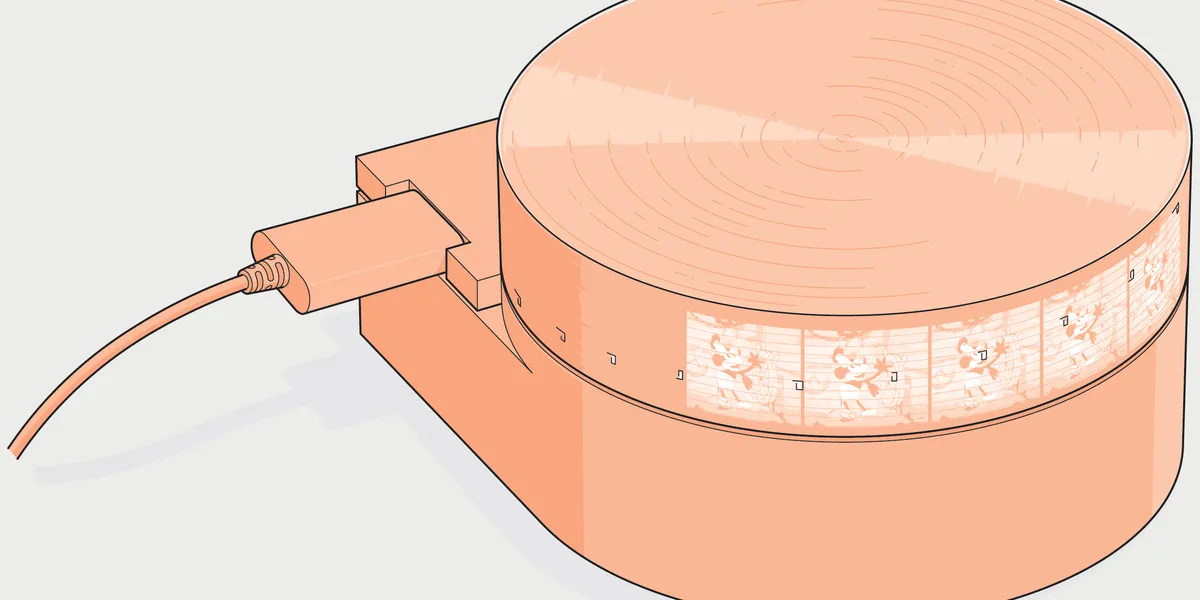

I never intended to join the cutting edge of electromechanical television. I just wanted to make a nice clock. But sometimes you have to go where the engineering takes you, and in my case it took me to the Scanwheel, a pocket-size wide-screen electromechanical TV with a resolution of 4,096 by 20 pixels. Yup, that’s 4K by 20.
The 3D-printed drum [top] is spun by a motor controlled by a driver board [second row, from top]. The driver board, in turn, is controlled by a Raspberry Pi Pico [middle], which also controls the LEDs [second row, from bottom], which are mounted in the 3D-printed casing [bottom] so that the holes pass over them as the drum turns.James Provost
Electromechanical television was the first form of practical television, developed by John Logie Baird in the 1920s. He used a so-called Nipkow disk, which has a spiral of holes punched through it. As the disk rotates, the holes pass one by one in front of a light source. By varying the brightness of the light as a hole travels across it, you can draw one scan line of a video frame. Spin the disk fast enough, and persistence of vision makes it look like an entire frame is being displayed simultaneously. Commercial electromechanical TV sets were produced in the United Kingdom, with regular broadcasts provided by the BBC in the 1930s.
Although cathode-ray tubes replaced electromechanical televisions in the 1940s, hobbyists have continued to build them and even improve on the original technology. For example, in the June 2022 installment of IEEE Spectrum’s Hands On, Markus Mierse presented a desktop-size 3D-printed color version.
I built an electromechanical display myself some years ago, but it had a traditional design with a Nipkow disk made from a vinyl record with holes drilled in it. Recently I started tinkering with electromechanical TV again as an outgrowth of my YouTube channel. There I’ve been focusing on developing volumetric displays, which create 3D pixels floating within a volume of space. In particular, I was interested in borrowing some ideas from plenoptic cameras, which use pinholes and lenses to capture multidimensional light fields of samples.
I wondered if I could run the process in reverse, to create light fields rather than capture them. I often explore ideas in two dimensions before expanding to the third, so I thought I’d first demonstrate a 2D display. I decided to make an electromechanical device into a clock. After all, you don’t need high resolution to display digits.
How Does the Scanwheel Display Work?
Thinking about the display as a clockface pushed me toward some key ideas. First, instead of having just one display area, I would use five light sources to create multiple areas—four to represent hours and minutes, and a central area for a separator that would blink each second. Second, to align the digits in a readable row rather than have them spread around an arc, I swapped the Nipkow disk for an established alternative: a Nipkow drum.
With a drum, the holes run along the curved cylindrical surface in a stair-step pattern. This means they always trace a straight line from the perspective of a viewer looking from the side, so the clock’s digits would be horizontally aligned.
“In tests, I’ve pushed the horizontal resolution to more than 8,000 pixels.”
These two decisions turned out to be key to achieving both miniaturization and high horizontal resolution. A disk needs a fairly wide diameter so that the scan lines aren’t ridiculously curved. But curvature isn’t a problem with a drum. A drum can be much smaller than a disk that has the same number of scan lines. (And unlike in the 1920s, packing multiple light sources close together inside a small drum isn’t a problem with modern LEDs.) I settled on a 6-centimeter-wide drum, turning the device from desktop-size to something you could carry in your pocket.
I then realized my five display zones could work in concert to create one single wide screen. Because it’s possible to modulate the brightness of an LED at very high rates, the horizontal resolution can also be very high. My system currently has 4K horizontal resolution, and this is primarily limited by the amount of onboard memory I have available. This memory holds the buffer that stores pixel data for each frame before it is read out to the LEDs and displayed. In tests, I’ve pushed the horizontal resolution to more than 8,000 pixels.
Despite the Scanwheel’s low vertical resolution—at 20 pixels, it has fewer scan lines than Baird’s 30-line televisions—its high horizontal resolution makes the legibility of the display surprisingly good: I can display not just crude digits but video streamed into the frame buffer.
Using the RP2040 Chip’s Special Silicon
That frame buffer lives on a Raspberry Pi Pico microcontroller board, based around the RP2040 microcontroller. The RP2040 is ideal for this project because of the chip’s dedicated PIO silicon. PIO stands for programmable input/output, and it’s a block of four coprocessors that uses a very limited instruction set. Each coprocessor can be set up to chew through input/output streams completely independently of the RP2040’s two CPU cores.
The first mechanical TVs used disks, which had to be wide to minimize image distortion but allowed bulky light sources. With small, modern light sources, a smaller drum can create images with minimal distortion.James Provost
It’s thanks to the PIO that I’m able to keep up with the spinning drum and modulate each of the five LEDs simultaneously as holes pass over them, a task complicated by the fact that the center LED is not a monochrome LED, but a color LED with separate red, green, and blue channels. In fact, the PIO does nearly all the work, pulling data from the frame buffer and controlling the LEDs and the spinning of the drum. The code running on the CPU (written in MicroPython) is primarily responsible for setting up the PIO and then leaving well enough alone.
A stepper motor connected to a driver board spins the drum, with power provided by the USB jack on the Pi Pico. All the Pi Pico has to do controlwise is send the board a pulse to incrementally advance the drum’s position once every millisecond. Video data is streamed into the Pi Pico via a network interface. You can set up the Scanwheel to mirror a portion of your computer’s screen, or to act as a separate display.
The casing, including the drum, is 3D printed. Now for a neat bit: In the Scanwheel’s GitHub repository at https://github.com/AncientJames/Scanwheel/tree/main, alongside all the other files you’ll need to make this project yourself, there’s an OpenSCAD file that generates the 3D-print file for the drum based on adjustable parameters. This means you can easily make a taller drum and add more scan lines, or try other customizations for your very own portable electromechanical display. You can even use it as a clock!
From Your Site Articles
Related Articles Around the Web
