

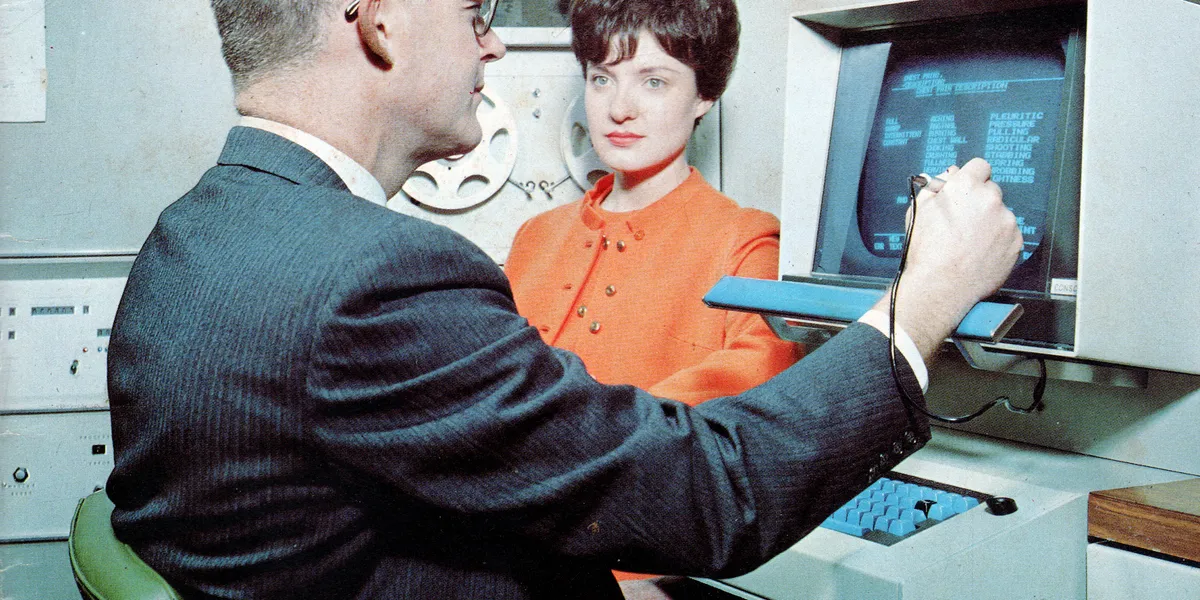

Most hospitals and health care providers use electronic health records instead of paper charts to note patient vaccinations, diagnoses, and procedures. AthenaOne, Epic, and Oracle Health are some of the systems employed around the world. Many patients can access their electronic medical records from home.
The platforms exist thanks to pioneering efforts such as the Medical Information System (MIS-I). The first hospital-wide computer system, it was developed in the 1960s by Lockheed Martin (then known as Lockheed Missiles and Space Co.) in partnership with El Camino Hospital, in Mountain View, Calif. Doctors and nurses used MIS-I (pronounced miss-ONE) to admit patients, order lab work and imaging, schedule follow-up appointments, and issue hospital bills, according to a 1973 article published by Datamation.
Although many people now know how to type on a keyboard, in the 1960s, most did not. Therefore, MIS-I included a light pen, which worked like a stylus for today’s touchscreens.
MIS-I was recognized as an IEEE Milestone during a ceremony on 14 May at El Camino Hospital. The IEEE Santa Clara Valley Section sponsored the Milestone.
“The medical information system was more than a technological breakthrough; it was proof of what can happen when clinicians, engineers, administrators, and community leaders unite around a common goal: improving care for patients,” Dan Woods said at the event. He is chief executive of El Camino Health, the nonprofit organization that maintains the hospital.
“This pioneering work helped establish the foundation for the modern medical informatics industry,” Woods said. “The legacy of Lockheed’s innovation continues to benefit patients and health care providers around the world, making this achievement truly worthy of lasting recognition.”
Bringing technology into clinical care
Prior to Lockheed’s effort, health records remained paper-based. They often were stored in dedicated rooms within the hospital. Files were kept in heavy-duty manila folders organized on mechanized open-shelf filing systems, revolving rotary files, or locked steel filing cabinets, according to EO Johnson Business Technologies. The process of retrieving a patient’s medical history was cumbersome and could hamper decision-making in a life-or-death situation. Paper records were prone to human error, according to an EHR in Practice article. In addition, upkeep could be costly due to administrative expenses such as transcribing doctors’ notes, storing patient charts, adding medical codes, and managing insurance claims.
Companies and universities including General Electric, IBM, and Harvard began exploring how to use computers to improve clinical care. They developed several systems for hospital laboratories to track test orders and results, as explained in the Milestone webpage.
In 1964 Lockheed was looking to diversify its portfolio, Melville Hodge, who helped lead the MIS development, said at the dedication ceremony. The company decided to apply its expertise to health care, and later that year this focus-area became part of a new information systems division. Hodge, who at the time oversaw multiple R&D efforts, became the driving force behind the MIS program.
MIS-I displayed patient information on a 14-inch television purchased from a department store. Below that monitor was a keyboard and a light pen.Ian Thomson/Computer History Museum
In 1966 Lockheed secured a contract with the Mayo Clinic, in Rochester, Minn., to assess its computer system needs and those of its two associated hospitals, Hodge wrote in a paper detailing MIS history.
He and a small team of engineers worked with Mayo Clinic physicians for two years to build the prototype of what would become MIS-I.
The system displayed patient information on a 14-inch television purchased from a department store. Below that monitor was a keyboard, and to its right was a printer. Doctors and nurses would swipe their ID badge to access the system, then use the keyboard to put information into the patient’s file or send a request to a pharmacy or laboratory. They also could print documents.
But one problem kept cropping up: Most doctors didn’t know how to type. The computer mouse was still in its infancy, and Hodge suspected it would not solve the problem, according to a video shown at the dedication ceremony. Instead, he “borrowed technology from a then-secret satellite program,” he said.
That technology was the light pen, which was used with MIT’s Whirlwind Computer in the 1950s.
“The insight that physicians could not and would not learn to type, combined with the innovative solution of light pen interaction, transformed an impossible dream into practical reality,” the Milestone proposers wrote.
To display text, the system used matrix programming, a 2D data structure consisting of rows and columns. Using the light pen, a doctor or nurse would select text from a list of general categories on the monitor. The options included the patient’s personal and medical information, family medical history, current illness, and physical exam findings, according to a 1968 article in the medical journal JAMA. The computer would display the requested information or list the next steps to complete tasks such as sending a prescription to a pharmacy. The keyboard remained part of the setup because it could allow users to input new information and update patient records.
To further develop the system, they submitted a proposal to the U.S. Department of Health, Education, and Welfare (now split into the Departments of Health and Human Services and Education) to secure additional funding, but it was rejected.
Herschel Brown, Lockheed’s executive vice president, and Kenneth Larkin, its director of information systems, decided to fund its commercial development, Hodge wrote.
When the company’s contract with the Mayo Clinic ended, the Lockheed team returned to Sunnyvale, California to refine, test, and deploy the system at El Camino Hospital.
“I admire Ed Hawkins, who was its first administrator, for having the courage to take on this kind of project while running a hospital that was only four years old at the time,” Hodge said at the dedication ceremony.
Making MIS-I a commercial success
Starting in 1968, early prototypes were installed in the hospital’s M.D. lounges and nursing station at El Camino Hospital. The organizations worked to configure the system so it met the hospital’s needs.
By 1969, a number of monitors had been installed, including in admissions, pharmacy, and radiology. The information from all the connected machines was stored in a data center housed in a separate location outside the hospital.
In 1971 Lockheed encountered difficulties with its C-5A and L-1011 aircraft programs, according to Hodge. The company was forced to curtail discretionary new business programs including MIS-I. The program was sold to Technicon of Tarrytown, N.Y., a leader in clinical laboratory automation.
The medical information system business operated independently as a subsidiary unit, and the transition marked the beginning of MIS-I’s commercial expansion.
That same year, MIS-I went live for hospital-wide use. Physicians’ orders were communicated to other departments, test results and radiology reports were retrieved, and nursing care planning and documentation were available, according to the Journal of Nursing Scholarship. MIS-I supported most information handling for nurses, physicians, and other medical personnel in the hospital.
But the change was not welcomed by all, according to the video about the technology. Nurses tended to praise the system, but many doctors had a hard time transitioning from paper to computers. They complained they were “spending more time fighting a machine” than interacting with their patients, according to the video. Some even retired to avoid learning the system. But nurses fought to keep it, emphasizing to doctors how much it improved patient care.
In 1974 El Camino Hospital held a vote of medical staff to determine whether to keep the system or return to paper-based records. About 60 percent of doctors and more than 90 percent of nurses voted in favor of keeping it, according to the Milestone webpage.
“The medical information system was more than a technological breakthrough; it was proof of what can happen when clinicians, engineers, administrators, and community leaders unite around a common goal: improving care for patients.” —Dan Woods, El Camino Health CEO
In 1975 nonprofit Battelle of Columbus, Ohio, evaluated how well the system was working for El Camino Hospital. It found that MIS-I reduced the time nursing staff spent on clerical tasks, improved communications among departments, and facilitated better planning of patient care. The survey also showed that more readily available, complete, and accurate information was being used to administer care and monitor patient progress, according to the filings.
By 1993, the technology was installed in more than 200 hospitals in the United States, Canada, and Europe, according to the Milestone entry.
El Camino Hospital used MIS-I for 34 years, until its decommissioning in 2005. It was initially replaced by Eclipsys Sunrise XA and then ultimately by Epic.
The dedication ceremony brought together IEEE leaders, hospital staff, and government representatives. Hodge and his family also attended. IEEE President-Elect Jill Gostin made a presentation about IEEE, and Brian Berg of the IEEE History Committee discussed the organization’s Milestone program.
Hodge participated in a Q&A session with Deb Muro, chief information officer of El Camino Health. He told a story about the early days of MIS-I that he said he will never forget. During a hospital board meeting at which physicians were complaining about the system, an announcement was made over the hospital’s public address system that MIS-I wasn’t working.
“I had to ignore it to survive,” Hodge said, laughing. “As physicians got more used to it, and with a phenomenal poking from the nurses, doctors who wouldn’t use it were forced to.”
A bronze plaque recognizing the MIS-I as an IEEE Milestone has been installed in the lobby of the hospital in Mountain View. The plaque reads:
From 1965 to 1974, the first hospital-wide computerized medical information system was created by Lockheed Missiles and Space Co. in partnership with El Camino Hospital. Innovative light-pen terminals enabled physicians and staff across all departments to efficiently and accurately access patient data and enter work orders. By providing immediate feedback and seamless communication, it reduced costs and errors, improved safety and outcomes, and led the way to modern medical and clinical informatics.
Reviewed by the IEEE History Committee and approved by the IEEE Board of Directors, IEEE Milestones recognize outstanding technical developments around the world that are at least 25 years old. The Milestone program is administered by the IEEE History and Heritage group.
To learn more about historical figures in engineering, IEEE Milestones, and IEEE History Center programs and events, check out The Institute’s IEEE Tech History collection. IEEE Spectrum also covers aspects of tech history.
From Your Site Articles
Related Articles Around the Web
