

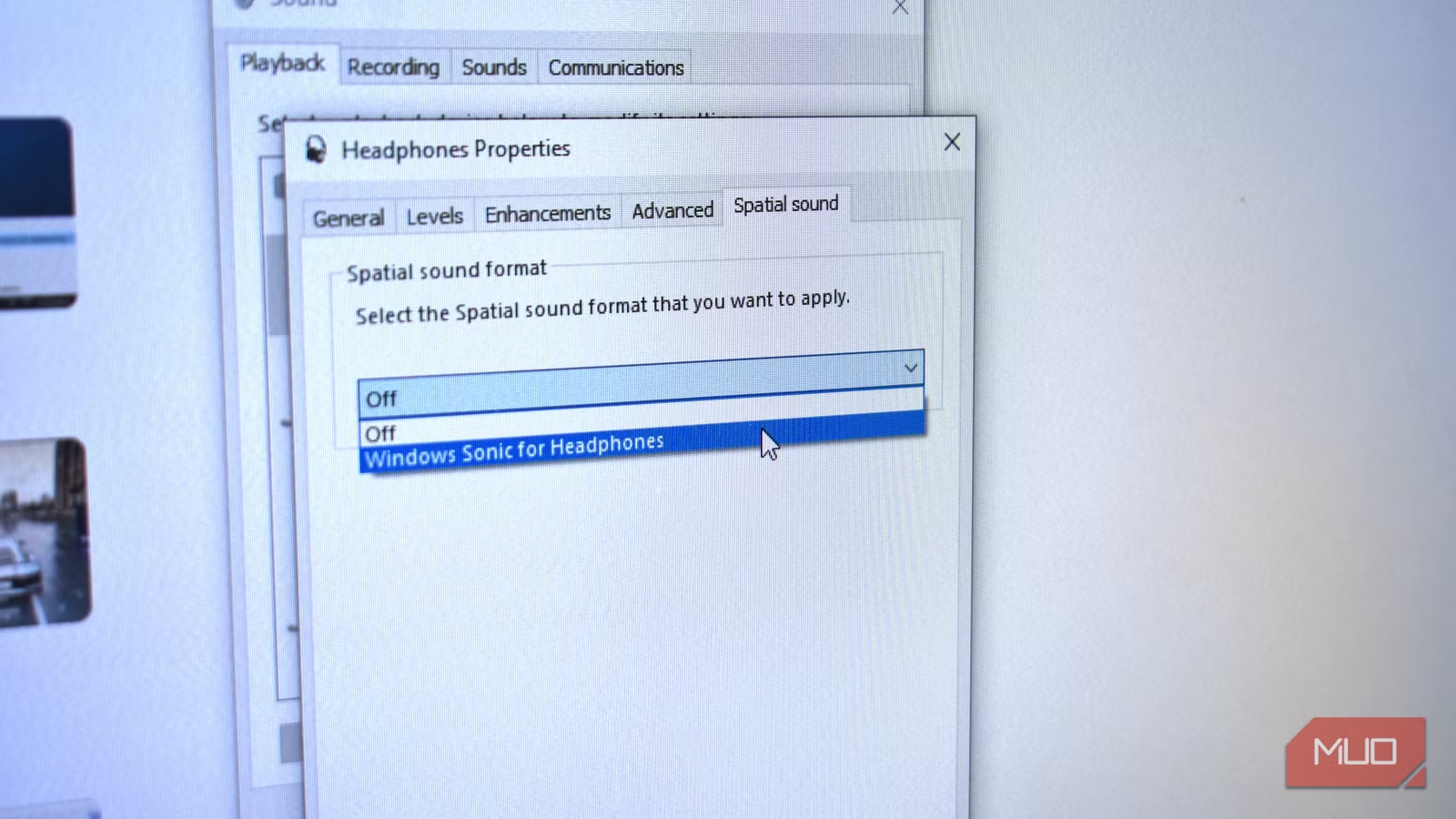
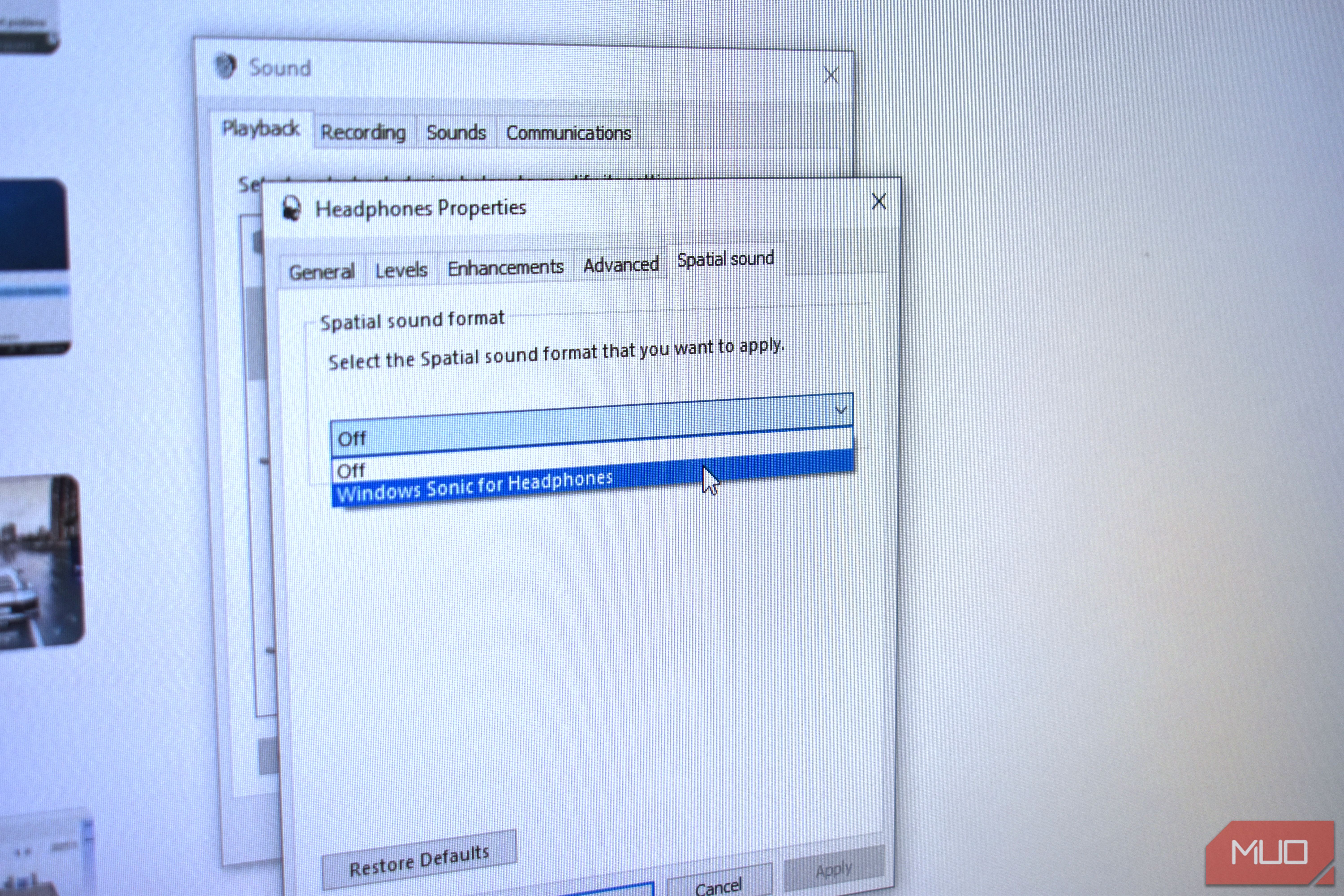
If you’ve used Windows for years, as most folks have, you’ve probably encountered an audio feature known as Windows Sonic. I’m guessing you turned it on, wondered what on earth was happening, then switched it off forever.
A totally understandable reaction, and millions will have done the same. Windows’ built-in spatial audio tool was never great, especially compared to tools like Dolby Atmos and DTS Headphone:X. It even rated poorly against regular stereo audio.
But over the years, Windows Sonic has improved. It’s still not perfect, mind, but it’s very much worth another try, and for a few good reasons.
Related
7 Times It’s Actually Worth Using Spatial Audio
Spatial audio doesn’t always work, but sometimes, it’s just what you need for that extra immersion.
Why Windows Sonic was easy to ignore
Quite frankly, it wasn’t very good, and everyone knew
When Microsoft first rolled out Windows Sonic in the Windows 10 Creators Update back in 2017 (our Windows Sonic article from 2017, just after the Creators Update), it seemed like a great idea.
Instead of requiring expensive surround sound hardware or a paid software license, Windows users could enable spatial audio for free with almost any pair of headphones. At the time, spatial audio was just taking off, so it seemed like the right moment to bring something to a wider audience of general users.
Windows Sonic uses spatial audio processing, often called HRTF (Head-Related Transfer Function), to recreate how sounds naturally reach your ears from different directions. Rather than simply making the left or right speaker louder, it tries to convince your brain that sounds are coming from above, behind, or somewhere off to the side.
On paper, impressive. In reality, Windows Sonic didn’t work how it should. Although spatial audio was taking off at the time, there weren’t a huge number of supported games and apps. Often, those that did support Windows Sonic delivered a terrible implementation, making audio sound hollow and distant rather than immersive, and it straight-up killed any music once turned on.
It was also a difficult time for Windows Sonic to launch. As said, at the time, Dolby Atmos and DTS Headphone:X were the alternatives, but often shipped with headphones, games, or other software, giving people easy access to the premium versions. In that, Microsoft’s spatial audio just didn’t feel as refined, and accordingly, many folks tried it once then binned it off.
Windows Sonic has steadily improved over the years
But the improvements aren’t all down to Microsoft
The thing is, Windows Sonic today isn’t quite the same feature many of us dismissed several years ago. Microsoft brought some upgrades to Sonic over the years, but improvements to Sonic’s overall audio quality have come from other sources, including games, the platforms themselves, and even the headphones.
Games actually support spatial audio
Back in 2017, when Windows Sonic first launched, most games were still mixing stereo, with some offering support for traditional 5.1/7.1 surround sound. That means, in terms of audio data, there actually wasn’t anything to work with; Windows Sonic either wouldn’t do anything or would guess at what the audio data meant.
Some games also included proprietary audio virtualization, which again, wouldn’t work with Windows Sonic. For example, Battlefield was built using DICE’s headphone mix, and CS:GO had its own HRTF implementation. It all led to a fractured spatial audio landscape.
But now, some nine years or so later, most game engines fully embrace object-based audio, making spatial audio implementations across the board more accurate than ever. Both Unreal Engine and Unity now include mature spatial audio frameworks, allowing developers to position sounds as individual objects in three-dimensional space rather than baking everything into fixed surround channels.
In addition, more games specifically support Windows Sonic, even if it’s one of the lesser-used spatial audio platforms. That alone delivers a very different audio experience from Sonic’s early days.
Windows Spatial Sound has had 9 years to mature
For me, better game support is the key reason why Sonic is worth revisiting. But the whole platform has had just under a decade to deliver improvements across the board, and in many cases, it has.
One of the clearest technical improvements came with expanded support for dynamic audio objects.
Traditional surround sound works with fixed channels: left, right, center, rear speakers, and so on. Object-based audio works differently. Instead of saying “this sound belongs to the rear-left speaker,” a game can say “this sound exists three meters behind the player and two meters above them,” and the spatial audio engine calculates how to reproduce it.
The more audio objects a system can handle, the more complex and detailed the soundscape can become. In 2023, Microsoft increased Windows Sonic’s supported dynamic audio objects from 112 to 128, bringing it closer to the capabilities expected from modern object-based audio systems such as Dolby Atmos.
For everyday users, this doesn’t mean you suddenly hear 16 extra sounds around you. The improvement is more subtle: busy scenes with lots of simultaneous audio sources can be represented more accurately.
Headphones have also improved since Sonic launched
I’m going to steer clear of saying “all headphones are now better,” because that’s an incredibly broad and comically vague statement. However, in general, I’d argue that most consumer headphones are likely delivering better quality audio than they did nine years ago for the most part.
There are a couple of additional points to consider in this. First is that when Windows Sonic launched, barely any headphones specifically supported spatial audio design, and those that did weren’t typically sitting on your desk. 2017 was around the time spatial audio implementations really started rolling out, but even then, it wasn’t commonplace.
I didn’t get my first proper pair of fully spatial headphones until 2020, and even then, the Creative Super X-Fi Theater cans relied on proprietary tech.
Most headphones at the time struggled with the subtle audio cues and positional awareness that spatial audio requires. The difference is that now even modern budget headphones can deliver that level of quality, let alone when you shift into the mid-range and premium models. Furthermore, most gaming headsets worth their salt are now specifically designed to accommodate spatial audio, again improving the overall quality.
It’s better — but Windows Sonic still isn’t the best spatial audio option
With all those improvements, I still can’t (and won’t!) claim that Windows Sonic is the best spatial audio option. It wouldn’t be true, and you’d probably laugh at me.
Dolby Atmos for Headphones still generally delivers a more convincing surround effect, while DTS Headphone:X remains an excellent option for supported games. If you’ve already paid for either technology and enjoy how they sound, there’s probably little reason to switch.
It’s also worth remembering that spatial audio isn’t universally better. Some music sounds more natural in standard stereo, and some competitive gamers still prefer completely unprocessed audio to avoid introducing any additional processing, however slight.
But, given where Windows Sonic was in 2017, it’s worth another try in 2026.
Related
I added hi-res audio to my Windows 11 PC for under $6, and my music finally sounds right
It’s a tiny outlay compared to how much you spent on your cans.
