

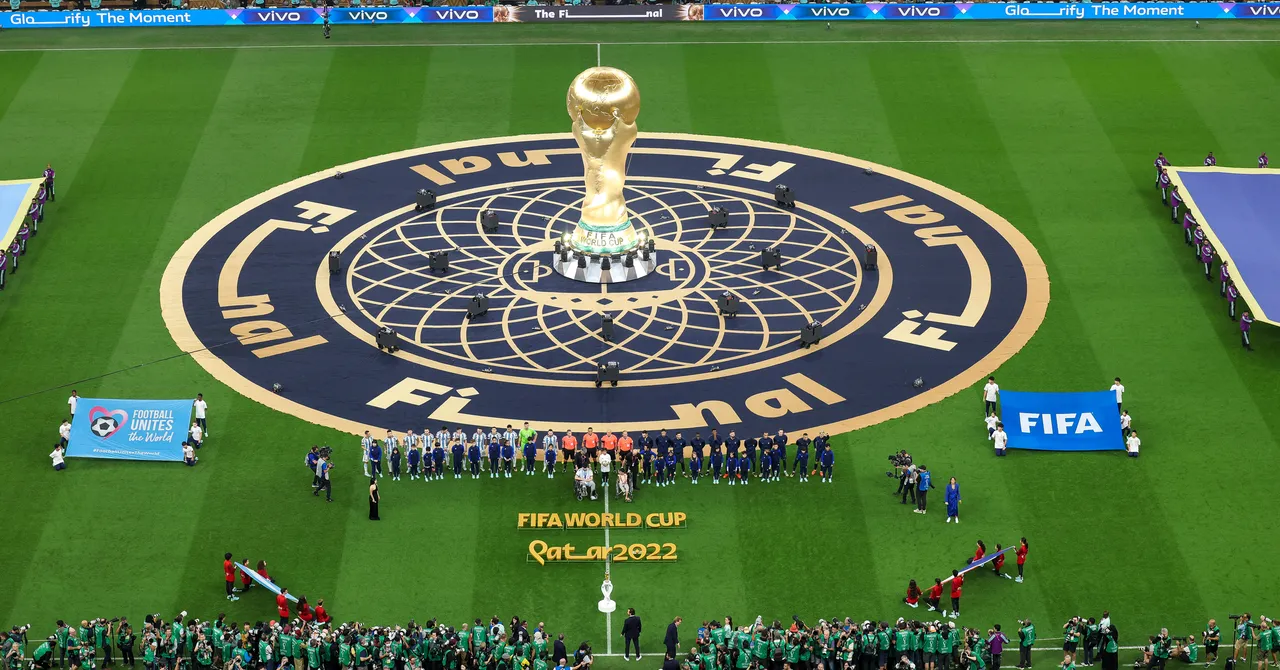
To casual soccer viewers, the game may look like it always has—same green field, 22 players, a referee, and the familiar rhythm of play unfolding over 90 minutes.
The changes are only visible if you look beneath the familiar surface. What appears to be a traditional match is now supported by layers of tracking systems, automated analysis, and real-time data that run quietly in the background.
Many of the technologies now underpinning the 2026 FIFA World Cup—from connected match balls to digital re-creations of contentious moments—were first trialed on Qatari pitches, all in pursuit of answering football’s oldest questions faster: Did the ball cross the line? Did it leave the field of play? Was the player offside?
“Innovation was central to Qatar’s FIFA World Cup bid and subsequent preparations,” says Thani Al Zarraa, executive director of Qatar’s Supreme Committee for Delivery and Legacy, which was formed in 2011 to oversee the infrastructure development for the 2022 World Cup. “Since the FIFA Arab Cup 2021, we have done more than host football’s biggest matches; we have helped shape how the game is played, officiated and experienced.”
The pattern is difficult to ignore. Starting in 2021, when several systems were tested together for the first time at scale during the FIFA Arab Cup, a growing number of FIFA’s technological innovations have passed through Qatar first. As the country continues to host major football tournaments, it has increasingly become a place where innovations can be trialed under real match conditions before reaching the global stage.
Optical Player Tracking
Among the technologies tested in Qatar was optical player tracking: a network of high-precision stadium cameras capturing every player’s movement dozens of times per second, down to centimeter accuracy. The cameras, largely invisible to fans, would soon become the foundation of technologies that would influence some of football’s biggest decisions on the world’s biggest stage.
Connected Ball Technology
A 2026 FIFA World Cup official ball embedded with sensor technology.
Photograph: Liang Sen/Getty Images
One of football’s oldest debates is also one of its simplest: Exactly when was the pass played?
To answer that question, FIFA introduced a connected ball equipped with a sensor suspended at its center. Adidas first trialed connected-ball technology during the FIFA Arab Cup before introducing the Al Rihla at the Qatar World Cup in 2022.
Fans saw its impact immediately. When Ecuador’s opening goal against Qatar was ruled out in the tournament’s first match, the decision relied on a system that could identify the precise moment the ball was played. Combined with AI-powered player tracking, the connected ball helped transform offside calls from lengthy investigations into decisions measured in milliseconds.
The FIFA Player App
That same year also saw the early rollout of a new digital layer for players. The FIFA Player App gave athletes direct access to their own performance data—positional heat maps, physical output, tactical actions—often within minutes of the final whistle.
Built in partnership with FIFPRO, the global representative organization for professional footballers, it marked a subtle shift: Performance analysis was no longer reserved for coaching staff. It was becoming part of the player experience.
VAR and Goal-Line Technology
By the time the 2022 FIFA World Cup began, many of these systems had moved beyond the trial stage. Semiautomated offside technology became one of the tournament’s defining innovations, accelerating decisions that once took minutes into near-instant calls. The connected ball, carrying its inertial sensor at its center, helped verify touches and refine the accuracy of every key moment feeding into VAR (video assistant referee) reviews.
Dedicated analyst workspaces and replay tablets gave the coaching staff live video feeds and performance information during matches. Rather than waiting until halftime or the final whistle, coaches could identify patterns and make adjustments while the game was still unfolding.
