

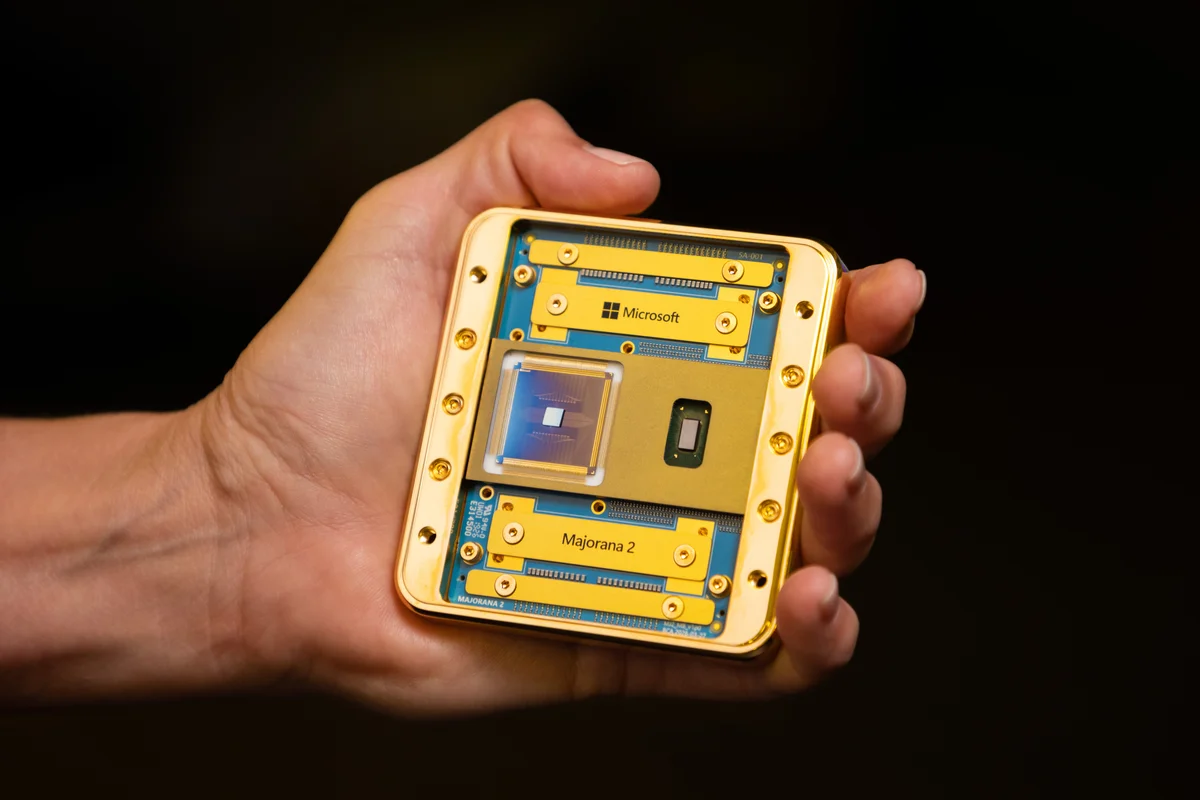
A top quantum computing expert assails Microsoft’s claims that it has a “topological qubit,” arguing in a new paper that the company has failed to demonstrate the technology.
University of St Andrews physicist Henry Legg argues that the “topological qubit,” a storer of quantum information that could theoretically maintain a higher fidelity than any in existence, might simply be noise.
The commentary was published today in Nature’s “Matters Arising,” the journal’s venue for formal criticism of its published papers. Legg’s response is aimed at Microsoft’s most recent Nature paper, which was published earlier this month—but it is just the latest in a string of criticism aimed at Microsoft’s Quantum division by other researchers in the field.
On supporting science journalism
If you’re enjoying this article, consider supporting our award-winning journalism by subscribing. By purchasing a subscription you are helping to ensure the future of impactful stories about the discoveries and ideas shaping our world today.
The company has been forced to retract certain previous peer-reviewed papers. And in the new commentary, Legg argues that their most recent Nature paper may be similarly flawed. In a response also published today by Nature, a member of Microsoft’s Quantum team argues that their measurements do justify the claim that they’ve produced a topological qubit.
In a statement to Scientific American, Microsoft’s Technical Fellow and Corporate Vice President, Quantum Hardware, Chetan Nayak said, “We stand by our results and our roadmap. At the end of the day, success is the delivery of a scalable quantum computer. We are confident in our ability to execute against our roadmap and proud of our continued engagement with DARPA, which moved Microsoft into the final phase of its Quantum Benchmarking Initiative after independently evaluating our results—those in the public realm and proprietary—with a team of highly qualified experts. Skepticism and rigor are hallmarks of the scientific process, which we appreciate and have supported from various academics. We have participated in dialogue and our thorough rebuttal was accepted and published by Nature.”
The critique—which Microsoft has known was in the works at Nature for some time—lands on the heels of the company’s unveiling of the “Majorana 2” chip, and an updated timeline to produce “scalable, practical quantum computing” to the end of the decade. “They simply cannot sell the 2029 roadmap as credible to the public when the underlying physics is not there,” Legg says.
“The ‘Matters Arising’ makes it painfully apparent that the paper in Nature has no scientific value,” says Sergey Frolov, a physicist at the University of Pittsburgh who was not involved in either paper. “And that it likely needs to be retracted, like the other Nature papers associated with Microsoft.”
It’s Time to Stand Up for Science
If you enjoyed this article, I’d like to ask for your support. Scientific American has served as an advocate for science and industry for 180 years, and right now may be the most critical moment in that two-century history.
I’ve been a Scientific American subscriber since I was 12 years old, and it helped shape the way I look at the world. SciAm always educates and delights me, and inspires a sense of awe for our vast, beautiful universe. I hope it does that for you, too.
If you subscribe to Scientific American, you help ensure that our coverage is centered on meaningful research and discovery; that we have the resources to report on the decisions that threaten labs across the U.S.; and that we support both budding and working scientists at a time when the value of science itself too often goes unrecognized.
In return, you get essential news, captivating podcasts, brilliant infographics, can’t-miss newsletters, must-watch videos, challenging games, and the science world’s best writing and reporting. You can even gift someone a subscription.
There has never been a more important time for us to stand up and show why science matters. I hope you’ll support us in that mission.
