

Whether you’re a Samsung fan or an impartial Android observer, we can all agree that Samsung’s Exynos chipsets have had a rocky few years. The Galaxy S23 skipped Exynos entirely due to inconsistent performance, overheating, and poor efficiency, while the Galaxy S25 also sidelined it — likely influenced by Qualcomm’s major leap with the Snapdragon 8 Elite, alongside reported low yields from Samsung’s 3nm process.
The Exynos 2500 eventually surfaced in last year’s Z Flip 7, but that wasn’t a mainstream showing. But now that we have the Galaxy S26 series, complete with Exynos 2600, Samsung thinks its custom processor is ready to compete with the best in the business once more.
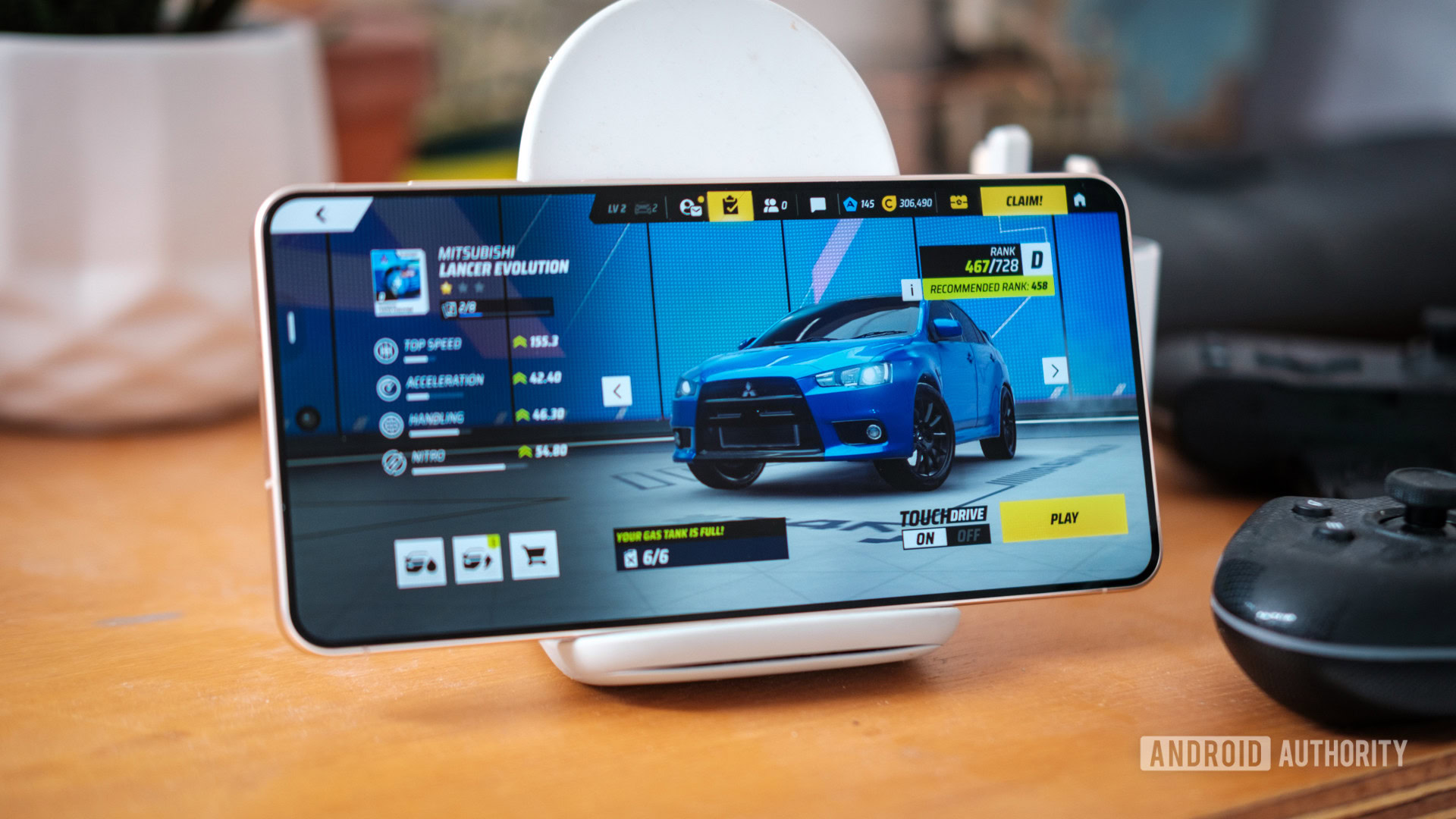
The most important question is, has Samsung solved the overheating issues? A look at benchmarks suggested Exynos might be slightly warmer, but I tested a handful of popular Android games to really find out: Asphalt Legends, Genshin Impact, and CoD Mobile. While I don’t have a Snapdragon Galaxy S26 for a direct comparison, I did grab the Snapdragon 8 Elite Gen 5-equipped Xiaomi 17 Ultra for comparison points.
And the results? They aren’t pretty.
Exynos 2600 real games test
Robert Triggs / Android Authority
Performance looks reasonably solid, but there are some notes here. First, CoD Mobile is locked to 60fps, while rival handsets have 90fps or 120fps modes unlocked, making direct performance comparisons a little difficult. I can only assume this gap exists because the game detects this as a safe default limit. Secondly, the Asphalt Legends result shows greater variation in frames because it was a longer test run that allowed the temperature to reach very high levels. Let’s get into that.
The problem is two-fold: the Exynos 2600 seems to run warmer than other flagships I’ve tested this year, before we even load it up with games. While this could be down to internal thermal designs, I believe this is a partial problem at best — 7°C or so between idle temperatures is a chip-level difference. Even before loading a game, just flicking through menus and the home screen is enough to see the Galaxy S26 Plus’ internal temperature rise above 30°C, while my Snapdragon handsets typically remain below.
Galaxy S26 Plus [Exynos 2600]Xiaomi 17 Ultra [8 Elite Gen 5]Temperatures in (°C)Start TempMax TempMean FPSStart TempMax TempMean FPSAsphalt Legends (3 minutes)33.239.3112.52932.1116.5COD Mobile: BR (3 minutes)32.036.859.934.236.1118.6Genshin Impact (3 minutes)33.336.859.932.135.159.6
The second issue is that the S26 Plus also continues to heat up faster than rival handsets, though by how much depends on the game in question. In our examples, a three-minute race in Asphalt Legends sees the Exynos 2600 add 6°C to its starting temperature, compared to 3°C for my Snapdragon handsets. That’s not a huge discrepancy, but combined with higher temperatures overall, it’s easy to see how this could quickly become an issue.
These two trends also appear in the CoD Mobile and Genshin Impact tests, though less so in the latter. Temperatures rise by 4.8°C and 3.5°C, respectively, resulting in marginally higher temperatures than the rival handset after just a few minutes of play.
It’s again worth noting the frame rate caps, which is why I’ve included the frame rate results here as well. The Exynos 2600’s AMD Xclipse GPU is capped at just 60fps in CoD Mobile, which helps keep temperatures closer to the competition, despite rival devices actually rendering at a far more demanding 120fps. As such, it’s clear that capping frame rates at 60fps can help keep these temperatures (and power drain) under control, but this doesn’t appear to be a compromise we have to make to achieve comparable or better temperature performance with the Snapdragon 8 Elite Gen 5.
In any case, faster-rising temperatures result in performance throttling. Check out our longer 13-minute gameplay session of Asphalt Legends — hardly a marathon gaming session in terms of time, but the uncapped frame rate highlights how a heavy load affects the Exynos. This is the same race played on a loop, and the major performance drops occur during race-to-menu transitions.
From 113fps to 80fps in 10 minutes; that’s quite aggressive throttling.
This graph demonstrates temperature throttling almost perfectly, with performance scaling back increasingly aggressively as the phone approaches and surpasses 40°C. Between the start and end of the playthrough, performance goes from an average of 113fps to 80fps, a 29% drop over a rather short gaming session.
That drop is certainly not what you want to experience on your morning commute. The phone was also very warm to the side of the camera housing by the end of this test — not uncomfortably so, but definitely warmer than you’d like.
How hot is too hot?
Paul Jones / Android Authority
So, does this mean the Exynos 2600 is still broken? Well, no, my Galaxy S26 Plus doesn’t become uncomfortable to hold (though it does get rather warm with temperatures approaching 45°C in the worst case), overheat, or end up unresponsive when playing games. Performance scales back when the phone’s temperature gets too high, but that’s par for the course, and it did a solid job maintaining 60fps in most of my tests.
Still, there are two things that concern me after spending some significant gaming time with the Galaxy S26 Plus. First, temperatures can get very high, leading to aggressive throttling after just a few minutes of play. The Asphalt Legends test is a prime example. A 120fps target frame rate with high graphics settings pushed the phone into throttling relatively quickly. My rival Snapdragon phone didn’t heat up anywhere near as quickly in this test.
The other concern is that some games don’t even allow you to aim for very high frame rates in the first place. CoD Mobile limits the handset to just 60fps in my testing — even the Pixel 10’s Tensor G5 can hit 90fps, if not the full 120fps. Whether this is a deliberate decision or simply a lack of proper configuration files, I don’t know. Asphalt Legends also didn’t support all the highest settings I’ve toggled on for this year’s Snapdragon flagships, suggesting this isn’t a one-off.
Exynos is hotter and slower than rival Snapdragon smartphones I’ve tested.
And that remains the most controversial revelation here. While I haven’t yet compared Galaxy S26 handsets exactly like-for-like, my experience is that Snapdragon handsets can remain cool under lighter gameplay workloads, ensuring robust performance over longer gaming sessions. Snapdragon chips throttle eventually too; temperatures can rise more quickly under emulation, stress tests, and more demanding games, while some brands push beyond sensible thermal limits. But by and large, the chip stays cool enough during the “lighter” workloads typical of Android games, though MediaTek’s Dimensity 9500 delivered even cooler temperatures in my testing.
The end result is that Galaxy S26 and S26 Plus customers are paying upwards of $799 for two different gaming experiences, depending on where they live. That’s been the case in the past, and it hasn’t changed this year either. Samsung needs to do better; perhaps its long-rumored custom GPU will finally close the gap?
Thank you for being part of our community. Read our Comment Policy before posting.
