

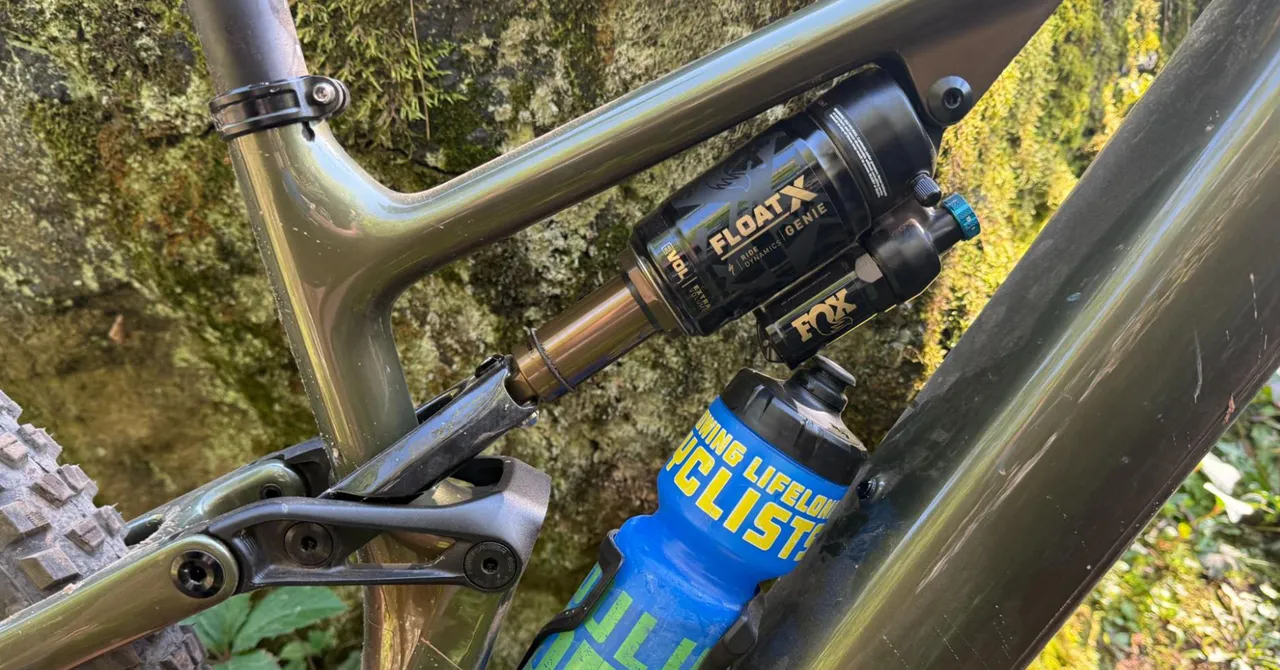
The trouble with being an aging mountain biker is that while my skills may marginally improve, the rocks don’t get any softer with every passing year. I’ve come to accept, for example, that I’m never going to clean the Teacup Trail in Sedona when riding from the west side of town over to the fun, mellow trails like Adobe Jack around Soldier Pass. But I stupidly keep trying, broken bones be damned, because what is also true: With every passing year, bike suspension keeps getting better.
Garage mechanics have been tinkering with bike suspension since around 1888. Full suspension—bikes that are equipped with a front fork and a smaller rear shock—went mainstream in the 1990s when brands like Specialized, Trek, and Santa Cruz brought the results of their tinkering out of the garage and into the daylight.
I bought my first full-suspension mountain bike, a Santa Cruz Superlight, in 2000. With 100 mm of travel (the maximum distance suspension compresses while absorbing impact) in the rear shock and 120 mm of travel in the front, it gave me the confidence to ride lines through New Mexico rocks I wouldn’t have dreamed of riding on my Specialized Stumpjumper hardtail, which had front suspension only.
Today’s full-suspension bikes have so much cush that the world’s best downhill riders can safely crush events like Red Bull’s Hardline Tasmania, a course that combines brutally technical features with massive jumps, because they have front shocks with 200 to 220 mm of travel.
I have ridden a full-suspension bike for the past three decades and have been testing bikes for WIRED since an ill-planned trip to the Mojave Desert in 2014. But there are far greater experts than me when it comes to explaining how suspension works—so I asked Vernon Felton, director of product at Canyon, former editor at Pinkbike, and the former editor in chief of Bike magazine, to lay it out for us.
What Is Suspension?
“Mountain bikes are designed to take you up and over mountains … and all the rocks and roots that stand between you and your destination,” Felton says. Of course, he adds, one can ride a mountain bike over all manner of obstacles without a suspension fork or rear shock, but “doing so, without the aid of suspension, requires a lot of very skillful body English and takes its toll on your body and energy levels.”
How Does It Work?
“Suspension almost always consists of a spring (made of either a metal coil or a sealed canister of air) that compresses when your wheels encounter rocks, roots, ruts, etc., and some kind of ‘rebound damper’ that slows down the spring when it rebounds back into its unloaded shape,” says Felton. “Without a damper unit (or ‘shock absorber’), your bike would bounce around uncontrollably like a pogo stick every time you hit a big enough bump.”
Better bike brands, he adds, work tirelessly with companies like Fox Racing and RockShox to “custom-tune those squishy bits so that they work optimally with the bike company’s frame design. The bike’s weight, style, and precise placement of its linkages all affect how the suspension works; consequently, companies employ specific ‘tunes’ to optimize oil flow inside the shock and change how the suspension feels.”
Why the need for oil? When a bike hits a rock, the suspension, either a coil spring or an air spring, is squeezed. At that point, a piston forces oil upward through small or large openings and valves, depending on the velocity of the impact. This creates resistance, also known as damping, which controls how quickly the suspension compresses. After the obstacle is cleared, the shock “rebounds” or returns to its original length. A shock’s “tune” essentially controls how quickly this process happens and, to some extent, how much impact the shock, rather than your arms, legs, back, neck, shoulders, and every other body part, will absorb.
How Does Suspension Differ between a Cross-Country, Trail, Enduro, and Downhill Mountain Bike?
“Ultimately, all suspension is designed to do the same thing—help you ride up and over rough terrain with more ease, speed, comfort, and control,” says Felton. But different styles of mountain biking, along with greatly varied terrain, require different styles and amounts of suspension.
“A cross-country racer is looking for the lightest and most efficient-feeling bike,” says Felton. “They place a premium on how quickly the bike lets them climb big mountains. As a result, cross-country suspension tends to have fewer inches of suspension travel, and the suspension might feel firm to a more casual rider.”
