

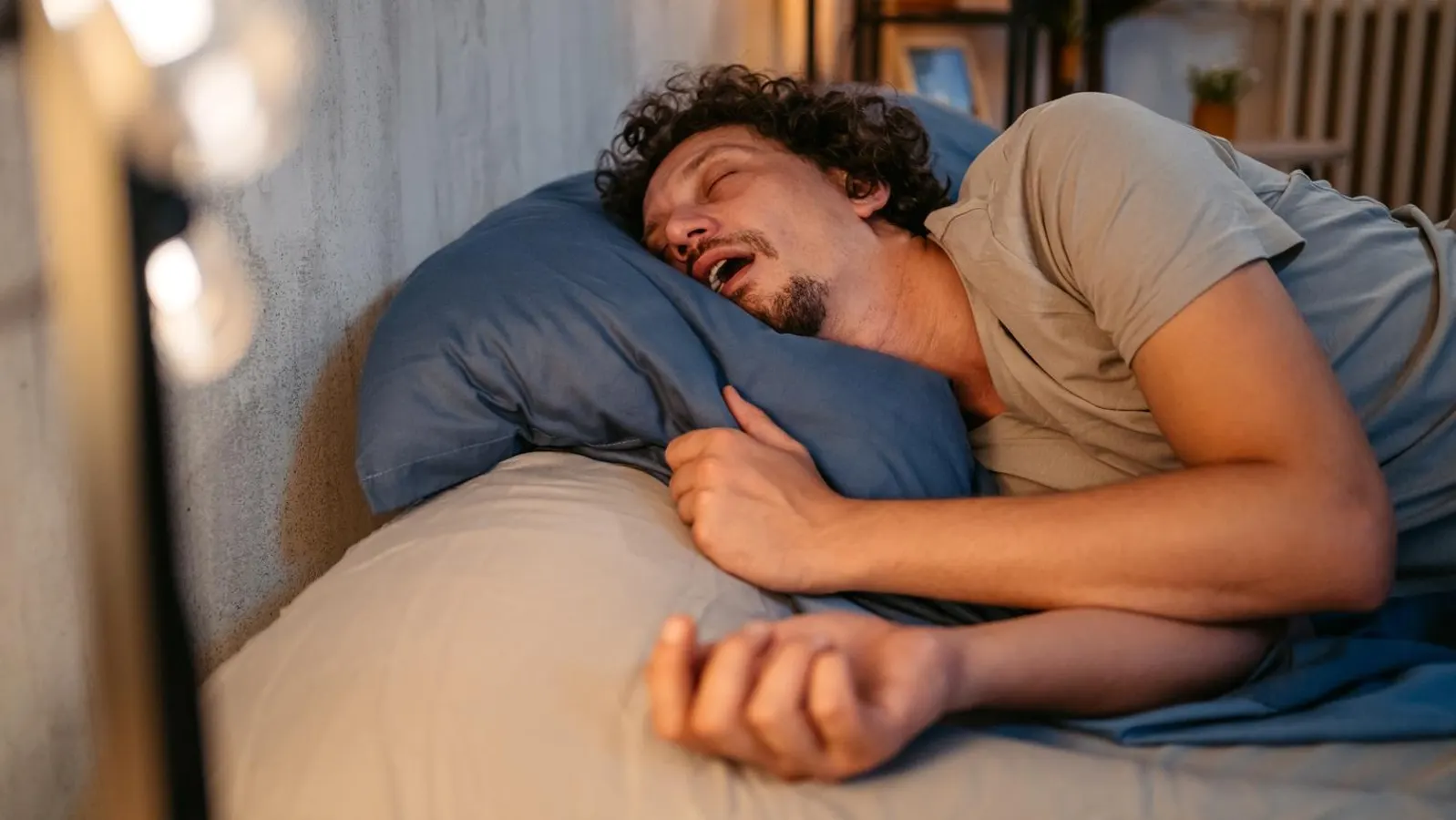
You snore because your airway was redesigned for language. That structural trade-off has been with us for 40,000 years.
getty
Snoring is one of the most common things a human body does during sleep, and one of the least understood. Most people who snore chalk it up to sleeping on their back or having had one too many drinks. But the real explanation is more interesting than either, and it reaches back to the moment our ancestors started talking.
To understand snoring, we first need to appreciate how remarkable it is that we breathe quietly at all.
What Causes A Person To Snore?
Every time you draw air into your lungs, it travels through the pharynx: a soft-walled, muscular tube at the back of your throat that doubles, improbably, as a passageway for both food and air. What keeps this tube from collapsing like a deflated straw is a network of pharyngeal dilator muscles: the genioglossus (the main muscle of the tongue), the soft palate tensors and a suite of supporting players that collectively hold the airway open with each breath.
During wakefulness, these muscles receive strong neural drive from the brainstem, keeping the airway patent and the airflow laminar. Sleep, however, changes the equation.
As you transition from wakefulness to sleep, this excitatory drive decreases substantially. In most people, the muscles relax just enough to allow normal breathing. In others, tens of millions of them, the airway narrows, airflow becomes turbulent and the soft tissues of the palate and uvula begin to oscillate. That oscillation is what we know today as snoring.
The biomechanics here are worth dwelling on. The upper airway is not a rigid tube. It’s a dynamic, neuromechanical structure whose patency depends on moment-to-moment coordination between muscle activity and mechanical forces.
Seminal research published in the Journal of Applied Physiology describes it plainly: repeated failures of the upper airway dilator muscles to counterbalance the forces acting to close the airway result in hypopneas or apneas — partial or complete obstructions. Snoring sits just below this threshold, the audible signature of an airway that is narrowed but not yet shut.
What determines whether someone crosses that threshold? The size and position of the tongue, the length and compliance of the soft palate, the dimensions of the tonsils and the geometry of the surrounding skeletal structures (i.e., the jaw, the palate, the skull base, etc.) all influence how much airway space is available when muscle tone drops during sleep.
A 2018 systematic review published in the American Journal of Otolaryngology points to progressive neuropathy of the soft palate and pharyngeal dilators as a likely mechanism behind the worsening of snoring over time: the repeated mechanical trauma of nightly vibration appears to damage the very muscles and nerves responsible for keeping the airway open.
This means that snoring, in a grim irony, may make itself worse.
The Reason We Snore Is The Reason We Can Speak
Snoring isn’t simply the consequence of lax anatomy in some subset of the population. It is, in a meaningful sense, the price our species paid for speech.
Consider what sets the human upper airway apart from that of every other primate. In most mammals, the larynx sits high in the neck, close to the skull base, allowing it to lock with the soft palate during swallowing. This arrangement makes simultaneous breathing and swallowing possible and renders the airway relatively collapse-resistant.
In humans, the larynx has descended far down into the neck. And that repositioning, researchers argue, was essential to the development of the resonating chamber that makes articulate speech possible.
With the larynx low, the tongue shifted partially into the oropharynx. The soft palate shortened. The oral cavity became more compact, the jaw receded relative to the braincase and the angle between the oral cavity and the skull base became more acute. The pharynx, once a narrow but sturdy passageway, became a wide, flexible, acoustically rich — and structurally vulnerable — tube.
This is the “Great Leap Forward” hypothesis, developed in the literature on sleep-disordered breathing and published in journals including Sleep Medicine. Researchers argue that the same anatomical reconfigurations that endowed Homo sapiens with the capacity for complex vocalization also positioned the soft tissues of the throat so that they could, during sleep, obstruct the airway.
Why, then, didn’t natural selection prune them away? It simply couldn’t see them. The serious health consequences of obstructive sleep apnea (e.g., hypertension, cardiovascular disease, stroke, etc.) manifest predominantly between the ages of 40 and 60, well past the peak reproductive years in virtually every human society throughout history and, until recently, past the average human lifespan altogether.
A trait that exacts its costs after your children have been raised is, from evolution’s accounting perspective, essentially free. The selective pressure to fix it simply wasn’t there. Speech, coordination and social bonding were all the benefits of the same anatomy that arrived early and paid handsomely. The snoring was, in evolutionary terms, someone else’s problem.
When Does A Snore Become A Cause For Concern?
Habitual snoring affects somewhere between 35 and 45% of adult men and 15 to 28% of adult women, with prevalence increasing with age across both sexes. The sex difference is consistent and robust, and almost certainly reflects differences in upper airway anatomy, fat distribution around the pharynx and hormonal influences on muscle tone — factors that converge, for women, toward greater snoring risk after menopause.
The well-established modifiable risk factors are, by now, familiar: obesity, smoking and alcohol. A large epidemiological study of over 2,000 adults identified male sex, age between 40 and 64, obesity and current cigarette smoking as independent predictors of habitual snoring.
The alcohol connection also makes physiological sense. As a central nervous system depressant, alcohol suppresses the already-fragile neuromuscular tone of the pharyngeal dilators, pushing a vulnerable airway closer to collapse. Smoking, by contrast, appears to act through airway inflammation and mucosal edema, narrowing the lumen and increasing its resistance to airflow.
But the environmental story is only part of it. Snoring also runs in families in ways that lifestyle alone cannot explain. The largest genomic study to date, using data from over 408,000 participants in the UK Biobank, identified 42 genome-wide significant loci associated with habitual snoring, including genes expressed in the brain, cerebellum, lungs and esophagus.
Mendelian randomization analyses from the same study found evidence for a causal, not merely correlated, relationship between higher BMI and snoring, which implies that weight loss is a mechanistically sound intervention.
So, when should snoring graduate from a social nuisance to a medical concern? The key signals are:
- Excessive daytime sleepiness
- Witnessed pauses in breathing during sleep
- Waking with headaches or a dry throat
- Difficulty concentrating
- Elevated blood pressure
These point toward obstructive sleep apnea: a condition in which the airway closes fully and repeatedly during sleep, causing intermittent hypoxia and sleep fragmentation. Snoring, at this severity, is a physiological stressor with measurable downstream consequences.
The human airway, in the end, is a study in evolutionary compromise. We gave up a little structural integrity for the ability to communicate clearly and efficiently. Most nights, the machinery holds. Sometimes, it doesn’t, and the sound it makes in failing is a reminder that the most remarkable things about us often come with the strangest hidden costs.
Did you already know the reasons why humans snore? Take my short and science-inspired Evolution IQ Test to know the many interesting ways in which animals evolved to overcome environmental pressures.
