

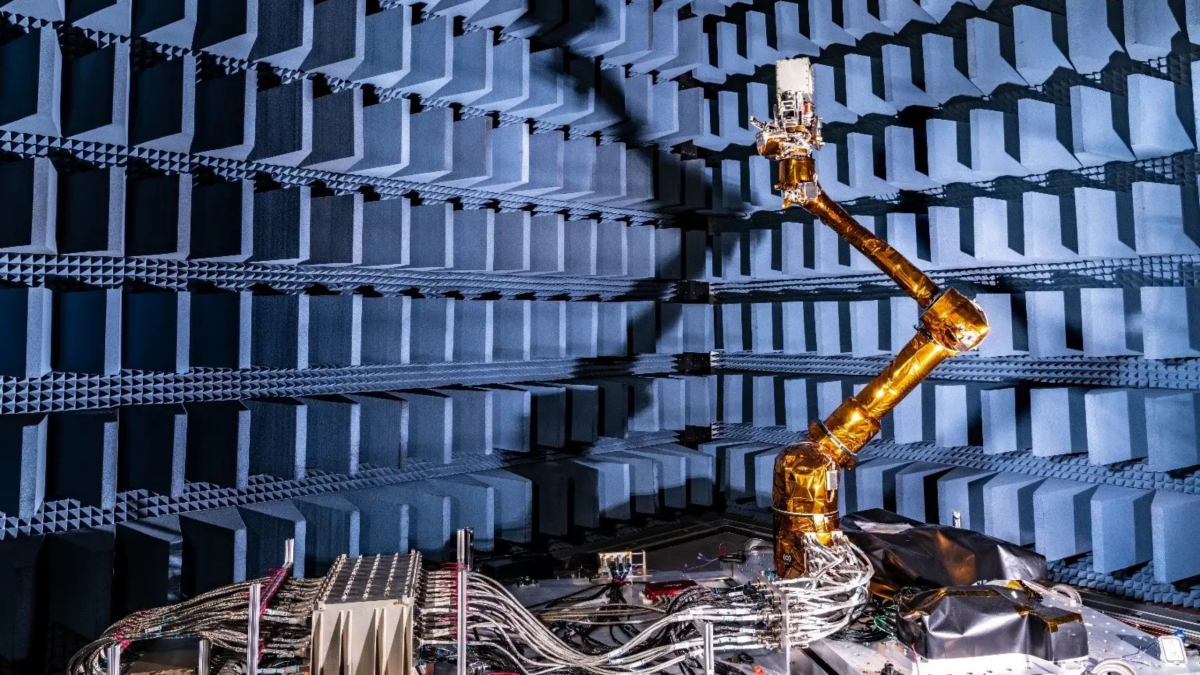
Brand new robotic arm technology could finally allow simple repairs and upgrades in space.
Credit: DARPA/US Naval Research Laboratory
All the way back in 2013, we wrote about the Defense Advanced Research Projects Agency’s (DARPA’s) Phoenix program, aimed at launching a spacebound service robot capable of scavenging or even resurrecting dead satellites floating in the graveyard orbit.
While that program hasn’t directly led to a satellite that can shear off and reattach solar panels, it has motivated real research and development. DARPA has announced that a sort of spiritual successor, the Robotic Servicing of Geosynchronous Satellite (RSGS) project, will get its first test launch in the summer of 2026. Rather than reusing components from old satellites, this new space robot will perform upgrades and fix simple malfunctions on satellites in the geosynchronous orbit range.
The project targets geosynchronous satellites because they are generally more expensive and have a much longer projected lifetime than low Earth orbit (LEO) satellites. Elon Musk’s approach to satellite lifetimes is to treat them as disposable, so companies like Starlink simply deorbit any problematic unit into the upper atmosphere.
The arms and integrated spacecraft of the RSGS, folded up for delivery.
Credit: Northrop Grumman
Losing a geosynchronous satellite, however, is a much harder loss to simply write off, and doubly frustrating if the only problem is a single mechanical or electrical malfunction. On Earth, such a problem would be trivial to fix quickly and affordably; in space, it’s currently impossible.
In 2020, DARPA awarded part of the RSGS contract to Northrop Grumman via a subsidiary, SpaceLogistics. It has also worked with NASA and the Naval Research Laboratory on other aspects of the design.
The main payload is a set of DARPA-developed robotic arms specifically designed for this mission. This is actually called a “highly dexterous robotic servicing suite,” capable of doing “on-orbit upgrades, inspections, anomaly resolution, and satellite relocation.”
That sort of functionality will be needed if things like modular satellites are ever to become a reality in space. The idea of space-based AI data centers is hard to believe at the best of times, but if it’s going to have any chance of working, it will need to allow swapping older GPUs for newer ones.
Missions like this one can function as a proof of concept for such more specialized applications.
Potential uses for the RSGS program, once successfully deployed.
Credit: DARPA
As mentioned, this program has been delayed several times due to recurring scheduling issues, pandemic-driven material shortages, and even tariffs. Northrop Grumman came in midway through development, taking on the task of integrating individual technologies into a working RSGS.
Because this is DARPA, we have to note that this is exactly the sort of technology that could be repurposed to physically compromise satellites. Under the surface, it might be aimed at surreptitiously installing surveillance tech or committing subtle acts of sabotage. Either way, there are currently very few means of detecting tampering with existing satellites.
Let’s also remember just how much of a pain it was for astronauts to service Hubble during its various troubles, struggling with the clumsy fingers of their space-suit gloves. If this technology can be proven and developed to maturity, it could help avoid financial losses and facilitate the continued use of irreplaceable scientific equipment.
