

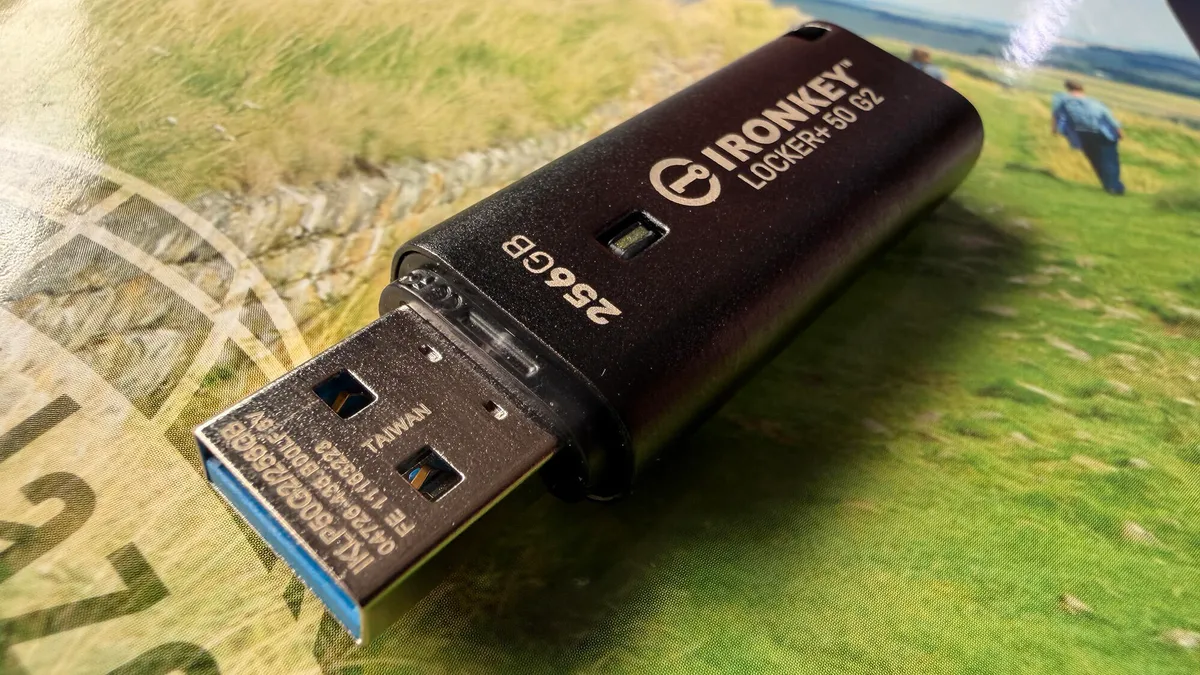
Kingston IronKey Locker+50 G2
pros and cons
Pros
- Military-grade encryption
- Built-in brute-force protection
- Starts at only $50.
Cons
- USB-A connector, so it needs a dock or converter for modern systems
- Cap is easily lost
- No lanyard.
Follow ZDNET: Add us as a preferred source on Google.
Carrying data around on unencrypted drives is just asking for trouble. Lose the drive, and not only are you down the device, but also all its data is open to anyone who finds it. If you run a business, this loss can be a fast track to fines and regulatory headaches. I recommend that anyone who needs a flash storage device should use hardware-encrypted flash drives.
With this approach, if you lose the drive, you’re only down the drive.
Also: A common charging habit was quietly killing my iPhone’s battery – here’s the fix
For the past few weeks, I’ve been testing the Kingston IronKey Locker+50 G2 flash drive, and while it’s not perfect, it’s a great solution for most people.
Hardware vs. software encryption
OK, so the IronKey Locker+50 G2 is a hardware-encrypted USB flash drive. This device is different from drives that use software encryption because, rather than using software to protect the data, which comes with the risk that data is left unencrypted on the drive or that remnants of cached files could be accessed, hardware encryption uses a special chip inside the drive that makes sure that the entire user-writable part of the device is always protected.
Also: I stress-tested this SSD enclosure with a bulldozer – here’s how it held up
Without the password, no one can access anything. And as soon as the drive is unmounted, everything is securely encrypted.
Hardware encryption is completely independent of the host system, making the drive less vulnerable to malware or hacking attempts. That’s why I generally vouch for hardware-level security in addition to software encryption.
Military-grade security
The encryption used here is 256-bit AES-XTS, a military-grade level of protection that encrypts data and adds tamper resistance. You plug the drive in (Windows and Mac supported), run the IronKey application, enter the passcode, and then the main storage partition is decrypted. Unmount or unplug the drive, and the data is instantly secured.
Also: 1 in 2 security leaders say they’re not ready for AI attacks – 4 actions to take now
Notably, the drive features brute-force protection. Say someone has shoulder-surfed part of your passcode and decided to guess the rest. They’ll get 10 guesses before the drive wipes the encryption keys stored on the drive. Their failure would make the data completely inaccessible.
I tried it with my IronKey, and all the test data stored on the drive was formatted the moment I entered the 10th password attempt. That data was gone. Forever.
Screenshot by Adrian Kingsley-Hughes/ZDNET
There are also some other useful security features. There’s a virtual on-screen keyboard to bypass key loggers. The virtual keyboard allows randomizing the keyboard layout (a technique that’s great for touchscreens, where marks might be left on the screen, so someone might use a thermal camera to see which keys were pressed).
The randomizer feature in action.
Screenshot by Adrian Kingsley-Hughes/ZDNET
There’s also a screenlogger protection feature that blanks the keyboard when keys are pressed. However, even with this feature enabled, I could still tell which keys were pressed. Maybe this screenlogger feature needs improvement.
Also: How to easily encrypt your files on an Android phone – for free
Also, hardware-encrypted drives are built to be physically tamper-proof. This step is achieved by filling the drive with epoxy resin, making it virtually impossible to access the chips without damaging them.
A few gotchas
A few things to be aware of. First, this is a USB-A flash drive. For modern laptops, you’ll either need a converter or a dock. No biggie, but if you’re using this drive on a modern system, not having a way to convert the USB-A to USB-C might stop you in your tracks.
I always have a dock on my laptop bag for such occasions.
Adrian Kingsley-Hughes/ZDNET
That cap that covers the USB-A connector is something I’ll have lost by the end of the month. I wish there were something to keep the cap attached to the drive.
The drive has a lanyard hole, but no lanyard, which is a bit of a cost-saving fail in my opinion.
Also: I bought a $40 earwax camera and keep finding reasons to use it
These minor gripes aside, I think that the IronKey Locker+50 G2 is a great flash drive for the modern world.
ZDNET’s buying advice
Kingston offers the IronKey Locker+50 G2 in four capacities: 32GB, 64GB, 128GB, and 256GB. Prices range from $50 to $240. I like it when companies offer drives across a range of storage capacities because it means buyers are only paying for the storage they need.
If you want to carry data on a flash drive, you need an encrypted drive to keep your personal information safe. For the price, the IronKey Locker+50 G2 offers a lot, and is one I can confidently recommend to most people.
