

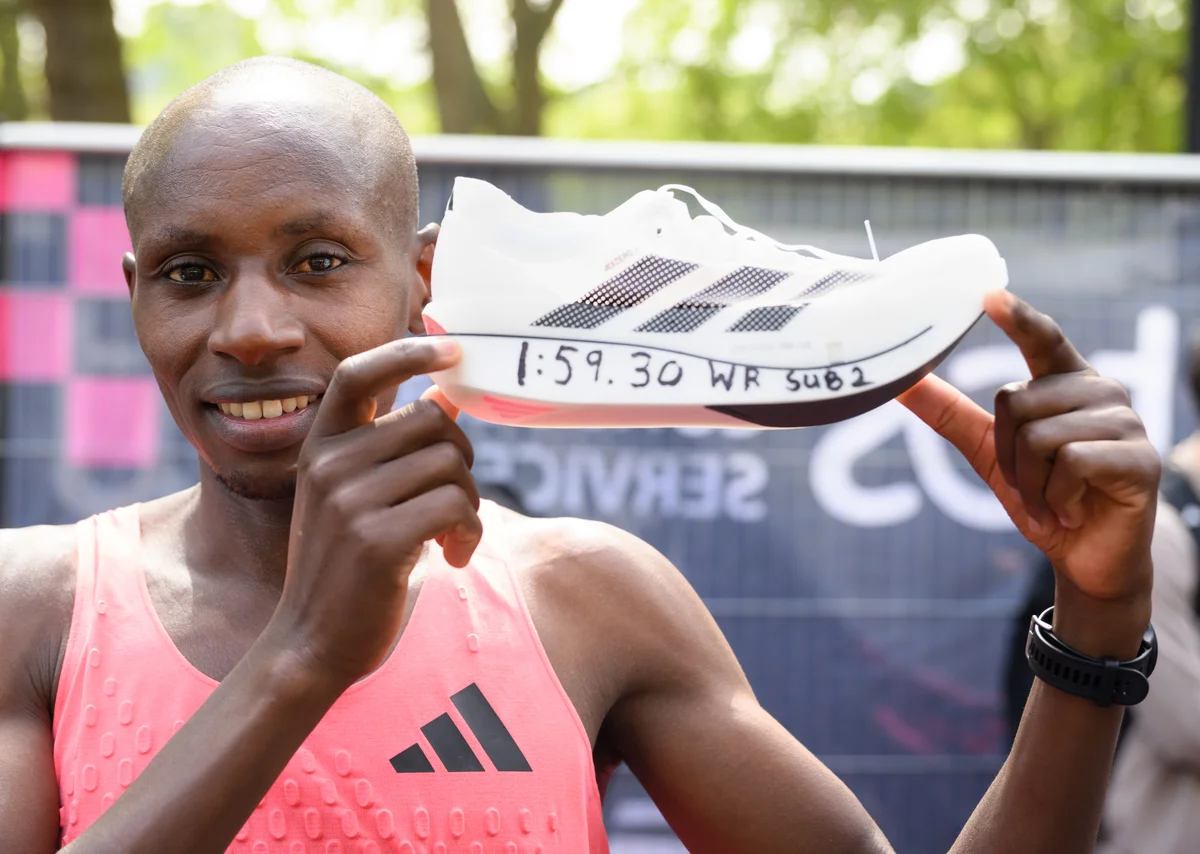
On Sunday three runners at the London Marathon set the sporting world on fire—not least because of their shared choice of footwear. Kenya’s Sabastian Sawe won the men’s race with a record-setting time of one hour, 59 minutes and 30 seconds (1:59:30) while Ethiopia’s Yomif Kejelcha came in second, finishing in 1:59:41, and fellow Ethiopian Tigist Assefa broke the women’s record with a time of 2:15:41. All three were wearing a pair of new Adidas shoes specifically designed for marathoning, the Adizero Adios Pro Evo 3.
The shoes’ apparent success is the latest shot fired in a long-simmering war among athletic wear companies to design footwear to help people move faster on long-distance runs. While “it’s gotta be the shoes” was once used as a tongue-in-cheek tagline for Air Jordans, there’s quite a bit of truth to that sentiment when it comes to marathoning, says Brad Wilkins, director of the University of Oregon’s Performance Research Laboratory.
“People are just getting faster and faster and faster, partially due to equipment, partially due to belief in the fact that we can run this fast and partially due to training and adaptations because of that belief,” he says.
On supporting science journalism
If you’re enjoying this article, consider supporting our award-winning journalism by subscribing. By purchasing a subscription you are helping to ensure the future of impactful stories about the discoveries and ideas shaping our world today.
The Adizero Adios Pro Evo 3 is somewhat odd looking when compared to a regular running shoe. The sole is packed with padding that surrounds a curved carbon plate, all of which gives the shoe the appearance of the bottom of a rocking chair. The design is all about economy, Wilkins explains. The padding is made of ultralightweight foam, which keeps the shoe’s mass as low as possible while still providing cushioning for the foot. The carbon plate, meanwhile, is designed to put the runner “kind of in a forward tilt,” he says. If you were just walking in the shoes, you would find it more difficult to get around than you would in an average pear of sneakers. But a long-distance runner’s stride is fundamentally different from the gait of someone going for a stroll.
“It puts you more on your forefoot,” Wilkins says, referring to the bend in such running shoes. “Some of the models of these shoes don’t even have outsoles in the heel. They’re basically expecting that you’re going to be running on your forefoot the whole time.”
The reason for that assumption is that conserving energy is one of the keys to success in marathoning. A running gait that primarily uses the front of the foot is more efficient than one that has the heel making contact with the ground. That’s because pressing down on the ground with the heel can generate backward momentum, requiring the runner to use more energy to propel themselves forward.
The materials and design of these shoes combine to “increase the springlike capability of the leg by adding, essentially, a spring on your foot,” says Daniel Lieberman, a professor of biological sciences at Harvard University and an amateur marathoner. “When a runner hits the ground with these shoes, the shoe is storing up elastic energy, and then it’s recoiling, pushing the runner back up into the air.”
He estimates that the latest generation of marathon shoes could help runners expend 4 to 6 percent less energy per stride.
“There’s no question, study after study shows these shoes are responsible for people running faster because they have more energy, and more energy means more gas on the tank,” he says.
In a statement, Adidas’ general manager of running Patrick Nava said that the Adizero Adios Pro Evo 3 shoes are the result of “more than a dozen iterations, working closely with our athletes and testing everywhere from our labs in Herzogenaurach [in Germany] to high-altitude camps in Kenya and Ethiopia.”
“At that level, every detail really matters—we were measuring things down to the nearest nanogram,” Nava said. “It was a long process, but it’s led to something we believe genuinely changes what a race-day shoe can feel like.”
Marathon times have grown steadily shorter since the distance of 42.195 kilometers (26.2 miles) was formalized in 1921. That’s not to say that footwear technology is the sole reason for the improved performance. Initially, winning times tended to be just under three hours. By the 1950s, they were down to around two hours and 20 minutes—and athletes have been shaving minutes and seconds off ever since. Lieberman says that because training and nutrition sciences have also improved over time, it’s impossible to determine how much credit to give new shoes for the improvement.
“When you have somebody running 26.2 miles, and you try to figure out scientifically what it is that’s causing one person to run faster than another; nobody can figure that out,” he says.
He points to the late neurologist Roger Bannister, who, as a medical student, ran the first sub-four-minute mile in 1954, as a comparison point.
“Now you’ve got these fancy, big shoes and these companies, and it’s a different world,” he says. “To me, it’s not quite the same thing, and there’s no question: the shoes have had a major effect on the ability to do it. This is technology-assisted, which is not to say that these athletes aren’t exceptional. But to me, it’s not quite exactly the same thing.”
As impressive as breaking the two-hour mark is, Wilkins says he doesn’t think humans have come close to their maximum long-distance speed. Seconds and minutes will continue to be stripped away as technology and training improves, he says.
“The bar has 100 percent been changed,” he says. “I think it’ll be very soon where, if you’re not running sub-two hours, you’re no longer in the elite kind of category.”
