

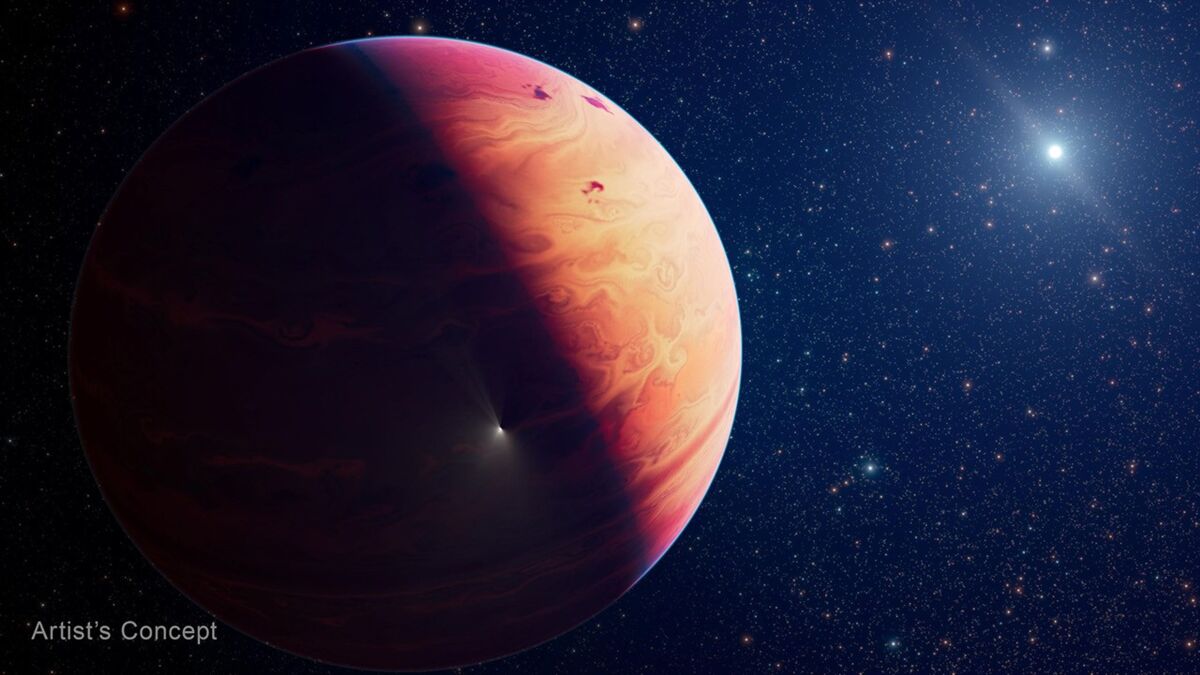
This planet is so large that astronomers found it hard to believe it could form like a regular planet.
Credit: NASA, ESA, CSA, Joseph Olmsted (STScI)
A new study published in Astrophysical Journal Letters digs into data collected by the James Webb Space Telescope, perhaps offering a new perspective on the formation of both planets and stars.
The issue comes down to an exoplanet called 29 Cygni b, which sits about 133 light-years from Earth. It’s the first exoplanet discovered around the star 29 Cygni, in the constellation Cygnus. 29 Cygni b comes in at a whopping 15 times the mass of Jupiter and orbits roughly as far out as Neptune, which is troublesome to existing models of planetary formation.
Planets are generally thought to form “bottom-up,” meaning that they grow from small nuggets of matter by colliding with (and eventually sucking up) more and more stuff. Depending on what stuff and how much, the planet will come out rocky, icy, or gaseous.
Stars, on the other hand, are thought to form when vast clouds of gas fragment to form smaller clouds, which can then condense down towards the center. In theory, heavier elements and larger fragments of matter could segment off a proto-planetary disc and condense down into a planet in much the same way.
29 Cygni b is a planet so heavy that it seems to have been made by bottom-up accretion of matter within a protoplanetary disc, but at a distance where that sort of accretion should be rare due to the low density of matter. That makes the star-like condensation theory a tempting alternative explanation for its existence.
Webb’s images show evidence for heavy chemical elements like carbon and oxygen, adjusting assumptions about how it could have been formed.
Credit: NASA, ESA, CSA
That ambiguity made the planet interesting to these NASA researchers, who saw it as potentially born from either process.
“In computer models, it’s very easy for fragmentation in a disk to run away to much higher masses than 29 Cygni b,” lead author William Balmer said in a NASA statement. “This is the lowest mass you could plausibly get. But at the same time, it’s about the highest mass you could get from accretion.”
The evidence they reviewed seems to favor the idea that it accreted like a regular planet, making it quite an outlier. They believe this because spectral analysis shows a higher concentration of metals in the atmosphere than in the host star, which implies it did not arise from condensation of a different bud from the same gaseous cloud.
There’s also the fact that the planet’s orbit aligns with the spin of the host star, 29 Cygni. This would be expected of a planet formed by accretion, but would have only a 50:50 chance of happening from the cloud-collapse model.
So, very likely, it formed like a regular planet, not a star. It just so happens to push to the very edges of possibility for that model, in terms of both its size and its distance from its star.
The team has three more large and distant planets they want to evaluate in the same way. Between them, these observations should help to imply just how likely the cloud-collapse model of planetary formation really is.
