

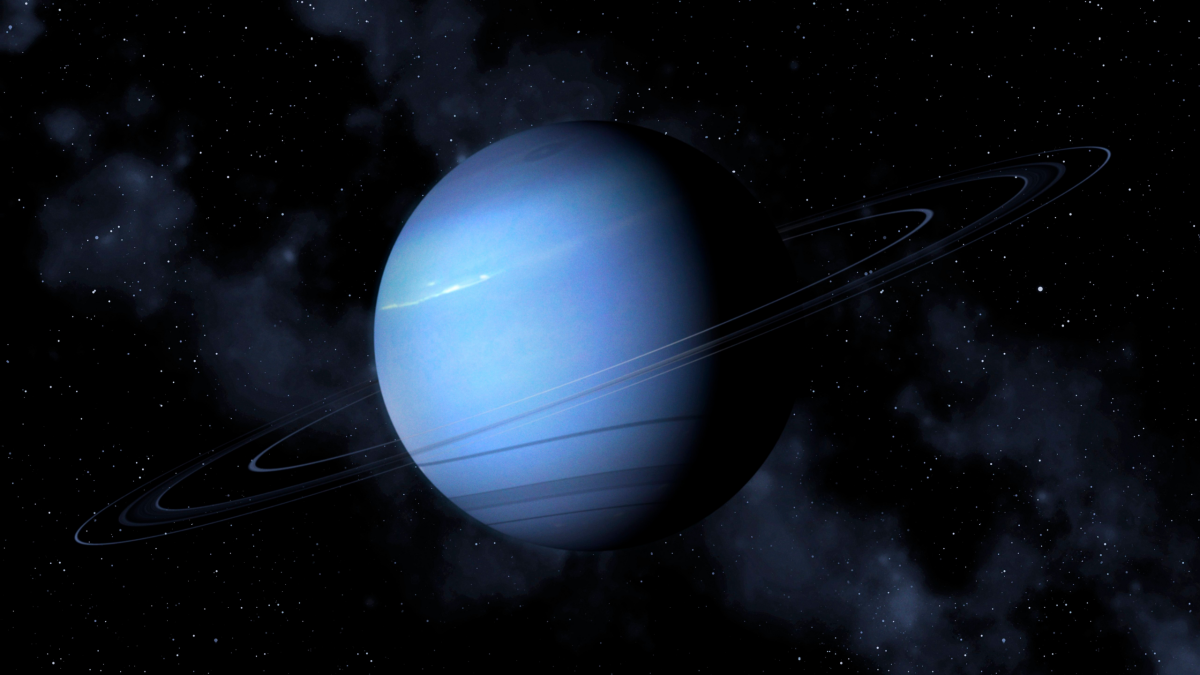
A simulation study published in Nature Communications has demonstrated that boring old elements like hydrogen and carbon should form odd, helical structures under the intense pressures and temperatures at the centers of ice giants like Neptune and Uranus.
Beyond showing a brand new structure of matter only found under the most extreme conditions, the simulation also found that these structures should behave in unusual ways—so unusual, in fact, that they could help to explain some of the most mysterious aspects of planetary science.
It’s been more than 40 years since Voyager made a successful flyby of Uranus, producing the first detailed readings of that planet’s magnetic field. Its findings created an orthodoxy about the planet’s interior structure that would last for decades.
In this figure, carbon is highlighted in yellow, and hydrogen in blue.
Credit: Cong Liu
Now, though, newer readings are muddying the field by directly questioning some of the uncontroversial facts about ice giants that have populated astronomy textbooks for generations.
The core of an ice giant can have pressures reaching thousands of gigapascals and, “ice” aside, temperatures reaching thousands of degrees. This study posits that these conditions should force simple elements into all-new forms.
In particular, they predict a duo of interlaced helices, one of hydrogen atoms and the other of carbon atoms. It’s not quite as neat as the double helix of DNA, but it’s close.
They call it a quasi-1D superionic state. The quasi-1D part means that these structures behave almost like a 1D object in the graphene category, but not quite. The superionic part means that while one substance (carbon, in this case) is locked into a solid state, another in the mix (hydrogen) can still flow like a fluid.
When taken together, these two properties seem to lead to some very odd behaviors. In particular, this structure should form different kinds of lattices under varying levels of heat and pressure, each with distinct aggregate properties. The most interesting of these is “anisotropic” energy conduction, in which electrons flow more efficiently in one direction than in another.
Illustration of Uranus’s magnetic field.
Credit: NASA
Flow within the core of a planet is one of the factors that give rise to its magnetic field; often, that’s the physical movement of molten substances, but it can also refer to the flow of energy within more static materials, such as superionic materials. This can refer to electrons, or to heat itself.
If this study’s suppositions are accurate, such natural directionality to the flow of energy within the planet would help to explain the odd dynamics observed in the magnetic fields of ice giants. This gives rise to the incredible auroras observed around Uranus, among other things.
This is only a simulation, however, based on machine learning and quantum simulations of atomic interactions. It will need to be verified through more direct observation, and given NASA’s current priorities, it could be quite some time before we send another probe to orbit any planet other than Earth or Mars.
