

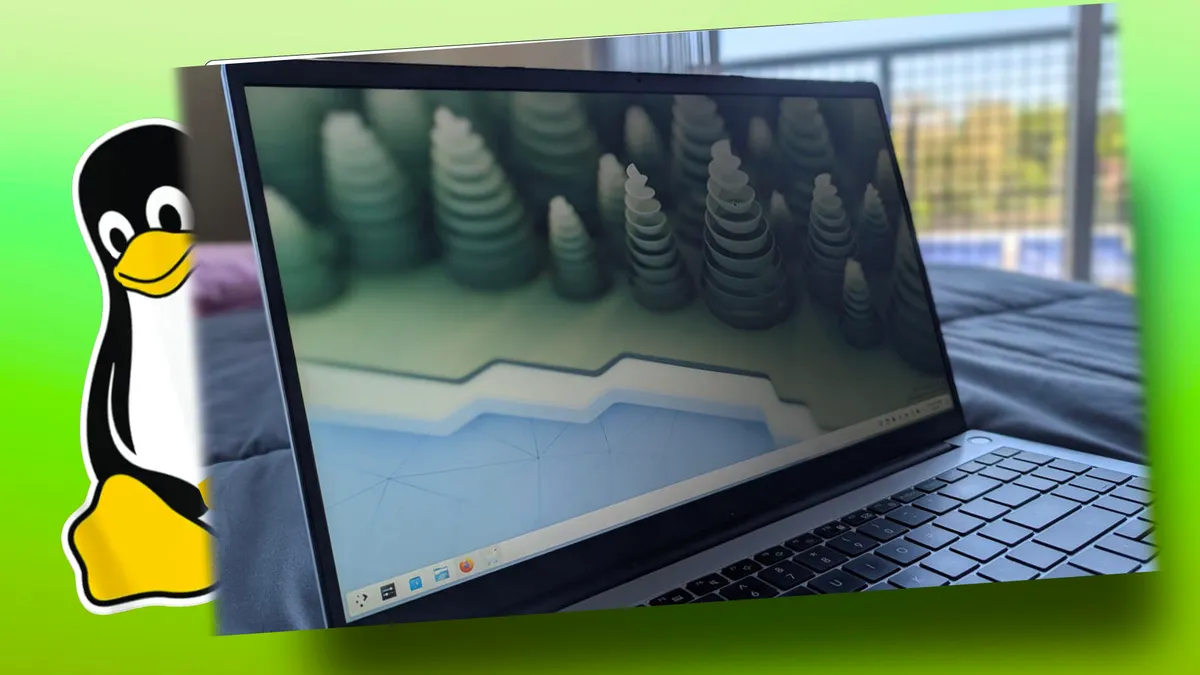
Jack Wallen and Elyse Betters Picaro/ZDNET
Follow ZDNET: Add us as a preferred source on Google.
ZDNET’s key takeaways
- KDE Linux is a distribution that highlights KDE Plasma.
- This distribution gives you Plasma exactly how it should be.
- KDE Linux is still in alpha stage, so it’s not yet suitable for daily use.
Over the past few years, I’ve become a big fan of KDE Plasma. Not only has it become one of the most stable Linux desktop environments, but it’s also incredibly user-friendly, fast, and beautiful.
But did you know that most Linux distributions ship with KDE Plasma, a desktop version usually customized to match the aesthetic and functionality of that particular OS? For example, when you use KDE Plasma on Kubuntu, it looks and feels different from what the KDE Plasma developers created.
Also: Garuda KDE Dr460nized might be the coolest-looking Linux distro available
Sometimes those differences are hard to catch; they could be subtle tweaks of the theme, or how the desktop behaves, such as what you’ll find in KDE Neon. On the other hand, some distributions (such as Garuda Dr460nized) present KDE Plasma in a dramatically different fashion.
If you want the purest form of the latest version of KDE Plasma, there’s really only one place to look: KDE Linux.
That’s right, there’s a distribution that aims to offer the best KDE implementation. KDE Linux was created and is maintained by the KDE team. According to the KDE Linux website, this distribution is “Designed to be safe, maintainable, functional, and modern, KDE Linux will be the best choice for home use, enterprise workstations, public institutions, pre-installation on computers you can buy, and more.”
Before you get too excited, it’s important to know that KDE Linux is not quite “there yet.” This immutable Linux distribution is still considered in its alpha stage, so it is most certainly not ready for general usage. Although it might seem surprisingly stable, it’s got a ways to go.
Also: KDE Neon gives you the latest and greatest KDE Plasma desktop
With that said, KDE Linux is really sweet. It’s as polished as I’ve ever seen KDE Plasma, its animations are buttery smooth, and it’s just overall pleasant to use. There are no gimmicks, no extra bells & whistles; it’s just pure KDE Plasma goodness.
However… (Yup, these days there always seems to be an “however”) Just getting to the installation is kind of a pain in the keister. Let me explain.
Installing KDE Linux
The actual installation of KDE Linux is very simple and straightforward. Once you get to this stage, it’s just a point-and-click affair that will land you (after a reboot) on the login page, where you can start to take in what this distribution is all about.
It’s getting to the installation part of the process that can be hair-pulling.
You see, the developers only (currently) make KDE Linux available as a .raw image. In order to install from a .raw image, you have to use a special tool to create a live USB drive with that image. Without that tool, it’s a seriously uphill climb.
The tool the KDE developers suggest is called ISO Image Writer and can be installed via Flatpak. Fortunately, ISO Image Writer is very easy to use. Download the KDE Linux .raw image (which is nearly 7 GB in size), open ISO Image writer, click “Path to ISO image,” locate the downloaded .raw image, plug in your USB drive, select the correct drive in ISO Image Writer, and then click Create.
This small tool simplifies burning .raw images.
Jack Wallen/ZDNET
Give the app time to create the live USB drive. Once it completes, safely remove it, insert it into the machine that will run KDE Linux, boot up, and either test it via the live instance or install it.
Also: These two Linux desktops are the simplest picks for new users
It’s a time-consuming process, but the end results are worth it. And don’t worry, once KDE Linux is out of the alpha stage, there will most likely be ISO images available.
My experience with KDE Linux
In a word: Impressed. I’ve been of the opinion, for years now, that KDE Plasma is one of the fastest, smoothest, and most beautiful Linux desktops on the market. Because of that, it didn’t surprise me one bit that KDE Linux was ever bit the equal to my take on the desktop.
What really surprised me was how stable KDE Linux is. Remember, this is in the alpha stages of development, so it has no right to be this stable. I’m currently writing this piece on KDE Linux (via Firefox > Google Docs), and I’ve not experienced a single issue. Updates went smoothly, apps open quickly, and not one thing has crashed.
Now, out of the box, KDE Linux doesn’t include a lot of apps. In fact, it’s pretty bare bones. You get Firefox, the Haruna multimedia player, and the usual KDE tools. That’s it. There’s no office suite, no image editor… nothing. That’s okay, because there’s KDE Discover, with Flatpak support built in, so you can install any of the apps you need.
Also: Cool things you can do with the Linux desktop that you can’t do with MacOS or Windows
I put KDE Discover through the paces (installing my usual collection of apps) and had zero issues.
I also planned on running through my usual performance test of installing Ollama (local AI) to see how well it performed. Of course, since this distribution is immutable, I wasn’t able to install ollama. I then installed Alpaca (a GUI for Ollama) to see if that would work. After a reboot, I was able to access Ollama and give it thorough testing.
I was not at all surprised when Ollama answered my first query (“What is Linux?”) very quickly. The next query was “Write a Python GUI program that accepts user input for name, age, email address, and favorite Linux distribution.”
If I’m using AI, it’s always Ollama.
Jack Wallen/ZDNET
Again, Ollama delivered. Now, I was using the llama3.2 model, which isn’t exactly the best option for writing code, but it still performed very well. Ergo, performance is on par with any Linux distribution I’ve tested.
One small issue
During my testing, I did experience constant crashing in Firefox. The same thing happened after installing Opera and Alpaca. It wasn’t until I rebooted the laptop running KDE Linux that the newly installed apps would open.
I decided to test that theory and install Slack and Spotify to see if they would run immediately after installation. This time around, the apps opened just fine. My guess is that this was the product of an OS update that required a restart. In the end, everything worked perfectly.
KDE Discover is an excellent app store.
Jack Wallen/ZDNET
And that, my friends, was the only issue I ran into with KDE Linux.
Also: I tried Peppermint Linux: How this bare-bones distro lets you build your ideal OS
I hope the developers are able to bring KDE Linux to general release status; if they do, you can bet that I’ll be highly recommending this distribution to anyone who wants to use Linux with the KDE Plasma desktop.
