

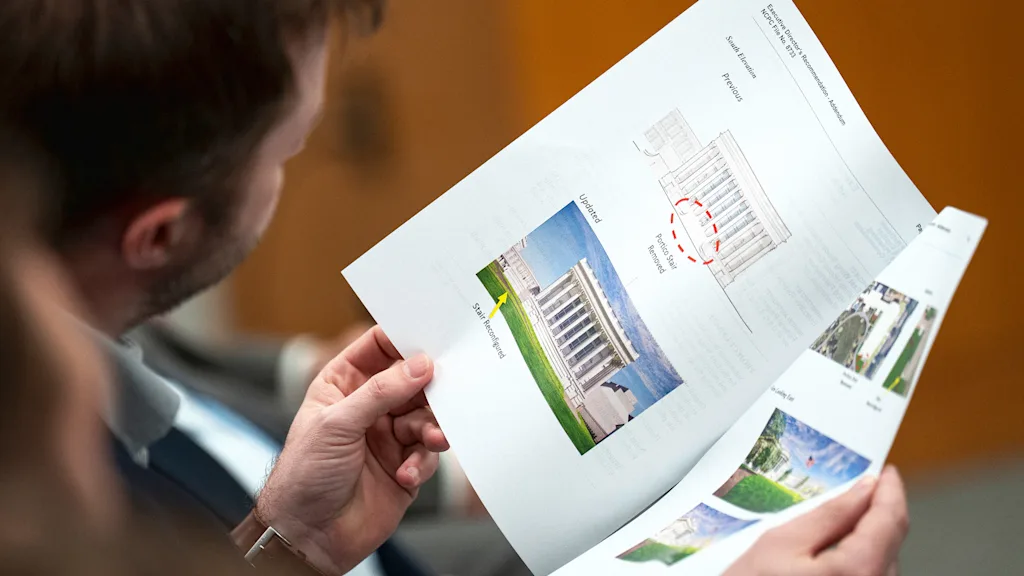
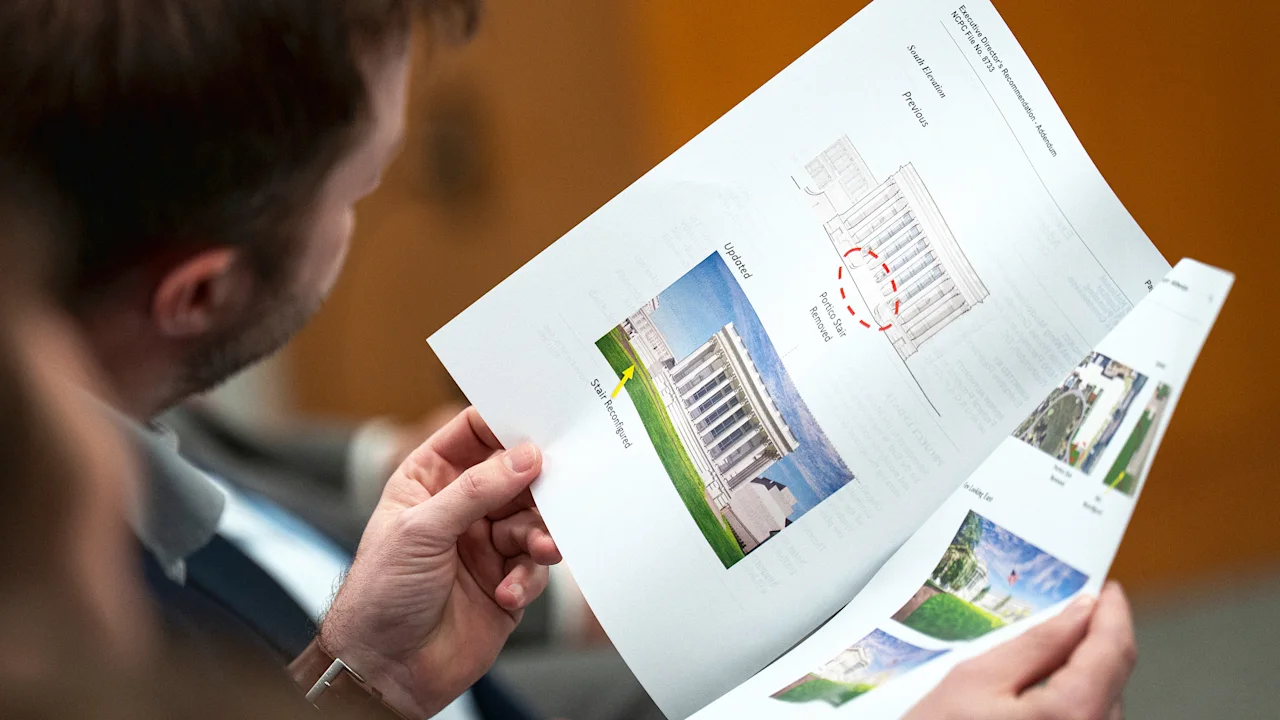
At the April 2 meeting of the National Capital Planning Commission (NCPC), a largely Trump-aligned panel voted by a large majority to support the design of the White House ballroom. Eight of the 11 commissioners at the meeting voted “yes,” while two commissioners voted “present” and only one (Washington, D.C., Council chair Phil Mendelson) voted no.
The vote is a crucial approval for the ballroom, known officially as the East Wing Modernization Project. The NCPC is a federal agency overseeing planning and design for federal land and buildings in the Washington, D.C., area. Its approval adds legitimacy to a construction project that many, including the recent court ruling, see as an overreach of power by the president.
All plans and development proposals for federal property are required by law to be submitted to the NCPC for review. Typically, this happens at a much earlier stage in a project’s process. The Trump administration did not submit plans for the East Wing’s demolition to the NCPC or any other government body, which many have argued makes it—and by extension, the ballroom—illegal. The NCPC approval of the ballroom could be used by proponents as proof of the project’s legitimacy.
As soon as the ballroom came up in the agenda, NCPC Chair William Scharf, a Trump appointee, dismissed the court order as beyond the commission’s purview. “That order really does not impact our action here today. The NCPC is not a party to that lawsuit. The injunction doesn’t speak to the NCPC review process,” he said. “From my perspective, we have a project before us, we’ve been asked to review it, and that’s really our job here today.”
From left: National Capital Planning Commission (NCPC) Commissioner Michael Blair; White House Staff Secretary and NCPC Chairman Will Scharf; and NCPC Vice Chairman Stuart Levenbach attend a meeting to vote on the proposal for a new $400 million ballroom at the White House, on April 2, 2026, in Washington, D.C. A federal judge issued a preliminary injunction and temporarily blocked President Donald Trump from moving ahead with any further construction on a new ballroom on the former site of the White House East Wing. [Photo: Al Drago/Getty Images]
Scharf then walked through an architectural history of the White House, noting the many changes to the complex since it was first envisioned in 1792. He noted that criticism came with many updates to the building—from the addition of porticoes in the early 1800s to the construction of the West Wing in the early 1900s and the Nixon-era construction of a press room. Over time, he argued, these elements have become iconic parts of the White House.
“I believe that in time, this ballroom will be considered every bit as much of a national treasure as the other key components of the White House,” he said. “And I believe that in time, successive presidents of both parties and all political stripes long into the future will be grateful to President Trump for having initiated and brought this project into being.”
