

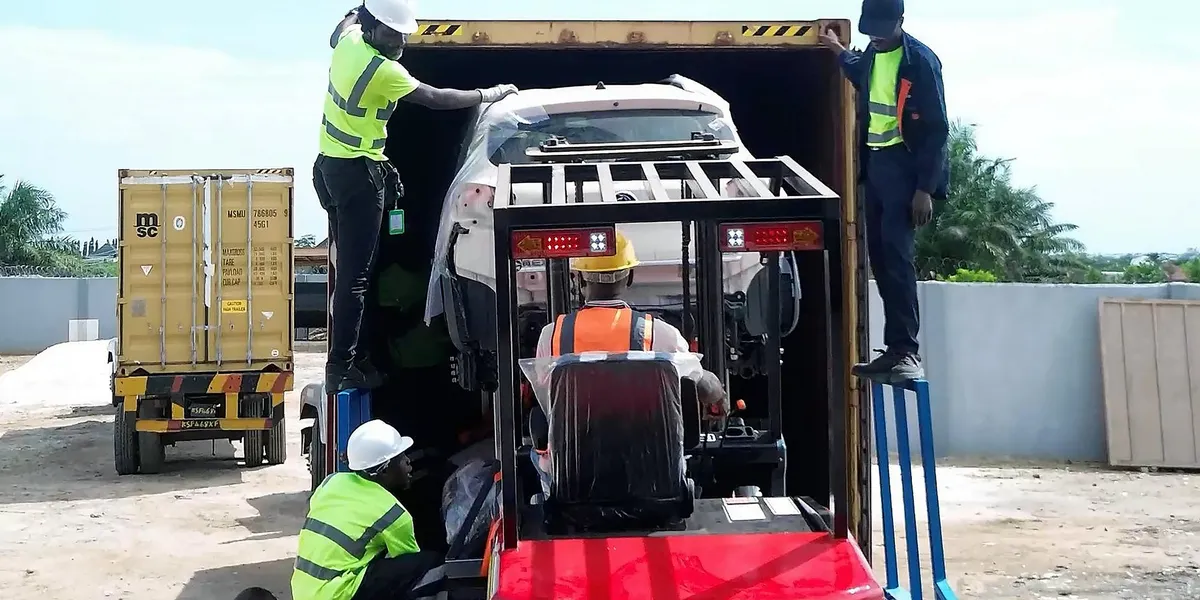

A growing number of Nigerian companies are turning to kit-based assembly to bring electric vehicles to market in Africa. Lagos-based Saglev Micromobility Nigeria recently partnered with Dongfeng Motor Corporation, in Wuhan, China, to assemble 18-seat electric passenger vans from imported kits.
Kit-based assembly allows Nigerian firms to reduce costs, create jobs, and develop local technical expertise—key steps toward expanding EV access. Fully assembled and imported EVs face high tariffs that put them out of reach for many African consumers, whereas kit-based approaches make electric mobility more affordable today. Saglev’s initiative reflects a broader trend: CIG Motors, NEV Electric, and regional players in Cote D’Ivoire, Ghana, and Kenya are also leveraging imported kits to build local EV ecosystems, signaling that parts of West Africa are intent on catching up with global electrification efforts.
Expanding the Local EV Ecosystem
CIG Motors operates a kit-assembly plant in Lagos producing vehicles from Chinese automakers GAC Motor and Wuling Motors. These vehicles include the Wuling Bingo, a compact five-door electric hatchback, and the Hongguang Mini EV Macaron, a microcar with roughly 200 kilometers of range aimed at ride-share operators looking for ultralow-cost urban transport. NEV Electric focuses on electric buses and three-wheelers for urban transit and last-mile delivery.
Saglev’s CEO, Olu Faleye, emphasizes that Nigeria’s EV transition addresses both practical economic needs in addition to environmental goals. Beyond passenger transport, electric vehicles could help reduce one of Nigeria’s persistent agricultural challenges: post-harvest spoilage. Nigeria loses an estimated 30–40 million tonnes of food annually because of weak logistics and limited refrigeration infrastructure, according to the Organization for Technology Advancement of Cold Chain in West Africa.
Electric vans, mini-trucks, and three-wheel cargo vehicles could help close this gap because their batteries can power refrigeration systems during transport without relying on costly diesel fuel. As EV adoption grows and charging infrastructure expands, temperature-controlled transport could become more affordable, reducing spoilage, improving farmer incomes, and helping stabilize food supplies, the organization says.
“I don’t believe that the promised land is making a fully built EV on the ground here.”
–Olu Faleye, Saglev CEO
Beyond Nigeria, Mombasa, Kenya–based Associated Vehicle Assemblers has begun assembling electric taxis and minibuses from imported kits, and Ghana’s government is spurring kit-car assembly there under its national Automotive Development Plan. In Ghana, assemblers benefit from import-duty exemptions on kits and equipment, corporate tax breaks, and access to industrial infrastructure. Saglev is already availing itself of those benefits, at its kit-assembly plant in Accra. The company says it also plans to expand its assembly operations to Cote D’Ivoire.
Infrastructure Challenges and Workarounds
Despite these signs that West Africa’s EV ecosystem is gaining traction, limited grid reliability and sparse public charging infrastructure remain major barriers to widespread EV adoption. Urban households in Nigeria experience roughly six or seven blackouts per week, each lasting about 12 hours, according to Nigeria’s National Bureau of Statistics. That’s more downtime each day than the average U.S. household experiences in a year. More than 40 percent of households rely on generators, which supply about 44 percent of residential electricity, according to research by Stears and Sterling Bank.
Many early EV adopters therefore charge vehicles using gasoline or diesel generators. Faleye notes that Nigerians have long relied on such workarounds and expects fossil fuels to remain part of the EV charging equation for the foreseeable future—at least until falling costs for solar panels and battery storage make cleaner charging viable.
He acknowledges that charging EVs using hydrocarbons is fraught from an environmental perspective, but he points out that the practice at least brings other benefits of EVs, including lower maintenance costs and the EVs’ synergies with refrigeration and transportation logistics. And he points to a 2020 peer-reviewed study in the journal Environmental and Climate Technologies that compared the overall efficiency of internal combustion vehicles and electric vehicles across the full well-to-wheel energy chain. The study’s conclusion: Even after accounting for conversion losses, generating electricity with a diesel or gasoline generator to power an electric vehicle can remain just as efficient overall as burning the same fuel directly in a vehicle’s internal combustion engine.
Scalable EV Adoption in Nigeria
The approach taken by Saglev and other Nigerian kit-car builders shows how local assembly can advance EV adoption even where infrastructure remains unreliable. By starting with kits, companies can deploy practical electric mobility solutions now while building the supply chains and technical expertise needed for more resource-intensive localized production.
Still, when asked whether Saglev plans to eventually move beyond kit assembly to independent design and manufacturing of EVs, Faleye calls such a move impractical.
“I don’t believe that the promised land is making a fully built EV on the ground here,” he says. “For me to do efficient vehicle manufacturing, I’d need a lot of robotics and 3D printing. That expense is unnecessary—it would just increase costs and make EVs more expensive.”
In a country where electricity can disappear for days, Nigeria’s kit-based EV strategy highlights a practical truth: incremental progress and ingenuity may matter more than perfect infrastructure. For Saglev, every kit-based vehicle rolling off the line is not just a van or bus—it’s a step toward an EV ecosystem that works for Nigeria’s realities today.
From Your Site Articles
Related Articles Around the Web
