

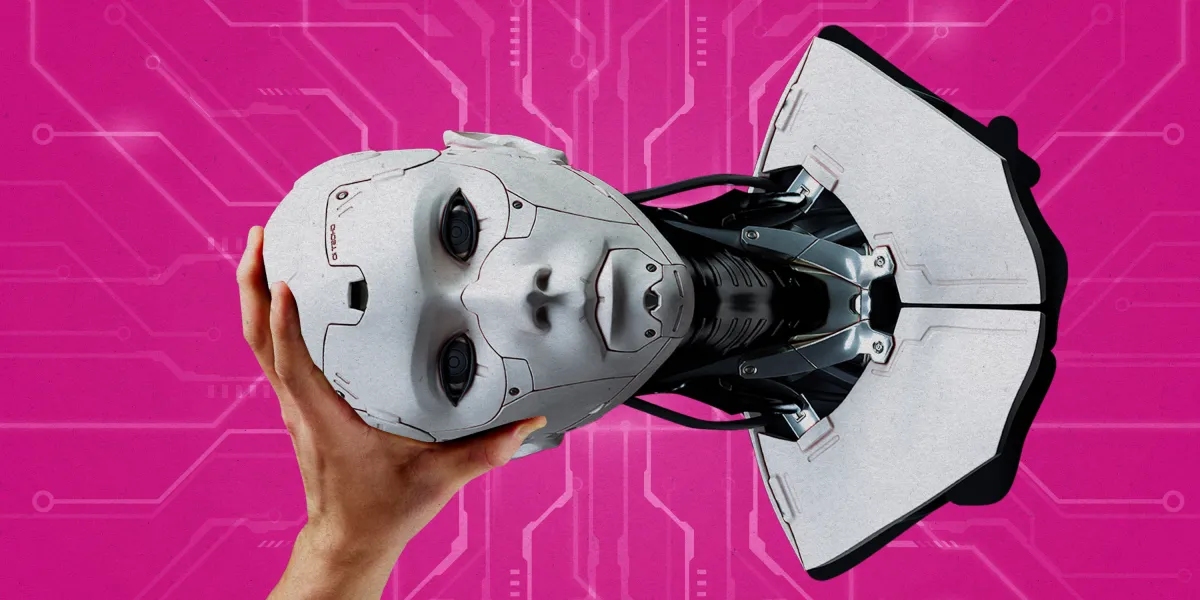
The implication—fueled by new demonstrations of humanoid robots putting away dishes or assembling cars—is that mimicking human limbs with single-purpose robot arms is the old way of automation. The new way is to replicate the way humans think, learn, and adapt while they work. The problem is that the lack of transparency about the human labor involved in training and operating such robots leaves the public both misunderstanding what robots can actually do and failing to see the strange new forms of work forming around them.
Consider how, in the AI era, robots often learn from humans who demonstrate how to do a chore. Creating this data at scale is now leading to Black Mirror–esque scenarios. A worker in Shanghai, for example, recently spent a week wearing a virtual-reality headset and an exoskeleton while opening and closing the door of a microwave hundreds of times a day to train the robot next to him, Rest of World reported. In North America, the robotics company Figure appears to be planning something similar: It announced in September it would partner with the investment firm Brookfield, which manages 100,000 residential units, to capture “massive amounts” of real-world data “across a variety of household environments.” (Figure did not respond to questions about this effort.)
Just as our words became training data for large language models, our movements are now poised to follow the same path. Except this future might leave humans with an even worse deal, and it’s already beginning. The roboticist Aaron Prather told me about recent work with a delivery company that had its workers wear movement-tracking sensors as they moved boxes; the data collected will be used to train robots. The effort to build humanoids will likely require manual laborers to act as data collectors at massive scale. “It’s going to be weird,” Prather says. “No doubts about it.”
Or consider tele-operation. Though the endgame in robotics is a machine that can complete a task on its own, robotics companies employ people to operate their robots remotely. Neo, a $20,000 humanoid robot from the startup 1X, is set to ship to homes this year, but the company’s founder, Bernt Øivind Børnich, told me recently that he’s not committed to any prescribed level of autonomy. If a robot gets stuck, or if the customer wants it to do a tricky task, a tele-operator from the company’s headquarters in Palo Alto, California, will pilot it, looking through its cameras to iron clothes or unload the dishwasher.
This isn’t inherently harmful—1X gets customer consent before switching into tele-operation mode—but privacy as we know it will not exist in a world where tele-operators are doing chores in your house through a robot. And if home humanoids are not genuinely autonomous, the arrangement is better understood as a form of wage arbitrage that re-creates the dynamics of gig work while, for the first time, allowing physical tasks to be performed wherever labor is cheapest.
We’ve been down similar roads before. Carrying out “AI-driven” content moderation on social media platforms or assembling training data for AI companies often requires workers in low-wage countries to view disturbing content. And despite claims that AI will soon enough train on its outputs and learn on its own, even the best models require an awful lot of human feedback to work as desired.
These human workforces do not mean that AI is just vaporware. But when they remain invisible, the public consistently overestimates the machines’ actual capabilities.
That’s great for investors and hype, but it has consequences for everyone. When Tesla marketed its driver-assistance software as “Autopilot,” for example, it inflated public expectations about what the system could safely do—a distortion a Miami jury recently found contributed to a crash that killed a 22-year-old woman (Tesla was ordered to pay $240 million in damages).
The same will be true for humanoid robots. If Huang is right, and physical AI is coming for our workplaces, homes, and public spaces, then the way we describe and scrutinize such technology matters. Yet robotics companies remain as opaque about training and tele-operation as AI firms are about their training data. If that does not change, we risk mistaking concealed human labor for machine intelligence—and seeing far more autonomy than truly exists.
