


Data centers for AI are turning the world of power generation on its head. There isn’t enough power capacity on the grid to even come close to how much energy is needed for the number being built. And traditional transmission and distribution networks aren’t efficient enough to take full advantage of all the power available. According to the U.S. Energy Information Administration (EIA), annual transmission and distribution losses average about 5 percent. The rate is much higher in some other parts of the world. Hence, hyperscalers such as Amazon Web Services, Google Cloud and Microsoft Azure are investigating every avenue to gain more power and raise efficiency.
Microsoft, for example, is extolling the potential virtues of high-temperature superconductors (HTS) as a replacement for copper wiring. According to the company, HTS can improve energy efficiency by reducing transmission losses, increasing the resiliency of electrical grids, and limiting the impact of data centers on communities by reducing the amount of space required to move power.
“Because superconductors take up less space to move large amounts of power, they could help us build cleaner, more compact systems,” Alastair Speirs, the general manager of global infrastructure at Microsoft wrote in a blog post.
Copper is a good conductor, but current encounters resistance as it moves along the line. This generates heat, lowers efficiency, and restricts how much current can be moved. HTS largely eliminates this resistance factor, as it’s made of superconducting materials that are cooled to cryogenic temperatures. (Despite the name, high-temperature superconductors still rely on frigid temperatures—albeit significantly warmer than those required by traditional superconductors.)
The resulting cables are smaller and lighter than copper wiring, don’t lower voltage as they transmit current, and don’t produce heat. This fits nicely into the needs of AI data centers that are trying to cram massive electrical loads into a tiny footprint. Fewer substations would also be needed. According to Speirs, next-gen superconducting transmission lines deliver capacity that is an order of magnitude higher than conventional lines at the same voltage level.
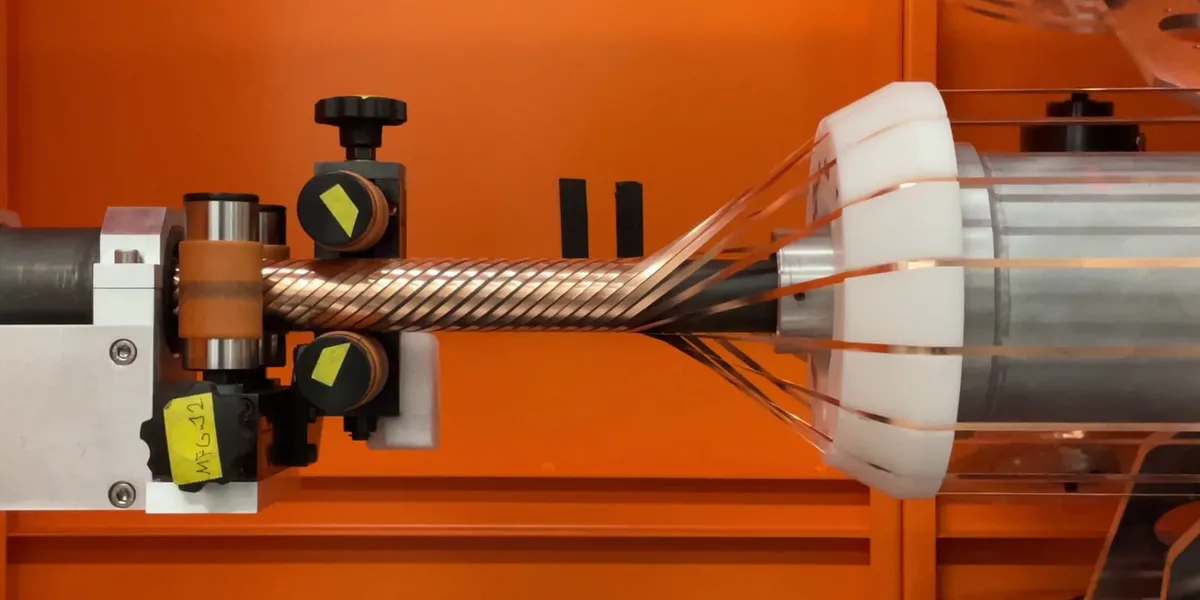
Microsoft is working with partners on the advancement of this technology including an investment of US $75 million into Veir, a superconducting power technology developer. Veir’s conductors use HTS tape, most commonly based on a class of materials known as rare-earth barium copper oxide (REBCO). REBCO is a ceramic superconducting layer deposited as a thin film on a metal substrate, then engineered into a rugged conductor that can be assembled into power cables.
“The key distinction from copper or aluminum is that, at operating temperature, the superconducting layer carries current with almost no electrical resistance, enabling very high current density in a much more compact form factor,” says Tim Heidel, Veir’s CEO and co-founder.
Liquid Nitrogen Cooling in Data Centers
Ruslan Nagimov, the principal infrastructure engineer for Cloud Operations and Innovation at Microsoft, stands near the world’s first HTS-powered rack prototype.Microsoft
HTS cables still operate at cryogenic temperatures, so cooling must be integrated into the power delivery system design. Veir maintains a low operating temperature using a closed-loop liquid nitrogen system: The nitrogen circulates through the length of the cable, exits at the far end, is re-cooled, and then recirculated back to the start.
“Liquid nitrogen is a plentiful, low cost, safe material used in numerous critical commercial and industrial applications at enormous scale,” says Heidel. “We are leveraging the experience and standards for working with liquid nitrogen proven in other industries to design stable, data center solutions designed for continuous operation, with monitoring and controls that fit critical infrastructure expectations rather than lab conditions.”
HTS cable cooling can either be done within the data center or externally. Heidel favors the latter as that minimizes footprint and operational complexity indoors. Liquid nitrogen lines are fed into the facility to serve the superconductors. They deliver power to where it’s needed and the cooling system is managed like other facility subsystem.
Rare earth materials, cooling loops, cryogenic temperatures—all of this adds considerably to costs. Thus, HTS isn’t going to replace copper in the vast majority of applications. Heidel says the economics are most compelling where power delivery is constrained by space, weight, voltage drop, and heat.
“In those cases, the value shows up at the system level: smaller footprints, reduced resistive losses, and more flexibility in how you route power,” says Heidel. “As the technology scales, costs should improve through higher-volume HTS tape manufacturing and better yields, and also through standardization of the surrounding system hardware, installation practices, and operating playbooks that reduce design complexity and deployment risk.”
AI data centers are becoming the perfect proving ground for this approach. Hyperscalers are willing to spend to develop higher-efficiency systems. They can balance spending on development against the revenue they might make by delivering AI services broadly.
“HTS manufacturing has matured—particularly on the tape side—which improves cost and supply availability,” says Husam Alissa, Microsoft’s director of systems technology. “Our focus currently is on validating and derisking this technology with our partners with focus on systems design and integration.”
From Your Site Articles
Related Articles Around the Web
