

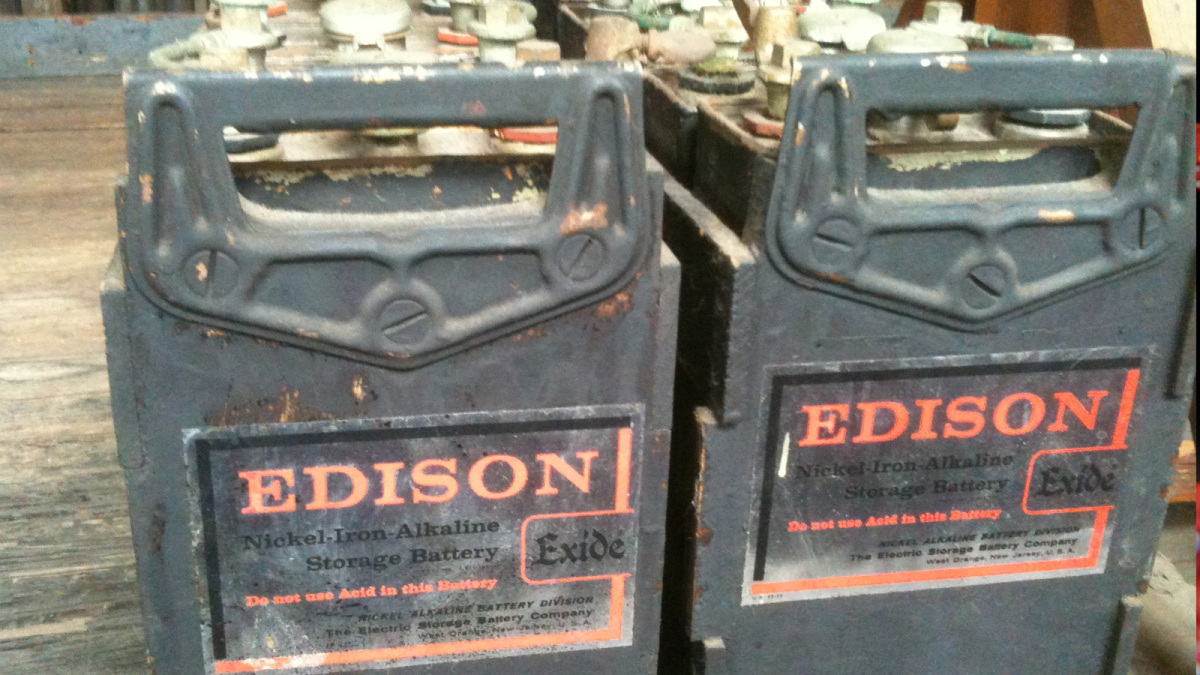
Nickel–iron batteries under the “Exide” brand manufactured in the early 1970s.
Credit: z22/Wikimedia Commons
A new nickel-iron battery technology inspired by Thomas Edison’s efforts and developed by an international team of researchers could offer large-scale, long-term energy storage without degradation and with much faster recharging. Although it lacks the capacity of lithium-ion batteries, it supports up to 12,000 recharge cycles without a loss in performance and can be recharged in just seconds.
Battery technology is holding back industries across the board, from renewable energy grid optimization to robotics, so there’s a real race to find the true next-generation design. There are real hopes for solid-state batteries and sodium batteries, but nickel-iron is another option being pursued, and the latest prototypes show real potential, as outlined in a study published this week.
“The technology’s fast charging, high output, and robust endurance suggest a good fit for storing excess electricity generated at solar farms during the daytime, to power the grid at night,” the researchers explained (via Interesting Engineering).
An illusrration of the (red) proteins holding the (silver) metal clusters.
Credit: Maher El-Kady/UCLA
Designed for backup power in data centers or large enterprises, the technology differentiates itself from the competition through the sheer density of its electrodes. It uses nickel and iron clusters, which are just 5 nanometers wide, allowing researchers to pack tens of thousands of them into the electrodes, increasing their surface area dramatically and enabling much faster recharges.
Amazingly, this is somewhat of an ancient technology. Thomas Edison used nickel-iron chemistry to develop battery technologies for early electric vehicles capable of delivering a 100-mile range. This new version uses more modern production techniques and materials, though, leveraging 2D graphene and proteins from beef production to grow the metal clusters required for the electrodes. When baked at high temperatures, the proteins are turned into carbon and embedded in the nickel, creating a superlight aerogel with a high surface area—perfect for battery charging.
To further advance this battery technology, researchers are experimenting with different metals within the nanocluster, as well as natural polymers, which could replace the beef proteins to make manufacturing more scalable.
“Because this technology could extend the lifetime of batteries to decades upon decades, it might be ideal for storing renewable energy or quickly taking over when power is lost,” the study concluded.
