

January 5, 2026
3 min read
Add Us On GoogleAdd SciAm
Starless ‘Failed Galaxy’ Is First of Its Kind Ever Seen
Scientists have found the best evidence yet for long-predicted “failed galaxies”
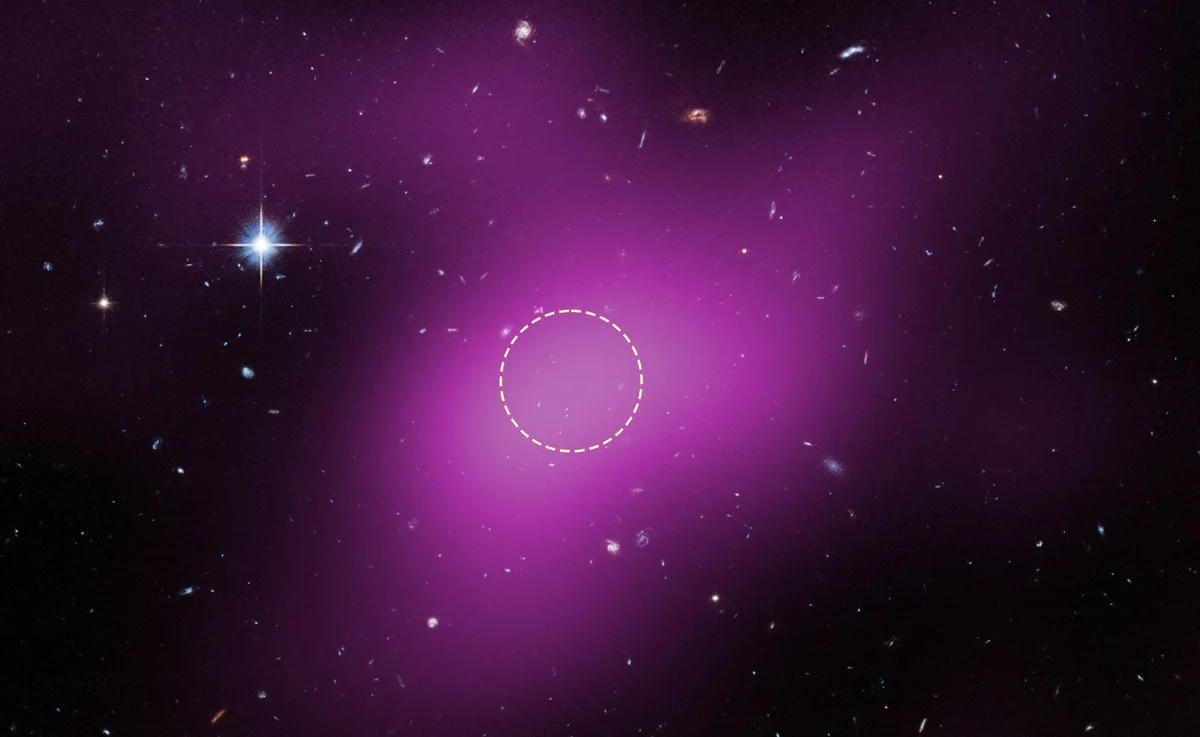
The “failed galaxy” Cloud-9, a dark matter-dominated blob of hydrogen gas some 14 million light-years from Earth. The diffuse magenta represents radio data from the ground-based Very Large Array (VLA) that shows the presence of the gas. The dashed circle marks the peak of radio emission, which is where researchers focused their search for stars. Follow-up observations by the Hubble Space Telescope found no stars within the cloud. The few objects that appear within its boundaries are background galaxies.
NASA, ESA, VLA, Gagandeep Anand (STScI), Alejandro Benitez-Llambay (University of Milano-Bicocca) (science); Joseph DePasquale (STScI) (image processing)
A potential new type of celestial object has all the makings of a normal small galaxy. It’s rich with the same hydrogen gas that births suns and planets, and it lies within a halo of dark matter, the same invisible stuff that holds galaxies together. Yet it’s missing one key component of glittering galaxies like our own Milky Way: stars.
Nicknamed Cloud-9, the gas cloud is technically the best-yet example of a RELHIC, or Reionization-Limited H I Cloud. The “H I” stands for Cloud-9’s bounty of neutral hydrogen, and “RELHIC” refers to what astronomers believe the object to be: a primordial fossil—or relic—from the universe’s early epochs that, for some reason, never managed to form stars or become a full-fledged galaxy. That makes Cloud-9 a “failed galaxy,” said Rachael Beaton, an astronomer at the Space Telescope Science Institute, during a January 5 press conference at the American Astronomical Society’s 247th meeting in Phoenix, Ariz.
Based on their understanding of dark matter’s behavior and the hierarchical process of galaxy formation, astronomers have long predicted that such starless objects should exist throughout the cosmos. But until recently, RELHICs had been notoriously difficult to spot.
On supporting science journalism
If you’re enjoying this article, consider supporting our award-winning journalism by subscribing. By purchasing a subscription you are helping to ensure the future of impactful stories about the discoveries and ideas shaping our world today.
The results—presented by Beaton at the meeting and published in the Astrophysical Journal Letters last November—bolster the case that we’ve finally found one of these elusive phantom galaxies. Cloud-9 first burst onto the astronomy scene in 2023, when the Five-Hundred-Meter Aperture Spherical Radio Telescope in China’s province of Guizhou discovered a nearly 5,000-light-year-wide spherical cloud of hydrogen gas about 14 million light-years from Earth that appeared to be a faint dwarf galaxy, albeit bereft of visible stars. More in-depth studies on the cloud showed that it contains about a million solar masses of hydrogen and some five billion solar masses of dark matter, but researchers couldn’t confirm it to be truly starless. Perhaps, instead, it was indeed a strange sort of dwarf galaxy that was sparsely populated with very old and dim stars.
So Beaton and her colleagues peered once again at the object through the keen gaze of the Hubble Space Telescope. And in all of Hubble’s observations, she said, it found hints of just one star within Cloud-9. It could be that other stars simply went by undetected, but based on further simulations, the team found that the cloud probably couldn’t host more than some 3,000 solar masses worth of stars—a meager smattering that would preclude the object being a dwarf galaxy. This new result not only makes Cloud-9 the foremost REHLIC candidate in astronomers’ catalogs but also a milestone for verifying the common prediction that “not every dark matter halo will have a galaxy in it,” Beaton said.
While the fresh information from Hubble “certainly eliminates the possibility that [Cloud-9] is a dwarf galaxy,” there’s still much left to learn about this peculiar object, says Kristine Spekkens, an astronomer at Queen’s University in Ontario, who was not involved with the work. For instance, she says, Cloud-9 doesn’t have quite as smooth a shape as astronomers would expect. Better mapping of its gas distribution could provide more insights into how exactly it formed and evolved over cosmic time.
Still, it will be difficult to definitively confirm that Cloud-9 is in fact a RELHIC so long as it remains in a league completely of its own, says Ethan Nadler, an astronomer at the University of California, San Diego, who didn’t take part in the Hubble observations. While dubbing the cloud officially “starless” will be challenging, finding similar objects may help researchers shed some light on this dark area of astronomy.
It’s Time to Stand Up for Science
If you enjoyed this article, I’d like to ask for your support. Scientific American has served as an advocate for science and industry for 180 years, and right now may be the most critical moment in that two-century history.
I’ve been a Scientific American subscriber since I was 12 years old, and it helped shape the way I look at the world. SciAm always educates and delights me, and inspires a sense of awe for our vast, beautiful universe. I hope it does that for you, too.
If you subscribe to Scientific American, you help ensure that our coverage is centered on meaningful research and discovery; that we have the resources to report on the decisions that threaten labs across the U.S.; and that we support both budding and working scientists at a time when the value of science itself too often goes unrecognized.
In return, you get essential news, captivating podcasts, brilliant infographics, can’t-miss newsletters, must-watch videos, challenging games, and the science world’s best writing and reporting. You can even gift someone a subscription.
There has never been a more important time for us to stand up and show why science matters. I hope you’ll support us in that mission.
