

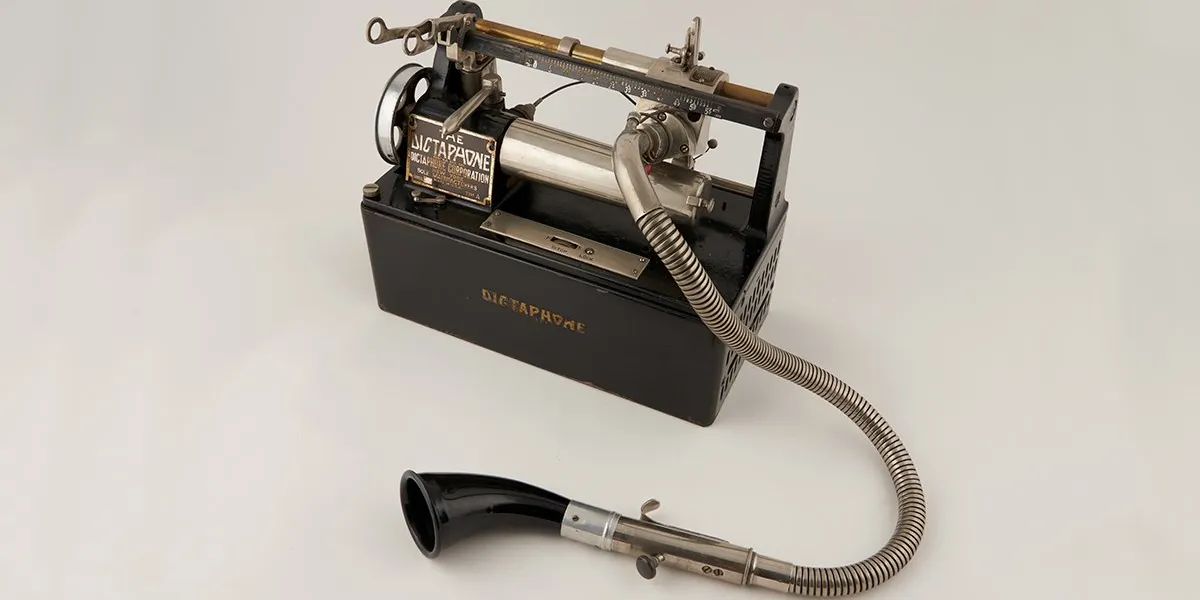

Thanks to Hollywood, whenever I think of a Dictaphone, my imagination immediately jumps to a mid-20th-century office, Don Draper suavely seated at his desk, voicing ad copy into a desktop machine. A perfectly coiffed woman from the secretarial pool then takes the recordings and neatly types them up, with carbon copies of course.
I had no idea the Dictaphone actually had its roots in the 19th century and a rivalry between two early tech giants: Alexander Graham Bell and Thomas Edison. And although it took decades to take hold in the modern office, it found novel uses in other fields.
Who invented the Dictaphone?
The Dictaphone was born from the competition and the cooperation of Bell and Edison and their capable teams of researchers. In 1877, Edison had introduced the phonograph, which he later declared his favorite invention. And yet he wasn’t quite certain about its commercial applications. Initially, he thought it might be good for recording telephone messages. Then he began to imagine other uses: a mechanical stenographer for businessmen, a notetaker for students, an elocution instructor, a talking book for the blind. The playback of recorded music—the phonograph’s eventual killer app—was No. 4 on Edison’s list. And after a few public demonstrations, he set aside the invention to pursue other interests.
Thomas Edison’s early phonograph from 1877 used a needle to record sound waves on a rotating cylinder wrapped with tinfoil. Thomas Edison National Historical Park/National Park Service/U.S. Department of the Interior
Enter Bell. In 1880, the French government had awarded Bell the Volta Prize and 50,000 francs (about US $10,000 at the time) for his invention of the telephone. The following year, he, his cousin Chichester A. Bell, and Charles Sumner Tainter used the prize money to found the Volta Laboratory Association in Washington, D.C., to do research on sound recording and transmission.
Tainter saw potential in the phonograph. Edison’s version used a needle to etch sound waves on a sheet of tinfoil wrapped around a metal cylinder. The foil was easily damaged, the sound quality was distorted and squeaky, and the cylinder could be replayed only a few times before degrading and becoming inaudible. Edison’s phonograph couldn’t be easily commercialized, in other words.
Chichester Bell and Tainter greatly improved the sound quality by replacing the tinfoil with wax-coated cardboard cylinders. By 1886, the researchers at Volta Lab had a patented product: the Graphophone.
Two colleagues of Alexander Graham Bell refined Edison’s phonograph in the 1880s to create the Graphophone, which used wax-coated cardboard cylinders rather than tinfoil. Universal History Archive/Getty Images
Bell and Tainter believed the Graphophone would find greatest use as a mechanical stenographer. As a “dictator,” you would speak into the tube, and a stylus would trace the sound wave on the wax cylinder. The cylinder would then be handed off to a secretary for transcription. Typists used playback machines with foot pedals to control the speed of the recording and to reverse and repeat as necessary.
A manufacturing company set up by Volta Lab sold several machines to the U.S. government. One enthusiastic early adopter was Edward D. Easton, a noted stenographer for the U.S. Congress and the Supreme Court. Although Easton took notes in shorthand, he immediately recited his notes into the Graphophone after each session.
Easton became an evangelist for the instrument, writing glowing accounts in a trade magazine. The machine made no mistakes and could take dictation as fast as the speaker could articulate. The phonograph never complained when a transcriber needed a phrase repeated. The phonograph didn’t suffer from poor penmanship. Anyone could learn to use the machine in two weeks or less, compared to months or years to master stenography. Such were Easton’s claims. (Easton was such a fan that he cofounded the Columbia Phonograph Co., which went on to become a leading maker of phonographs and recorded music and lives on today as Columbia Records.)
Before long, several companies were manufacturing and selling phonographs and dictation machines. Even though demand was initially light, patent-infringement lawsuits sprang up, which soon threatened to bankrupt all of the companies involved. Finally, in 1896, the various parties agreed to stop fighting and to cross-license each other’s intellectual property. This didn’t end the Bell-Edison rivalry, but it allowed the phonograph business to take off in earnest, aided by the sales of mass-produced recorded music cylinders. And the accepted name for this entertainment machine became the phonograph.
The Dictaphone Gets Down to Business
But Bell, Tainter, and Edison didn’t forget the original promise of mechanical stenography, and the rivals soon came out with competing and very similar products designed specifically for dictation: the Dictaphone and the Ediphone. The public found it difficult to distinguish the two products, and it wasn’t long before “dictaphone” was being used to describe all dictation machines. (The Columbia Graphophone Co. trademarked “Dictaphone” in 1907—a confusing neologism of dicta from the Latin for “sayings” or “say repeatedly” and phone from the Greek for “voice” or “sound.”)
As David Morton recounts in his 1999 book Off the Record (Rutgers University Press), Dictaphone sales accelerated as scientific management for business began to take root. Office managers intent on streamlining, standardizing, and systemizing workflows saw the Dictaphone as a labor-saving device. In 1912, for instance, an efficiency commission set up by U.S. President William Taft endorsed the use of dictation machines in government offices. The railroad and insurance industries followed suit as they standardized their financial records. Later, managers began using dictation machines to conquer their business correspondence.
A Congressional reporter uses a Dictaphone in 1908. The U.S. government was an early adopter of the machines.Library of Congress
And yet, the Dictaphone wasn’t obviously destined to become an indispensable piece of office equipment like the typewriter. In 1923, for instance, 15,000 dictation machines were sold in the United States, versus 744,000 typewriters.
In 1926, the Dictaphone Corp. tried to drum up interest by sponsoring Henry Lunn, founder of a large U.K. travel company, on an around-the-world lecture tour. At each hotel he visited, the company ensured there was a Dictaphone for Lunn to record his diary. Consider this a prototype for the modern hotel business center. At the end of his journey, Lunn published Round the World With a Dictaphone—part travelogue, part proselytizing for Christian churches to support the League of Nations, and part Dictaphone promotion. Even so, by 1945, Dictaphone estimated that only 15 to 25 percent of the potential market had been captured.
There were social reasons working against dictation machines, Morton says in his book. Executives relied on their secretaries not only for dictation and transcription, but also for their often unacknowledged aid in prompting, correcting, and filling in their bosses’ thoughts—the soft skills that a machine could not replace.
Morton also attributes the slow uptake to the technology itself. One quirk of the Dictaphone is that it continued to use wax cylinders long after phonograph players had switched to discs. Transcribers often complained that the wax recordings were unintelligible—dictators needed to speak directly into the speaking tube, loudly, clearly, and at an appropriate pace, but many did not.
A secretary plays back the sound from a recorded Ediphone cylinder in 1930 to transcribe the cylinder’s contents.Popperfoto/Getty Images
During World War II, Dictaphone finally ditched the wax cylinders in favor of etching grooves on a plastic belt, although the new machines were available only to U.S. government agencies until the end of the war. In 1947, the company publicly introduced the new technology with its Time-Master series. Each Dictabelt held about 15 minutes of recording. Meanwhile, Edison’s Ediphone was rebranded the Voicewriter and recorded on distinctive red plastic discs.
This 1953 Edison Voicewriter recorded the speaker’s voice on plastic Diamond Discs. Magnetic tape came later.Cooper Hewitt/Smithsonian Design Museum/Smithsonian Institution
In the 1960s, Dictaphone finally embraced magnetic recording tape, in the form of cassette tapes. Pressure initially came from European companies, such as the Dutch electronics company Philips, which entered the U.S. market in 1958 with a low-priced tape-cartridge machine. Four years later, Philips introduced the Compact Cassette, which became the basis of today’s audio cassette. Transistorized electronics furthered miniaturization and made dictation machines much more portable. Eventually, solid-state storage replaced magnetic tape, and today, we all carry around a dictation device with an effectively infinite recording time via cloud storage, and, if we choose to use it, automatic transcription.
The Dictaphone in the Classroom
None of the stories about businessmen using (or abusing) Dictaphones really surprised me. What did surprise me were the creative ways the Dictaphone was used as a pedagogical tool.
In 1924, for example, Dwight Everett Watkins at the University of California described in a paper how his students used a microphone, an amplifier, a telemegaphone (a type of speaker), and a Dictaphone to aid in public speaking. The setup helped students understand their rhetorical imperfections: bad grammar and bad sentence and paragraph structure. It also helped with elocution—one of the early applications that Edison envisioned for his phonograph.
In 1933, George F. Meyer wrote about using the Dictaphone as an educational aid for blind and low-vision students in Minneapolis. Teachers recorded course material that would otherwise have had to be read aloud. And the students liked being able to listen to the material repeatedly without inconveniencing a human reader.
Students in 1930 listen to a Dictaphone recording, which the seated woman controls with foot pedals.George Rinhart/Corbis/Getty Images
In 1938, Frances M. Freeman wrote her master’s thesis on whether the Dictaphone could help typing students who were struggling to master the skill. Her study was supported by the Dictaphone Sales Corp., but unfortunately for the company, she concluded that using a Dictaphone offered no advantage in learning to type. She did find that the students in the Dictaphone group seemed more alert in class than students taught the traditional way.
That last finding was borne out in a 1964 experiment at Dunbar Elementary School in New Orleans, where the Dictaphone Corp. had outfitted an “electronic classroom.” The idea was to help reluctant students by fostering an environment where learning was fun. As Principal Beulah E. Brown related in an article about the experiment, she’d first encountered a Dictaphone several years earlier while on sabbatical and immediately saw its pedagogical potential. The Dictaphone, Brown wrote, promised individually tailored educational experiences, allowing students to focus on specific challenges and freeing the teacher to have more personal interactions with each child. Testimonials from Warren Honore’s fifth grade class attest to its success as an engaging technology.
From the Dictaphone to Email to AI
As a historian of technology, I loved learning that two heavyweights in the field, Melvin Kranzberg and Thomas Kuhn, were both committed fans of the Dictaphone. I also enjoyed meditating on the role of the dictaphone and other technology as a mediator in the writing process.
My research turned up Tolstoy’s Dictaphone: Technology and the Muse (Graywolf Press), a 1996 collection of essays edited by the literary critic Sven Birkerts. The title comes from an anecdote about the Russian writer Leo Tolstoy, who refused the offer of a Dictaphone because it would be “too dreadfully exciting” and would distract him from his literary pursuits. To form the volume, Birkerts posed questions to his authors concerning the place of self and soul in a society being bombarded with new forms of communication—namely, email and the internet.
Today, of course, our world is being shaped by AI, arguably an even bigger disrupter than email was in the 1990s or the Dictaphone was in the early 20th century. But then, technology is always trying to remake society, and the path it takes is never inevitable. Sometimes, when we’re lucky, it is delightfully surprising.
Part of a continuing series looking at historical artifacts that embrace the boundless potential of technology.
An abridged version of this article appears in the January 2026 print issue as “This Machine Listened to ‘Dictators.’ ”
From Your Site Articles
Related Articles Around the Web
